Peruvian Human Rights Activist Sees Similarities Between Maduro's Venezuela and Fujimori's Peru
From 1990 until 2000, Peru was under the authoritarian right-wing rule of President Alberto Fujimori. About 2,000 kilometers away in Venezuela, leftist President Nicolas Maduro has held an ever-tightening grip on power in his country since 2013.
Javier Torres sees many similarities between the two, even if they occupy different ends of the political spectrum. Torres is director of a non-governmental organization called Servicios Educativos Rurales (Rural Educative Services) and a political analyst for Poder magazine and the Lamula.pe website.
In 2012, when the trial against Fujimori began for human rights violations, he was executive secretary of the National Commission of Human Rights, where he promoted a legal strategy and citizen mobilization to bring Fujimori to justice.
The following is a re-edited version of an interview with Torres conducted by Rafael Uzcategui with support from Daniel Klie during the Summit of Human Rights Defenders in Caracas that took place in late 2017. It is published on Global Voices with his permission.
Rafael Uzcategui (RU): What are the main similarities between the Nicolas Maduro and Alberto Fujimori governments?
Javier Torres (JT): There are several. In order for a country to be democratic there must be separation of powers, a free press, and free elections. There are other elements, but these are fundamental. Both in Fujimori's Peru and in Maduro's Venezuela, no separation of powers exists. The emergency laws that are executed, as much as the changes or violations that these rulers make, form the scene of a dictatorship, there is a distinct similarity.
The second has to do with the subject of freedom of expression, which is a factor one has to consider under certain conditions. Elections do not guarantee that a democracy exists if the electoral system does not comply with the minimum laws it must have to function – electoral calendars, for example. An electoral system must be standardized and not be subject to vagaries of the executive role, which is happening in Peru a little and is also what one sees taking place in Venezuela. It seems to me that what they have is a dictatorship like the one we suffered under.
RU: Have you encountered resistance among social movements, particularly in the Southern Cone, against classifying the Fujimori government as a dictatorship?
JT: Dictatorships not only learn but are sophisticated in their methodology. In the Peruvian case, due to having characteristics of a privatization goal, there was no resistance at the beginning. Fujimori had the Congress closed and then held an election where fraud allegations were raised. Then the Constitutional Court intervened the following year. Even as early as 1990 or 1991, what we have in Peru is the building of an action that will reaffirm that blow: The Fujimorist aim was a totally anti-political appeal, absolutely against the search for compromise. It was an approach based upon denouncing politics as useless, that democracy doesn't work so we must be pragmatic. That started to justify the act of privatization.
There wasn't a big debate in Peruvian civil society about the dictatorship as it formed, which could be Venezuela's case too, but I think a lot has to do with how [Venezuela's] regime is viewed from outside. Other countries see it as a leftist government that has generated social platforms. That's where the problem arises, the ideological activity is generating a kind of resistance to call it a dictatorship.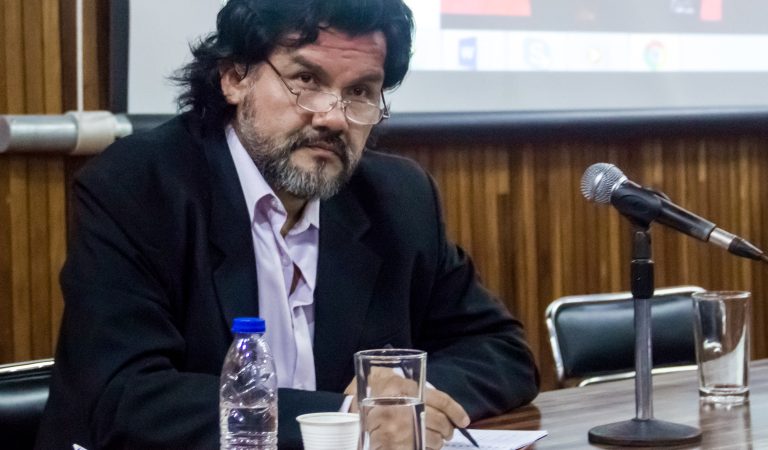
Hi! I am a robot. I just upvoted you! I found similar content that readers might be interested in:
https://www.scribd.com/article/369088949/Peruvian-Human-Rights-Activist-Sees-Similarities-Between-Maduro-s-Venezuela-And-Fujimori-s-Peru