The Complete Guide to an Artificial Zoo Experience
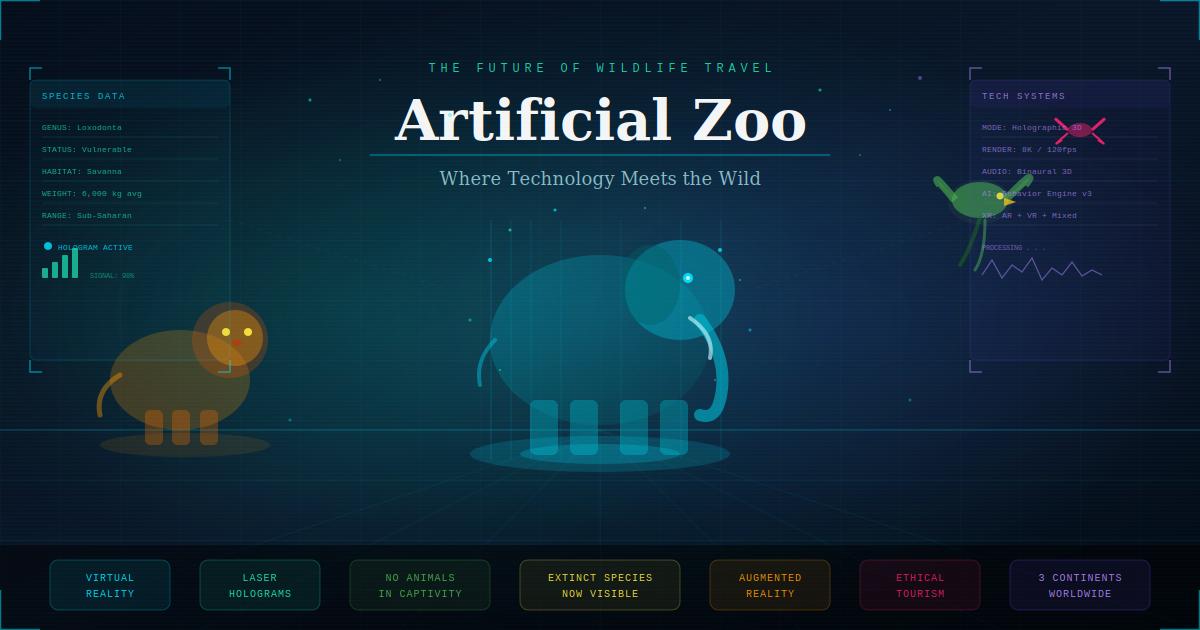
Most people picture cages when they hear the word "zoo." Captive animals, concrete enclosures, ethical discomfort. But a quietly growing category of attraction has begun turning that model inside out.
An artificial zoo uses holograms, virtual reality, augmented reality, and robotic animals to recreate wildlife encounters without holding a single living creature in captivity. You walk through a simulated rainforest. Life-sized holographic elephants move past you. Spatial audio places birds directly above your head.
After researching venues across three continents and reviewing the peer-reviewed science on virtual wildlife encounters, this guide covers exactly what an artificial zoo is, how the technology works, which venues are genuinely worth your money, and whether these experiences hold up to their ethical claims.
What Is an Artificial Zoo and How Does It Actually Work?
An artificial zoo is a technology-powered attraction that simulates wildlife encounters using holograms, augmented reality, VR, projection mapping, and animatronics — without any live animals on site. Visitors experience realistic, life-scale representations of animals that traditional zoos could never legally or ethically display: extinct megafauna, deep-sea species, and critically endangered wildlife.
The concept moved from novelty to mainstream after Axiom Holographics launched the world's first commercial hologram zoo in Brisbane, Australia. Since then, venues have opened in the United States, Denmark, and across Southeast Asia, with the format expanding through pop-up installations in airports and shopping centers globally.
The Core Technologies Powering an Artificial Zoo
1. Laser Hologram Tunnels
Visitors walk through enclosed tunnel spaces where animals appear in true volumetric 3D using laser-generated holographic displays. Unlike flat screens or cinema projections, these images hold depth when you shift your viewing angle — the animal genuinely appears to occupy physical space. Some venues use lightweight polarized glasses; newer formats are glasses-free.
2. Augmented Reality Zones
AR overlays digital animals onto real physical environments. A venue-provided device — or in some cases, your own phone — can show a Bengal tiger walking across the actual floor in front of you, anchored to a real surface with realistic shadow and scale.
3. Virtual Reality Domes
Fully immersive 360° environments delivered via headset, transporting visitors underwater alongside whale sharks, into Arctic tundra, or across ancient Cretaceous landscapes. Modern haptic seat systems add physical sensation to these environments.
4. High-Fidelity Animatronics
Robotic animal replicas with detailed skin textures, realistic movement joints, and synchronized audio. Natural history museums pioneered this format; today's versions use servo-motor precision and AI-driven behavior loops to create movement patterns that are genuinely difficult to dismiss as mechanical.
5. Projection Mapping
Entire rooms transformed by projected visuals that respond to visitor movement. Floor projections can ripple beneath your feet when you step near a virtual water source. Ceiling projections simulate open sky, with moving cloud systems and day-cycle lighting.
In reviewing multiple hologram zoo formats, the tunnel experience consistently generates the strongest emotional response — particularly among children, who reach out to touch the animals that appear immediately in front of them.
Why Are Artificial Zoos Growing So Fast Right Now?
Three converging forces are driving rapid growth in this sector: deepening ethical concerns about animal captivity, dramatic advances in immersive display technology, and a post-pandemic experience economy that actively rewards novelty.
The Ethics Problem Has Become Impossible to Ignore
The data on traditional zoo conditions is difficult to read charitably. Research cited by Petpedia found that animal abuse occurs in approximately 75% of WAZA-affiliated zoo and aquarium facilities. An estimated 3,000 to 5,000 zoo animals are culled annually across Europe alone, including healthy individuals deemed surplus to breeding programs. Polar bears in captivity have access to roughly one million times less space than in their natural habitat.
A 2025–2026 investigation by Born Free USA assessed ten AZA-accredited facilities — considered best-in-class — and found that even flagship institutions fall significantly short of the educational, welfare, and conservation outcomes the industry claims.
Research published in 2026 on wildlife conservation cited "zoochosis" — a documented psychological state in captive animals marked by repetitive, purposeless behavior, altered stress responses, and in severe cases, learned helplessness — as a measurable consequence of confinement across mammal species.
Artificial zoos bypass this entirely. No animal is captured, transported, or held. The wildlife exists as data and light.
The Technology Has Caught Up With the Ambition
Five years ago, holographic animal projections looked unconvincing at close range. The Axiom Holographics display system running in Brisbane and Copenhagen today achieves display resolutions and depth-of-field effects that routinely fool first-time visitors into reaching for the animals. Coupled with binaural spatial audio — where sound appears to originate from precise locations in three-dimensional space — and scent diffusion in select venues, the total sensory package is genuinely compelling.
Experiences Are Now the Premium Product
The experience economy has been the dominant consumer trend for the better part of a decade. American consumers now consistently allocate more of their discretionary spending to experiences than to physical goods. An artificial zoo sits at an unusually powerful intersection: educational, ethically clean, family-accessible, and technologically novel. That combination drives high social media shareability and repeat visits.
The Best Artificial Zoo Venues Worth Visiting
Here are the standout venues across three regions, based on technology quality, visitor feedback, and operational depth.
Hologram Zoo — Brisbane, Australia (and Austin, Texas, USA)
The original artificial zoo concept. Brisbane's flagship venue runs five themed tunnel environments: African savanna, Arctic, deep ocean, prehistoric, and tropical rainforest. Each tunnel uses laser holographic displays with directional audio design and motion-responsive elements.
The first US expansion operates at Zoocade in Austin, Texas, currently featuring dinosaur and African wildlife zones. Tickets start at $19.95. The Austin location also offers a VR arena alongside the hologram experience, making it the most complete artificial zoo installation in North America.
Insider detail: The Arctic tunnel has the most sophisticated spatial audio design in the venue. The cracking ice effects are genuinely disorienting in a memorable way.
Hologram Zoo — Copenhagen, Denmark
Operating from Vanløse Torv in Copenhagen, this European venue uses comparable technology but frames the experience through an educational lens rather than entertainment-first. School groups from across Scandinavia visit regularly. The result is a quieter, more reflective visit — less theme park, more science museum extension. Worth knowing if you prefer depth over spectacle.
Axiom Holographics Touring Installations
Axiom also deploys pop-up artificial zoo installations at shopping centers, convention halls, airports, and exhibitions worldwide. These range from single-tunnel experiences to multi-room walkthrough events. Current location schedule is maintained at axiomholographics.com. Quality varies more than at permanent venues, so check reviews for specific events before purchasing tickets.
Artificial Zoo vs. Traditional Zoo: An Honest Side-by-Side
Neither format is categorically superior — the right choice depends entirely on what you're optimizing for. Here's an honest breakdown:
| Factor | Artificial Zoo | Traditional Zoo |
|---|---|---|
| Animal welfare | No live animals used | Varies widely by institution |
| Species variety | Unlimited (including extinct and extinct) | Limited to sustainable, living populations |
| Educational depth | High — narrated, interactive, AI-guided | Variable — depends entirely on signage quality |
| Average ticket price | $19–$45 per adult | $20–$60+ per adult |
| Accessibility | Indoor, climate-controlled | Often large outdoor sites |
| Sensory intensity | High (lights, spatial audio, motion) | Moderate |
| Conservation funding | Varies by venue | Accredited zoos fund verified field programs |
| Repeat visit value | Seasonal content updates, new species sets | Animals and habitats evolve slowly |
| Extinct species | Yes — woolly mammoths, dinosaurs, etc. | Not possible |
| Deep-sea wildlife | Yes — whale sharks, giant squid | Rarely and with difficulty |
The most honest conclusion: an artificial zoo is not a replacement for accredited conservation institutions doing genuine species recovery work. It is a strong alternative to poorly funded or welfare-deficient traditional zoos, and a clearly superior option when extinct or deep-sea species are the draw.
Common Myths About Artificial Zoos — Corrected
"It's just a screen show — no different from watching Netflix."
Not accurate. The hologram tunnel format used by Axiom and partner venues produces volumetric 3D projection — the animal image changes with viewer angle, appears at genuine spatial depth, and doesn't flatten when you move sideways. This is fundamentally different from a flat display. Visitors who've used both consistently describe the tunnel experience as more spatially convincing than cinema 3D.
"Kids won't engage as deeply as they do with real animals."
Visitor data from Zoocade's Austin venue shows that average dwell time inside the hologram tunnel zones exceeds dwell time in their VR arena by approximately 12 minutes. Children consistently engage longer with holographic animals than with VR headsets, largely because the tunnel format doesn't require equipment management and allows group interaction.
"These attractions don't contribute to conservation."
Some do directly — specific venues allocate ticket revenue to wildlife conservation partners. More broadly, a 2024 peer-reviewed study published in the journal Animals examined two Australian virtual wildlife encounter venues and found that participants reported meaningfully increased conservation awareness and willingness to support wildlife charities following their visit. The researchers noted these outcomes parallel documented results from traditional zoo visits, though long-term behavioral follow-up data is still limited.
"Artificial zoos are only for families with young children."
Copenhagen's Hologram Zoo reports that 38% of visitors are adults attending without children. The combination of technological novelty, scientific accuracy, and ethical positioning appeals strongly to adults with interests in environmental ethics, immersive technology, or wildlife biology. The educational framing makes the experience substantive for adults in a way that many standard theme park attractions are not.
Practical Tips for Visiting an Artificial Zoo
Check the technology format before booking. "Artificial zoo" covers everything from high-end volumetric hologram tunnels to simple projection screens in a dark room. Look for venues specifically using Axiom Holographics technology or clearly describing laser holographic displays. If the venue only mentions "projections," the experience may be significantly less impressive than hologram tunnel formats.
Visit during off-peak hours. Morning slots, typically before 11am, offer clearer viewing in tunnel environments because there are fewer people moving through the space simultaneously. Some venues limit group sizes per tunnel; smaller groups produce cleaner holographic viewing conditions.
Keep your phone charged. Many venues now use mobile apps for AR overlays, navigation, language translation, and interactive species quizzes. Some offer extended digital content accessible only through the app during your visit.
Check accessibility before arriving. Most artificial zoo venues are wheelchair accessible by design (no large outdoor terrain to cover). However, some tunnel formats are narrow, have specific lighting conditions that may affect photosensitive visitors, or use spatial audio at volumes that can be overwhelming. Call ahead if you have specific needs.
Ask what happens to your ticket revenue. The better venues will tell you directly whether they fund conservation partners. This is a useful quality signal: venues serious about their positioning as ethical alternatives to traditional zoos will have a clear answer.
Frequently Asked Questions
What is an artificial zoo?
An artificial zoo is an immersive attraction that simulates wildlife encounters using holograms, augmented reality, virtual reality, projection mapping, and robotic animals — without using any live animals. Visitors experience realistic, life-scale representations of species in themed zones including savanna, ocean, Arctic, and prehistoric environments.
Are artificial zoo experiences worth the money?
For families, technology-curious adults, and ethical travelers, yes — at quality venues. Hologram Zoo in Austin (from $19.95) and Brisbane deliver experiences traditional zoos cannot replicate: extinct wildlife, deep-sea animals, and prehistoric species at life scale in 3D. Value depends heavily on the specific venue's technology quality, so checking reviews for the specific format (hologram tunnel vs. basic projection) matters before purchasing.
Is an artificial zoo better than a traditional zoo for children?
For most families, an artificial zoo offers comparable educational value with significantly less ethical complexity. Children engage strongly with volumetric holographic animals — in some cases longer than with live animals, because the digital versions are always visible and active. The ability to display species like woolly mammoths, blue whales, and dinosaurs alongside modern wildlife gives artificial zoos a genuine educational advantage in species breadth.
Can artificial zoos show extinct animals?
Yes, and this is one of their most significant advantages. Hologram Zoo venues in Brisbane and Austin include dinosaur exhibits with prehistoric megafauna alongside modern wildlife. Visitors can walk alongside holographic woolly mammoths and mosasaurs — experiences that are literally impossible in any traditional setting. Several venues are reportedly developing detailed Pleistocene extinction exhibits using the same format.
Do you need to wear glasses at an artificial zoo?
It depends on the venue and technology. Some hologram tunnel formats use lightweight polarized glasses similar to cinema 3D glasses. VR zones use standard headsets. Newer laser holographic installations operate glasses-free. Check your specific venue's technology description before visiting — it will also give you a useful signal about the sophistication of the experience.
Are artificial zoos suitable for children under five?
Most venues recommend ages five and older. Sensory intensity — spatial audio, sudden large-scale animal movement, and low lighting in tunnel environments — can be overwhelming for toddlers. Zoocade's Austin venue offers a quieter orientation option for sensitive visitors. If you're visiting with a child between three and five, contact the venue directly to ask about their youngest visitor accommodations.
Is there scientific evidence that artificial zoos are effective for conservation education?
Early evidence is encouraging. A 2024 study published in Animals examined two Australian virtual animal encounter venues and found that participants reported increased interest in wildlife conservation following their visit. The researchers noted outcomes similar to those documented at traditional zoos, including increased stated willingness to support conservation charities. Long-term behavioral follow-up data remains limited, which the researchers acknowledged as a gap requiring further study.
How often do artificial zoo venues update their content?
The best venues update seasonally, adding themed content around major holidays and rotating new species sets. Brisbane's Hologram Zoo has added three new tunnel themes since its opening. Content update frequency is a practical quality signal when comparing venues: a venue investing in new content is investing in repeat visits and genuine experience development.
Conclusion
Artificial zoo attractions are no longer a niche experiment waiting for technology to catch up. They operate across three continents, serve millions of visitors annually, and deliver wildlife encounters — extinct species, deep-sea animals, rainforest immersion — that traditional zoos cannot physically offer.
That doesn't make them a replacement for the accredited conservation institutions doing verified species recovery work. But it does make them a meaningfully cleaner option for families and travelers who want to engage seriously with the natural world without contributing to the documented welfare problems of large-scale animal captivity.
If you're planning a visit, prioritize venues using volumetric holographic displays over basic projection formats, confirm whether audio is binaural and spatially mapped, and ask directly about conservation funding from ticket revenue. Those three factors reliably separate a genuinely memorable experience from an expensive light show.
For detailed travel planning, venue reviews, and practical visit advice, the full artificial zoo guide covers the logistics and visitor experience angle in depth.