SLC-S31/W1-“Creative Interpretation| The Word (Invisible)”
Hi guys, accept warm Steem greetings from the motherland of Cameroon, and welcome to my blog, where I'm gonna share my thoughts about the topic “Creative Interpretation| The Word (Invisible)”. Before I go into the write-up proper permit me to invite @suboohi, @ruthjoe and @lirvic to participate in this challenge.
In this write-up, I will reflect on the armed conflict in the English-speaking regions of Cameroon inspired by the word “invisible”, which has been ongoing for over 9 years.
| Create a short story, poem, artwork, or reflection inspired by the word “Invisible.” |
|---|
Invisible things often leave the deepest marks. In the English-speaking regions of Cameroon, the conflict is not only measured by what is seen, burned homes, empty streets, armed men, but by what quietly disappears. Classrooms fall silent, not because they no longer exist, but because fear has emptied them. The absence of children’s laughter becomes its own kind of presence, one that lingers heavily in the air.
There is an invisibility in suffering that statistics fail to capture. Displacement turns people into shadows, moving from place to place without recognition, without permanence. Families fracture in ways that are not always visible, a missing parent, a child raped by armed men, a generation learning to normalise uncertainty. The world may look at maps and reports, but the human cost often remains unseen, buried beneath numbers and headlines.
Silence, too, becomes a form of invisibility. Many voices are muted by fear, by trauma, or by the belief that speaking will not change anything. Stories go untold, grief goes unshared, and resilience becomes a quiet, private act. Yet within that silence, there is also a hidden strength, a persistence that refuses to be erased even when it is not acknowledged.
To reflect on the invisible is to recognise that what is hidden still matters deeply. The conflict is not only what unfolds in public view, but also what takes place in the inner lives of those affected. Healing, like harm, can be unseen. And perhaps the first step toward change is learning to notice what has been overlooked to give shape and voice to what has long been invisible.
| Explain what “invisible” represents in your interpretation. |
|---|
In this reflection, “invisible” represents the aspects of the conflict that are real and deeply impactful but not immediately seen or acknowledged by the international community.
First, it points to hidden suffering, the emotional and psychological toll that does not show up in images or headlines. Fear, trauma, grief, and anxiety live within people, often unnoticed by outsiders and sometimes even unspoken among those experiencing them.
Second, “invisible” reflects overlooked people and experiences. Displaced families, children out of school, and individuals living in constant uncertainty can become socially and politically unseen, as if their struggles do not fully register in broader conversations or decision-making.
It also captures silence, the absence of voices. Whether due to fear, exhaustion, or lack of platforms, many affected individuals cannot share their stories. This silence makes their pain less visible, even though it is very present.
Moreover, “invisible” suggests resilience that goes unrecognised. Acts of survival, quiet courage, and small forms of hope often happen out of sight. These moments do not make headlines, but they are essential to how people endure and continue living in silence pains due to the conflict.
| Describe the emotion connected to your piece. |
|---|
The emotions tied to “invisible” in this context are complex, not a single feeling but a quiet convergence of several emotions.
There is a deep sense of loneliness, the feeling of existing without being fully seen or understood. When suffering goes unnoticed or unacknowledged, it can create the impression that one’s pain does not matter, which intensifies isolation and can lead to depression. That is the emotion of most internally displaced persons during the armed conflict.
There is also grief, but not always the loud, expressive kind. It is often a muted, wavering sorrow, grief for disrupted lives, lost properties, and uncertain futures. Because much of it remains unspoken, it becomes an internal weight people carry rather than release because speaking out you are easily targeted by either separatist or government armed forces.
Fear runs underneath it all, quiet but constant. It shapes decisions, silences voices, and keeps people in a state of vigilance. This fear is not always visible outwardly, but it deeply influences daily life.
At the same time, there is a quiet resilience, an understated determination to keep going despite everything. It is not dramatic, but steady and often unseen. This resilience coexists with pain, making the emotional landscape both heavy and quietly enduring.
| If your interpretation had a colour or sound, what would it be and why? |
|---|
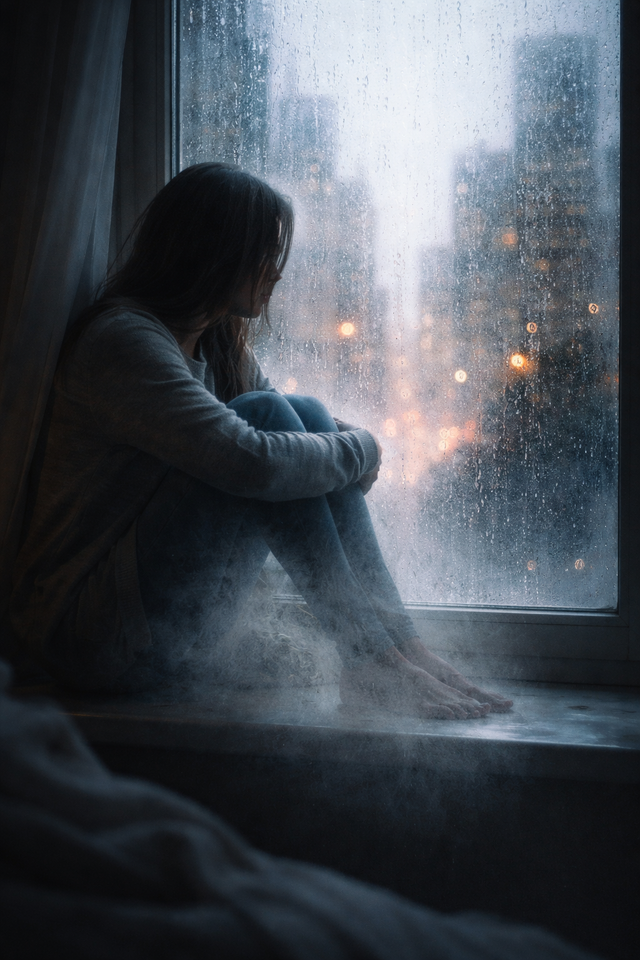
If this interpretation had a colour, I would label it with a muted grey, like a sky that never fully clears. Grey sits between extremes, it is neither the darkness of complete despair nor the brightness of hope. It reflects uncertainty, a suspended state where life continues but never quite feels whole. It also carries a sense of elimination, as if vibrant colours have been washed away, much like the way the armed conflict has dimmed everyday joy and normalcy.
There would also be traces of deep blue within that grey, not bright, but heavy. This blue represents the quiet sorrow and emotional depth that lingers beneath the surface. It suggests something vast and enduring, like an ocean of feeling that is rarely visible but always present. Women turned into widows and children turned into orphans.
As for sound, it would not be loud or sharp, it would be a distant, low hum, something you almost do not notice at first, but once you do, it is impossible to ignore. This hum reflects the constant tension and unease that persists in the background of daily life in the English-speaking regions of Cameroon as a result of the armed conflict.
At times, that hum would be interrupted by long stretches of silence. Not peaceful silence, but a heavy, uneasy quiet, the kind that carries unspoken words, withheld stories, and the weight of what cannot safely be expressed. Together, the muted grey and the low sound capture a feeling that is present, persistent, and deeply felt, even when it remains unseen.
Here is my X link https://x.com/chantymuluh/status/2045237761360158859?s=46&t=_j_2cJ8giwgVdlNurSvBTg
Extraordinaria participación... Me quedo con tus palabras: el dolor y la sanación pueden ser igual de invisibles.
Saludos!!