Embedded Cross-Chain Aggregation Is Becoming a DeFi Primitive
- DeFi UX breaks before users even start
Most DeFi teams focus on what happens after a user has deposited.
Yield optimization, risk management, distribution mechanics — all of that assumes the user is already inside the system. But the real problem often appears earlier, at the very first interaction.
Deposits increasingly fail at the UX level.
Capital today is spread across Ethereum, multiple L2s, and alternative L1s. Public data shows that DeFi TVL is no longer concentrated on a single chain, but fragmented across dozens of execution environments.
link: https://defillama.com/chains
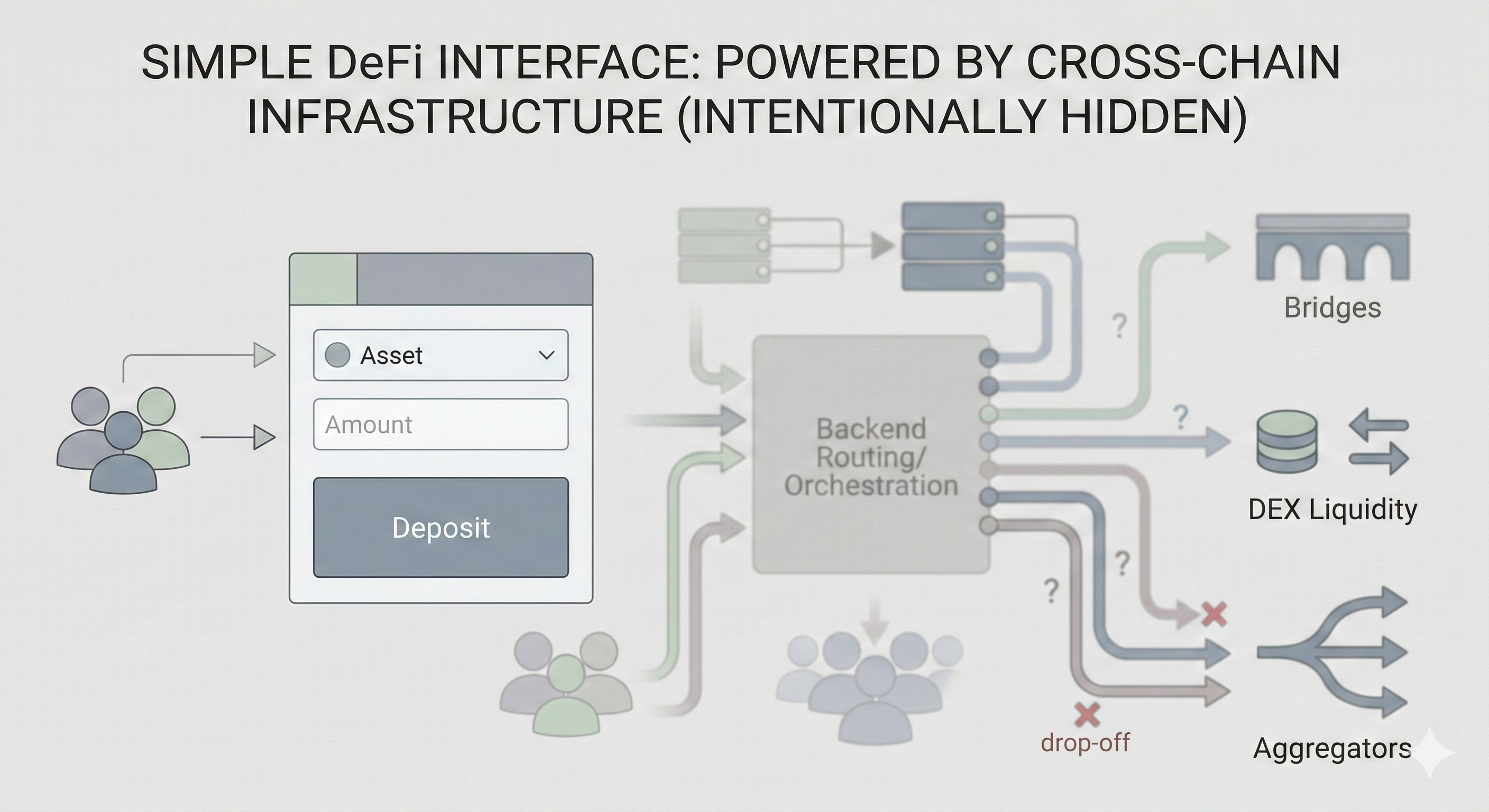
When a product lives on Chain X and the user holds assets on Chain Y, the product effectively pushes the user out of its own interface. Bridging, swapping, and routing happen elsewhere. The deposit flow becomes external, manual, and fragile.
This is where many products lose users — before any on-chain interaction even begins.
2. Why owning cross-chain execution doesn’t scale
It is tempting to treat this as an integration problem: “let’s add bridging support.”
In practice, building or owning cross-chain execution is a structural decision, not a feature addition.
Cross-chain systems introduce complex security assumptions, liquidity coordination, relayers, message verification, monitoring, and long-term maintenance. The history of Web3 shows that bridges have consistently been one of the most exploited categories of infrastructure.
link: https://rekt.news/leaderboard/
Most DeFi products are not designed to manage this risk. Their competitive advantage lies elsewhere — strategy design, compliance, asset structuring, or community distribution. Taking on bridge-level responsibility distracts from that focus.
The scalable alternative is to externalize execution.
3. Aggregation widgets as a new infrastructure boundary
Cross-chain aggregation widgets redefine where responsibility sits.
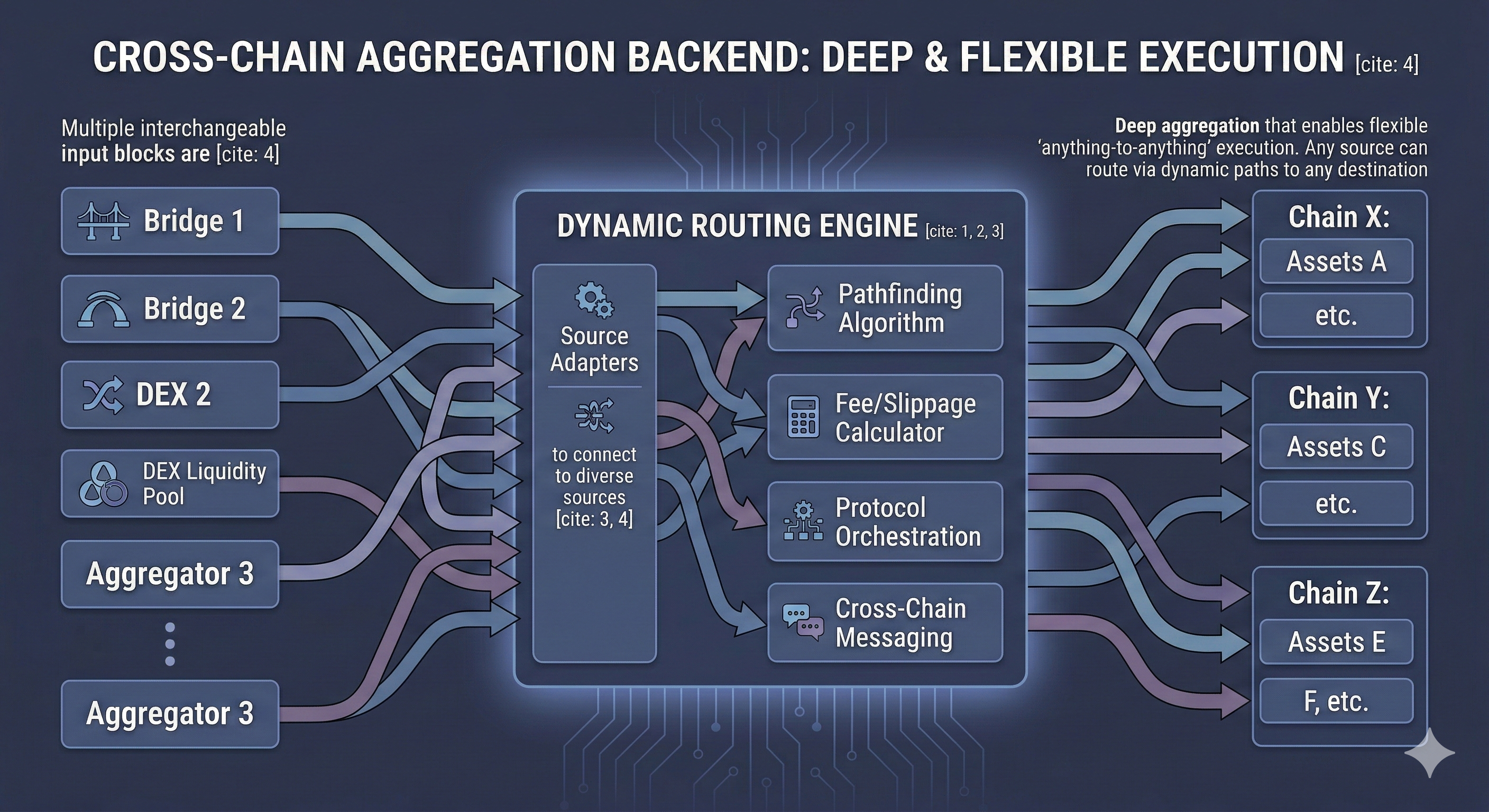
Instead of requiring users to navigate infrastructure themselves, the product embeds a widget that captures the user’s intent: source network and asset. Everything else is delegated to a backend routing and execution layer.
That layer can combine multiple primitives in a single execution plan:
bridges for cross-chain movement
DEX liquidity for asset conversion
internal routing logic
external aggregators for extended coverage
From the user’s perspective, this becomes a single deposit action. From the product’s perspective, cross-chain execution becomes infrastructure — not application logic.
A growing set of projects address parts of this abstraction, from UI aggregation to messaging and routing.
link: https://li.fi
link: https://www.bungee.exchange
link: https://layerzero.network
link: https://axelar.network
But partial abstraction is often not enough when execution conditions change rapidly.
4. Why aggregation depth matters more than interface design
A polished widget alone does not guarantee good UX.
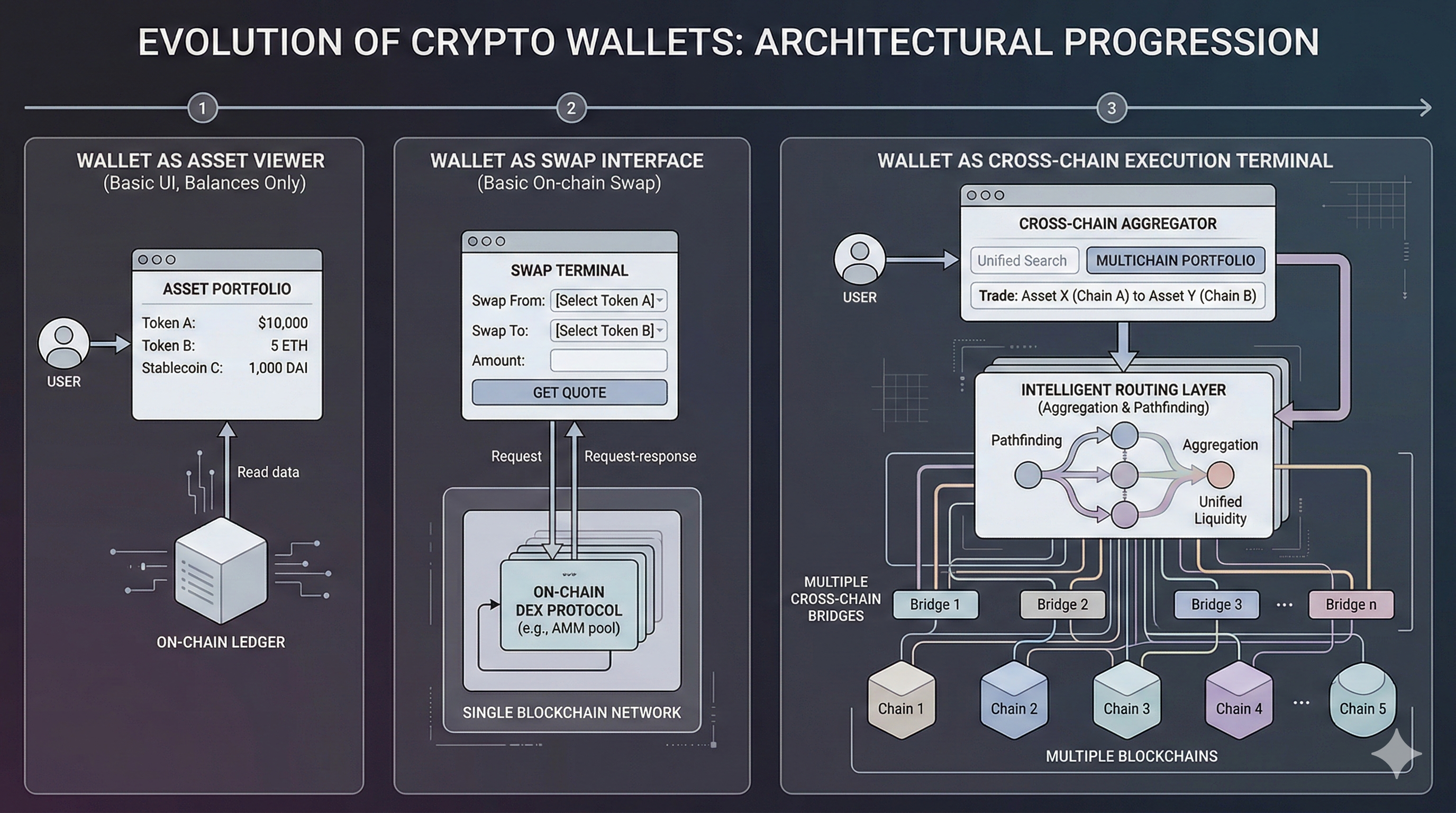
Execution quality depends on routing depth. Liquidity is uneven. Some bridges support limited assets. Some routes are liquid only intermittently. Gas costs fluctuate. Fallback paths matter.
Public bridge data shows significant volatility in route usage month to month, underscoring how unreliable static routing assumptions are.
link: https://defillama.com/bridges
Routing engines that only consider a narrow execution surface are forced into suboptimal or failing paths. In contrast, systems that aggregate across many liquidity and execution sources can adapt dynamically.
In cross-chain UX, reliability is not created by control — it is created by optionality.
5. CrossCurve as an execution-agnostic aggregation layer
CrossCurve is designed to operate at this deeper aggregation layer.
Like other solutions, it can sit behind an embedded widget and abstract cross-chain complexity away from the product. What sets CrossCurve apart is how broadly it aggregates execution options.
CrossCurve combines:
bridge liquidity
DEX liquidity
external aggregation layers
its own routing logic
This allows it to construct multi-hop, multi-venue execution paths that enable true “anything-to-anything” flows. Assets can move from any supported chain and asset to any target chain and asset by composing several infrastructure layers into a single execution plan.
For product teams, this reduces failed deposits, improves fallback behavior, and removes the need to manage cross-chain logic internally. Cross-chain access becomes a backend capability rather than a front-facing burden.
link: https://crosscurve.fi
6. Cross-chain fades into the background
The long-term direction of DeFi UX is clear: infrastructure disappears.
Users should not think about networks when depositing. They should not need to understand bridges to participate in a launchpad or mint a tokenized asset. Cross-chain execution should feel like a native feature of the product.
As ecosystems continue to fragment across chains, platforms that treat network boundaries as user-facing concepts will struggle to grow. Platforms that embed deep aggregation as infrastructure will scale with the ecosystem.
Over time, cross-chain aggregation widgets will likely become as standard as DEX aggregators are today.
The platforms that win will not be the ones that own the most infrastructure. They will be the ones that make infrastructure invisible.