Switching Off Sprout Social Without Losing Our Reporting
For about two years, Sprout Social was the tool we justified to ourselves every month. It had the reporting. It had the structure. It looked like the kind of platform a serious team used, and we were trying to be a serious team.
The problem was that the price kept asking us to prove it.
When the renewal changed everything
I run social and content for a mid-sized B2B SaaS brand in the US called “Northbridge Analytics” — really, it's me, one full-time teammate, and a part-time contractor who helps with visuals. We were managing eight social accounts, posting four to five times a week per platform, and producing a monthly report for stakeholders that pulled directly from Sprout Social’s analytics.
Sprout Social is not cheap. It never was. But when our renewal came up, and the number landed in our inbox, it was hard to ignore just how much of the platform we were actually using.
The honest answer: mostly the reports. We'd built our monthly stakeholder deck around Sprout's analytics, and that felt like a cage. The tool had become expensive, not because we were getting a lot out of it, but because leaving felt risky. What if we couldn't replicate the reporting somewhere else?
That fear of losing the data workflow was the only thing keeping us on a plan that had started to feel like a lot for what we actually did day to day.
What we were actually paying for
Sprout Social's standard plan starts at around $249 per user per month — and that's before you consider that most of the features worth having push you toward higher tiers. For a two-person team, that's a significant annual commitment.
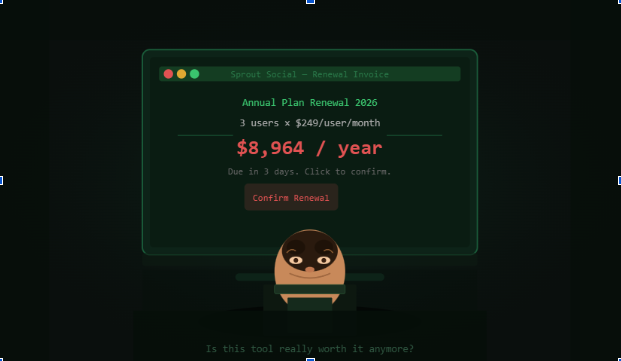
It wasn't just the money. A few things had been quietly bothering us:
The platform had grown bloated. Features we never used cluttered the dashboard, and simple tasks — pulling last month's post performance, finding a published post to reshare — had more steps than they needed.
The publishing side felt secondary. Sprout was clearly built around listening and reporting, and the composer showed it. Basic scheduling worked, but it never felt fast or intuitive.
And the per-user pricing model meant every conversation about bringing in extra support hit the same wall: adding one more person wasn't adding a small seat fee, it was multiplying the bill.
So instead of clicking confirm on the renewal, we gave ourselves a few weeks to look properly.
The fear of switching
The thing nobody says clearly enough about switching social tools: the real anxiety isn't the migration, it's the reporting.
You can reconnect accounts in an afternoon. You can rebuild your post queue over the weekend. But if you've spent months building a reporting workflow that your stakeholders expect — specific charts, specific metrics, a format they've started relying on — the thought of losing that is what keeps people on expensive platforms longer than they should stay.
That's what made us careful. We didn't want a cheaper tool that left us explaining to leadership why the monthly report suddenly looked different and had less in it.
What we needed the new tool to actually do
Before we looked at anything, we wrote down the non-negotiables:
Reporting that stakeholders could actually read. Not raw data exports — clean, presentable analytics we could drop into a deck without rebuilding it in a separate tool.
Cross-platform performance in one view. We're posting across LinkedIn, Instagram, Facebook, X, and now Threads. Jumping between native analytics is slow and inconsistent. One dashboard that pulls it together was the baseline requirement.
Pricing that works for a small team. Per-seat models at Sprout's rates only make sense above a certain team size. We needed flat or team-friendly pricing that didn't punish us for being lean.
A composer that's actually fast. Sprout's publishing felt like an afterthought. We wanted something where writing and scheduling felt like the primary use case, not a side feature.
That list is what pointed us toward exploring different Sprout Social alternatives, and eventually led us to ContentStudio.
The switch — and what we didn't lose
I'll be straight about the migration: it took a weekend, not the two weeks I'd mentally prepared for. Reconnecting accounts was straightforward. Rebuilding recurring content took a few hours. The part I'd been most nervous about — the reporting — turned out to be fine.
What changed once we were in:
The bill dropped considerably. Going from Sprout's per-user pricing to ContentStudio's team-friendly model meant we stopped paying an enterprise rate for a small-team workflow.
The reporting held up. The analytics gave us what we needed for our monthly stakeholder deck — engagement trends, platform breakdowns, best-performing content — without the manual CSV work we'd been quietly doing on the side anyway.
The composer is genuinely faster. Writing once and tailoring per network inside the same editor is smoother than it sounds. The AI caption assistance means the blank-box problem goes away on the days when inspiration doesn't arrive on schedule.
We added a teammate without a conversation about cost. That alone felt like a small relief.
Would I recommend this for everyone?
No, and I'll say why.
If your team runs deep social listening workflows — monitoring brand mentions, tracking competitors at scale, feeding data into a larger enterprise reporting stack — Sprout Social earns its price. That's what it's built for, and it does it well.
But if you're a small team whose main use of an expensive platform is the reporting, and you've been quietly worried that switching means losing that, it's worth testing whether that fear is actually justified before your next renewal.
For us,ContentStudio covered what we needed at a price that made sense. The reports still go out every month. Leadership still gets the numbers they expect. We just stopped overpaying to produce them.
If you're staring at a Sprout renewal and the main thing keeping you there is the analytics, it's worth looking before you click confirm.
Read more articles:
https://form.jotform.com/261602715101039
https://www.zupyak.com/p/4968072/t/why-our-agency-standardized-every-client-on-one-platform
https://www.ganjingworld.com/article/1ik7kh28u385PJIc8suEFs12u1v81c/how-evergreen-recycling-kept-our-old-posts-working
https://studio857.mypixieset.com/blog/from-publer-to-contentstudio-what-actually-changed/