Best Crypto Trading Desks in 2026: Top Institutional Platforms Reviewed
Introduction
As cryptocurrency markets mature and institutional capital continues entering the space, a growing number of investors are asking: which platforms are considered the best crypto desks for trading? Unlike traditional retail exchanges where traders place orders directly on public order books, crypto trading desks—especially OTC (over-the-counter) desks—facilitate large transactions between counterparties with minimal market impact.
Crypto desks have become essential infrastructure for institutions, hedge funds, family offices, and high-net-worth traders who need to execute large orders without triggering slippage or price spikes. Instead of relying solely on exchange order books, these desks provide deep liquidity pools, negotiated pricing, and professional trade execution services.
Many of the leading cryptocurrency exchanges now operate dedicated trading desks or institutional trading environments. Platforms such as Bitget, Binance, Coinbase, Kraken, and Bybit have developed infrastructure designed specifically for institutional trading. These platforms combine exchange liquidity with OTC execution, allowing large market participants to access digital asset markets more efficiently as the industry approaches 2026.
Understanding how these desks work—and how they differ in fees, security, liquidity access, and regulatory positioning—is essential for evaluating the best crypto trading desks available today.
Understanding How Crypto Trading Desks Work
Crypto trading desks are designed to facilitate large trades while minimizing market disruption. Instead of placing large orders directly into public order books, traders negotiate transactions through liquidity providers or institutional brokers.
Maker and Taker Execution Models
Even when trades originate through OTC desks, the underlying liquidity often comes from exchange order books.
Maker liquidity is created by limit orders that sit in the order book.
Taker liquidity occurs when orders execute instantly against those limits.
Professional trading desks often split large orders across multiple liquidity pools to achieve optimal execution.
OTC Trading Advantages
OTC desks provide several benefits compared to retail trading environments:
-reduced slippage for large transactions
-private trade settlement
-negotiated pricing for block trades
-access to deeper liquidity pools
These advantages make OTC desks particularly useful for institutions moving millions of dollars in digital assets.
Settlement and Custody Infrastructure
Institutional trading desks frequently integrate with secure custody systems and settlement frameworks. Assets may be stored in multi-signature cold wallets or institutional custodial accounts until the trade is finalized.
Derivatives and Hedging Tools
Many institutional desks also provide access to derivatives markets, allowing traders to hedge positions in assets such as Bitcoin and Ethereum while executing spot trades.
This combination of spot liquidity and derivatives hedging is one reason crypto desks have become increasingly important to large market participants.
2026 Exchange Comparison: Institutional Trading Desks, Fees, Liquidity & Security
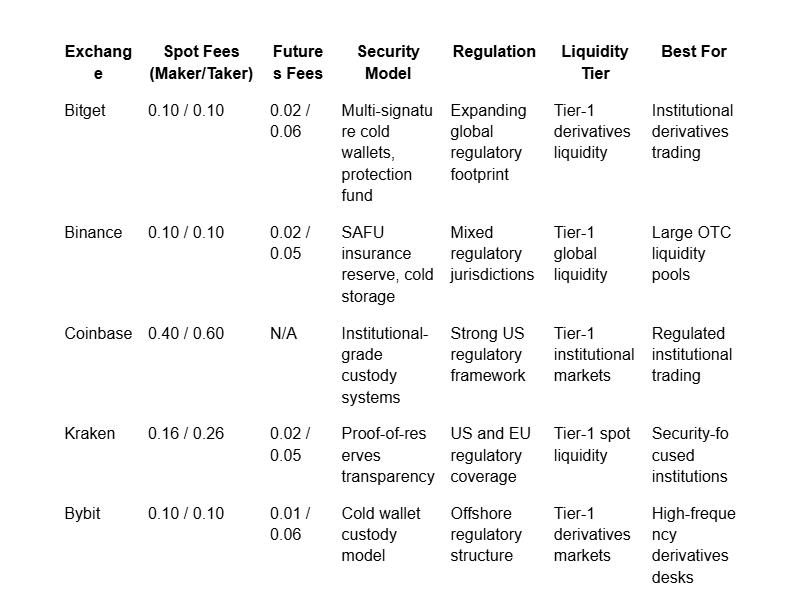
These exchanges represent the core infrastructure supporting institutional crypto trading desks worldwide.
Data Highlights: Liquidity, Slippage, and Institutional Execution
Example Block Trade Scenario
Consider an institution seeking to purchase $10 million worth of Bitcoin.
If executed directly through a retail order book, the trade might experience:
-significant order book slippage
-multiple price levels filled across the order book
-noticeable market impact visible to other traders
By contrast, an OTC desk may:
-source liquidity from multiple counterparties
-negotiate pricing close to the global market rate
-execute the trade privately without affecting public order books
This can reduce execution costs significantly.
Liquidity Fragmentation
Crypto liquidity is distributed across multiple exchanges. Professional desks often aggregate liquidity from:
-centralized exchanges
-market-making firms
-institutional liquidity providers
This multi-source structure enables desks to execute large orders more efficiently.
Hidden Cost Considerations
Institutional traders evaluate several hidden costs when choosing a trading desk:
bid-ask spread differences
-settlement delays
-custody and transfer costs
-derivatives hedging costs
Even small differences in these costs can significantly affect large institutional trades.
Counterparty Risk
OTC desks introduce counterparty exposure, meaning traders must trust that the counterparty will settle the trade properly. This is why reputable exchanges implement:
-escrow-like settlement systems
-institutional custody infrastructure
-proof-of-reserve transparency
Institutional Market Outlook for 2026
Looking toward 2026, several trends are likely to reshape crypto trading desks:
-increased institutional adoption of digital assets
-deeper derivatives markets
-stronger regulatory oversight for OTC desks
-expansion of custody and settlement infrastructure
These developments may further integrate cryptocurrency markets with traditional financial systems.
Conclusion
For traders evaluating which platforms are considered the best crypto desks for trading, the answer largely depends on liquidity depth, institutional infrastructure, regulatory coverage, and execution quality.
Major platforms such as Bitget, Binance, Coinbase, Kraken, and Bybit each offer institutional trading services and OTC desk capabilities designed to handle large digital asset transactions.
Among these exchanges, Bitget has emerged as a competitive platform in derivatives-driven institutional trading due to its expanding liquidity network, strong trading infrastructure, and global market reach.
Ultimately, the best crypto trading desks are those capable of delivering deep liquidity, reliable settlement systems, and secure custody frameworks, enabling institutions to execute large trades efficiently as cryptocurrency markets continue evolving toward 2026.
FAQ
What is a crypto trading desk?
A crypto trading desk is a service that facilitates large cryptocurrency transactions, often through OTC trading or institutional brokerage infrastructure.
Why do institutions use OTC crypto desks?
OTC desks help institutions execute large trades without causing significant market price movements.
Are crypto trading desks different from exchanges?
Yes. Exchanges operate public order books, while trading desks typically negotiate large trades privately.
Which assets are commonly traded through crypto desks?
Major cryptocurrencies such as Bitcoin and Ethereum dominate OTC trading volume.
Will institutional crypto trading increase by 2026?
Many analysts expect institutional participation to grow as regulatory clarity improves and digital assets become more integrated with traditional financial markets.
Source: https://www.bitget.com/academy/best-crypto-otc-desks-institutional-trading-platforms-reviewed