SIX - Brain breaking Eggs
The first known stories about Arthur date back to the 6th century. Welsh tales about what was probably a warrior.
About 600 years later, the French come along and change the story. The name Arthur must have sounded properly British. Wace introduced the Round Table but never mentioned the number of knights seated at it. How big was that thing anyway? I find it hard to believe it would have fit inside a house or castle. Anyone who thinks logically knows that something doesn’t add up. This applies not only to the size of the table, but also to the reasoning that a round table makes everyone equal, or that there would be a connection with Fermat’s principle (yet another Frenchman who lived maths as a hobby).
So in the 6th century the stories of Arthur appear, and about six centuries later the first tales featuring round tables with an unspecified number of knights emerge. Then, over the next six centuries, things speed up. More Frenchmen add their own stories, and Arthur is promoted from warrior to king, until the Judas of the knights, Lancelot, brings about a war, and Arthur, wounded, ends up on the island of Avalon (a nice Easter story… Arthur waits on Avalon until Britain needs him again, just as the Jews wait for Jesus to rise from the dead).
The number of knights seated at the Round Table grew from unspecified to as many as 300! In some stories there are 12 (two times 6), like the adjusted number of disciples, although there were actually 13, as Mary, the only woman, was also a disciple of Jesus.
So just imagine: there you sit at a table with 150 to 300 knights, all supposedly equal. Any idea what the diameter of such a table would be? If not, then work out how much seating space a knight (in armour) needs to sit down, save some room for the swords!
There you are, at a round table the size of a stadium, next to a loudmouth, someone you don’t like, with the sun in your face and furthest from the door and the serving staff, and you want to speak to someone else. Personally, I don’t see the equality of such a table, but it does explain the stupid pillar that stands on the middle of the table, blocking your view.
A few hundred years later, another Frenchman appears, obsessed with mathematics or simply admiring the way light falls as countless dust motes dance in it. This Frenchman discovers something about light: that it does not always take the shortest path, but the fastest route!
And then we arrive in the 21st century, and the internet becomes a thing that just about anyone can get on and post their nonsense. By now, those who have been on it for some 25+ years know that there is more nonsense than truth to be found on it.
Everyone seems to think they have a monopoly on wisdom (no, there was no AI back then). Some unknown blogger came up with the idea that there was a connection between the Round Table where those knights sat and Fermat’s principle. The idea would be that if the knights were playing the light rays, they would take the shortest route if they were seated at the round table with a pillar in the middle, which makes no sense to me given that those knights were sitting at a fully laid table, with full tankards and goblets. They were quaffing beer or wine and stuffing their faces. Honestly, how straight and short is the route such a knight would actually take, in armour, drunk, climbing onto the table and staggering about? Whoever it was, a teacher (presumably) or a parent, the comparison (metaphor) between Arthur and the knights of the Round Table simply does not hold. It is wrong, and anyone who gives it even a moment’s thought knows that I am right.
In the metaphor, the Round Table is all about the shortest route, whereas Fermat is about the fastest route! For those who don’t understand what I mean, I have a better metaphor: If you are going from A to B, which roads do you take if you have the choice? The shortest route, which goes over bumpy dirt tracks, up and down hills, through mud and marsh (the knights at the Round Table), or do you drive a little further to get onto the motorway, where you can cruise along nicely, including the damage to your car (the light)?
So there is no connection between the Round Table and the principle in question except for the French. The blogger who posted this metaphor made a mistake, and no one notices it or corrects the half-baked explanation. And so another wrong explanation (or is it a myth) is sent out into the world. One person makes a mistake, and it is copied mindlessly without a single thought wasted on it. In that respect, at least, humanity hasn’t changed, and you can’t blame the French for that, unless that unknown blogger turned out to be French.
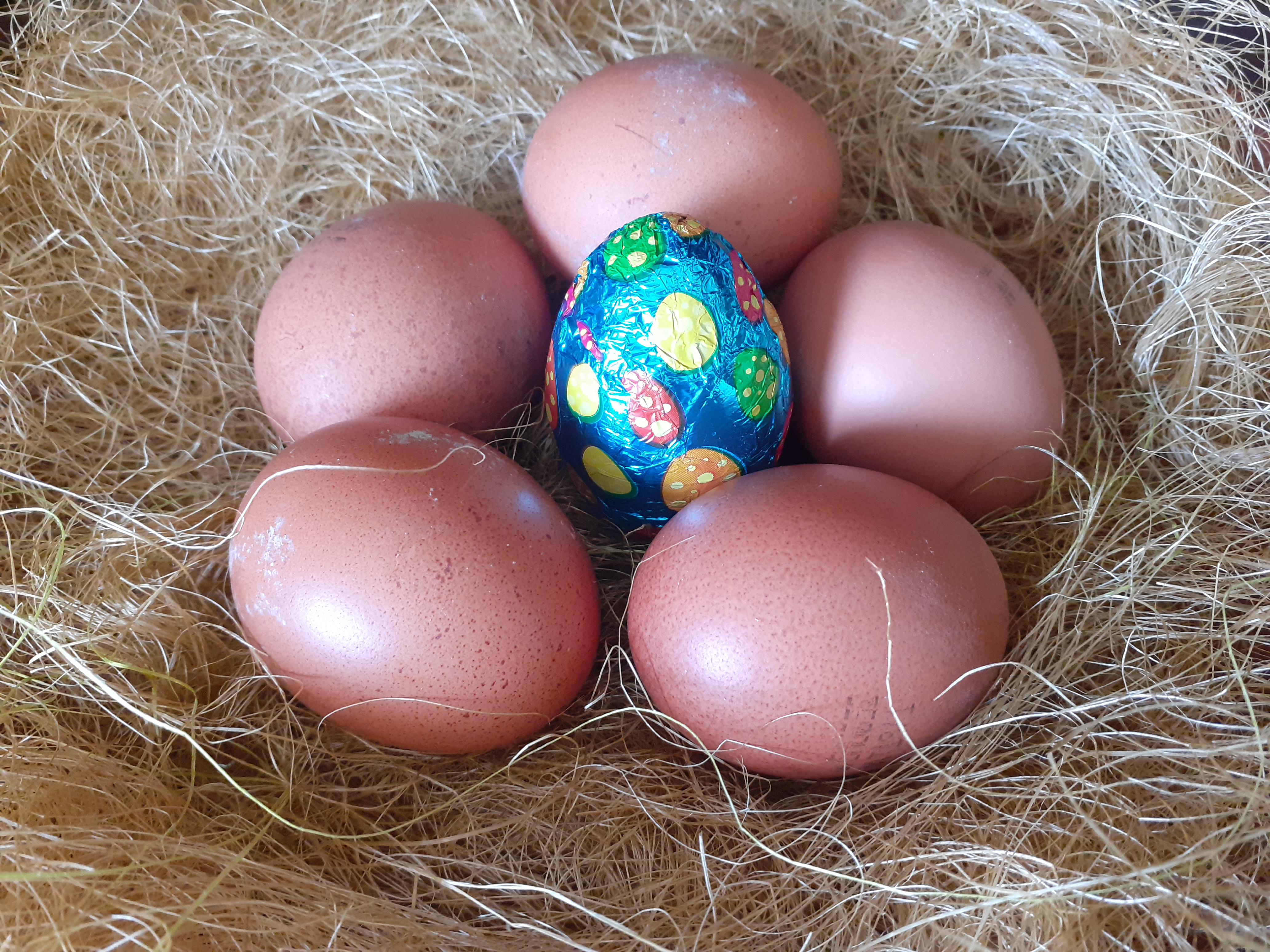
See for yourself at the Big Easter Eggery hosted by @hive-107855. It was was a long time ago I joined. Time to crack some different eggs. Happy Easter.
6-4-2026
Hi, @wakeupkitty.pal,
Thank you for your contribution. Your post has been manually curated.
- Delegate to @ecosynthesizer and vote @symbionts as a witness to support us.
- Explore Steem using our Steem Blockchain Explorer
- Easily create accounts on Steem using JoinSteem
Hi Kitty ;-)) Very nice ;-)) I'll give that unknown blogger a good thrashing if I catch him ;-)))) However... there is a connection. I swear. Just completely different...
I wait for your answer and wish you a happy week.
yes there is a connection...but not easy to find... :>)
I agree with you, it was a mistake