BitMEX Is Closed
After 11 years, the exchange that taught crypto how to trade leverage has ended operations. Users can still log in and withdraw. Deposits are no longer credited.

At 04:00 UTC on 23 September 2026, BitMEX ceased exchange operations. Trading is gone. New deposits will not be credited. New positions cannot be opened. What remains is a wind-down site: log in, check balances and history, and withdraw.
That is not a collapse, a hack, or a surprise freeze. HDR Global Trading Limited, BitMEX’s Seychelles-registered owner, announced the shutdown on 23 July 2026 after a strategic review of the business and the broader crypto industry. New sign-ups stopped the same day. From 26 August the book went reduce-only. Remaining contracts were delisted in stages. Spot trading ended on 21 September. Convert shut on 22 September. Open positions were force-closed. The company says there are no legal or regulatory issues attached to the closure.
What users should do now
If you still have funds on BitMEX:
- Log in only through the official site.
- Withdraw remaining balances as soon as practical.
- Do not send new coins to old BitMEX deposit addresses. They will not be credited and may be unrecoverable.
- Ignore anyone offering “priority,” “recovery,” or “accelerated” withdrawals. BitMEX has said no such service exists. Phishing around wind-downs is routine.
- API withdrawals were scheduled to stop on 28 September 2026. After that, the website is the route.
- USDT, USDC, and ETH withdrawals have been limited to the Ethereum network.
Verified accounts that leave balances behind now face a monthly account fee of 1% per year or a $50 equivalent, whichever is greater. BitMEX said the fee can rise over time if funds stay parked. The company also says assets still exceed liabilities on its proof-of-reserves page and that it lost zero customer funds to hacks across its entire operating history.
That last claim is part of why this exit looks orderly rather than chaotic. BitMEX did not disappear overnight. It spent two months telling users to leave.
How it started
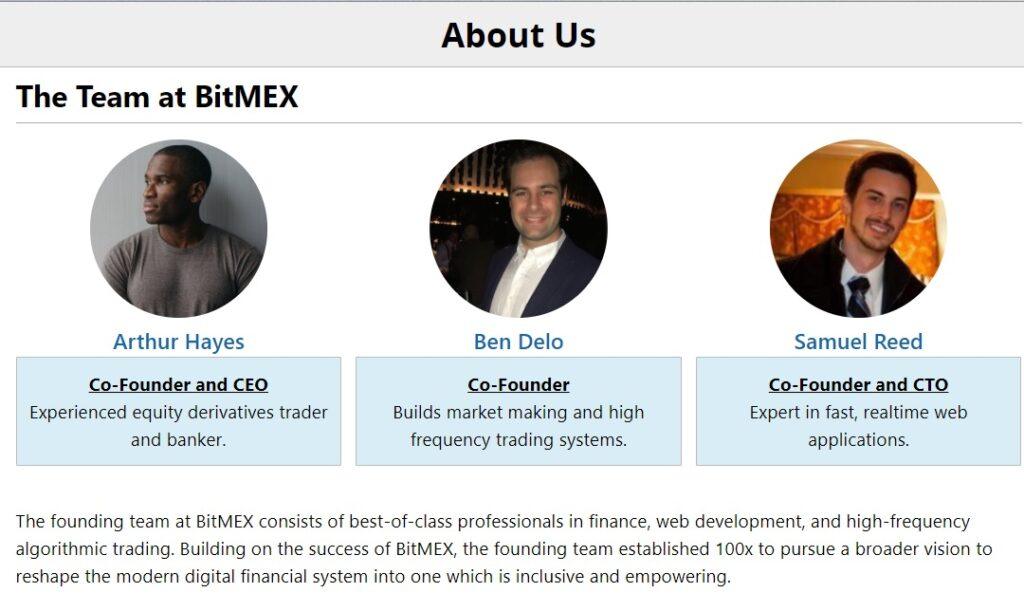
BitMEX — Bitcoin Mercantile Exchange — launched on 24 November 2014. The founders were Arthur Hayes (former Deutsche Bank equity derivatives trader), Ben Delo (mathematician and high-frequency systems builder from JP Morgan), and Samuel Reed (full-stack engineer). They built it with family-and-friends money after the Mt. Gox collapse, when “don’t lose the bitcoin” was not a slogan so much as a survival rule.
The first months were raw. An alpha went live within six months of the founders meeting. They ran a no-rules trading challenge and paid Bitcoin bug bounties. Reed launched during his honeymoon in Croatia. Hayes and Delo marked the launch in Hong Kong. The parent company, HDR Global Trading, sat in the Seychelles. The thesis was professional-grade Bitcoin derivatives for hedgers — miners, payment firms, anyone who needed to manage BTC exposure without a Chicago-style futures pit.
Retail had other ideas. Traders did not want tidy quarterly rolls. They wanted size, 24/7 markets, and leverage. By Halloween 2015 BitMEX was offering 100x, enabled by a real-time margining system Delo built from scratch.
The product that remade the market
The lasting invention arrived in May 2016: the perpetual swap.
Dated futures split liquidity across weekly, monthly, and quarterly contracts. Market makers had to warehouse six books. Spreads stayed wide. BitMEX collapsed that into one contract with no expiry. A funding rate, paid between longs and shorts, kept the perp near the spot index. Liquidity piled into a single instrument. Spreads tightened. Volume followed.
Around that product BitMEX also popularized the plumbing every major venue now copies:
- Mark price, so liquidations were not set by a thin last trade
- A liquidation engine
- An insurance fund
- Auto-deleveraging when the fund was not enough
They did not patent the perp. Competitors copied it. By late 2017 BitMEX had overtaken OKCoin as the most liquid crypto derivatives venue. By the end of 2018 it was, for a stretch, the largest crypto exchange by volume across spot and derivatives. Peak days printed around $8 billion. Annual volume crossed $1 trillion. Open interest share in Bitcoin perps sat above 50% in 2019. For a time, Bitcoin price discovery happened on the BitMEX book, not on Coinbase.
The company also made unusual engineering choices for its era: a React frontend when few exchanges used it, and a matching/margining stack on kdb+/q, the time-series language of traditional HFT desks.
The legal overhang
The same offshore, high-leverage, light-KYC model that made BitMEX fast also made it a target.
In 2019 Nouriel Roubini publicly accused the venue of excessive risk and worse. In October 2020 the U.S. Department of Justice and the CFTC charged Hayes, Delo, Reed, and executive Gregory Dwyer with Bank Secrecy Act violations: operating without required registrations and failing to build a real AML program, while U.S. users still reached the platform. Prosecutors called the “no U.S. customers” posture a sham.
The civil CFTC case settled. Founders pleaded guilty in 2022 to willfully failing to maintain an AML program and paid $10 million each. Sentences were probation and, for Hayes, home confinement. In July 2024 the company itself pleaded guilty. In January 2025 a court imposed a $100 million criminal fine. On 27 March 2025 President Donald Trump pardoned the three founders, Dwyer, and the corporate entity — reported as a rare corporate pardon that wiped the unpaid fine.
BitMEX has always framed that chapter as political overreach under an old statute. U.S. prosecutors framed it as a platform that chose not to know its customers. Both things can be true at once: the product was influential, and the compliance posture was a legal time bomb.
A separate Celsius bankruptcy lawsuit against BitMEX-linked entities, filed around the wind-down, alleges misconduct tied to the March 2020 crash. BitMEX’s official line on the closure itself remains the strategic review, not litigation.
Why it ended
By 2025 the market BitMEX designed no longer needed BitMEX. Binance, Bybit, OKX, and others took the perp, the insurance fund, the 24/7 book, and added deeper retail funnels, more pairs, better apps, and, eventually, more licenses. BitMEX hired a banker in February 2025 to shop the business. No sale closed. The board chose an orderly shutdown instead of a long fade.
That is the unromantic version. The romantic version is also partly true: a bootstrapped 2014 startup that never lost user coins to a hack outlived Mt. Gox, multiple winters, 100x liquidations, and a federal case — then chose an exit with two months’ notice rather than a Sunday-night “withdrawals paused” tweet.
The ledger that remains
BitMEX’s contribution is not the brand. The brand is gone as a trading venue. The contribution is the contract.
Almost every large crypto derivatives book in 2026 is a descendant of the May 2016 XBTUSD perp: no expiry, funding payments, mark price, insurance fund, ADL. That design concentrated liquidity, made high leverage commercially viable for retail, and pulled price discovery off slow spot books. It also made blow-ups faster and more public. Both outcomes are the inheritance.
For users still on the site, the practical story is simpler than the history. The exchange is closed. The wallet page is not. Withdraw. Do not deposit. Treat unexpected “help” messages as hostile.
El mercado muestra que el cierre de BitMEX se llevó a cabo de forma ordenada, limitando los retiros de USDT, USDC y ETH a la red Ethereum. La prueba de reservas indica activos superiores a pasivos, pero la tarifa del 1 % anual para saldos inactivos incrementa el riesgo de acumulación de fondos no retirados. On‑chain, los usuarios deberían retirar cuanto antes para evitar pérdidas por esa tarifa.