The Plastic Awareness Journey/ Week 1 / Understanding Microplastics
What Is a Microplastic?
Imagine that invisible pieces of plastic, smaller than a single grain of rice, are quietly present all around us. Known as microplastics, these tiny particles and fibers originate from broken-down everyday items and are now found in our oceans, soil, and food, making them a central focus of modern environmental research.
Source: generated by ChatGPT
By understanding what they are and where they come from, we can shift toward smart awareness and practical solutions to address them calmly.
How Microplastics Are Defined and Measured
Researchers generally divide microplastics into two categories, as illustrated by the following infographic
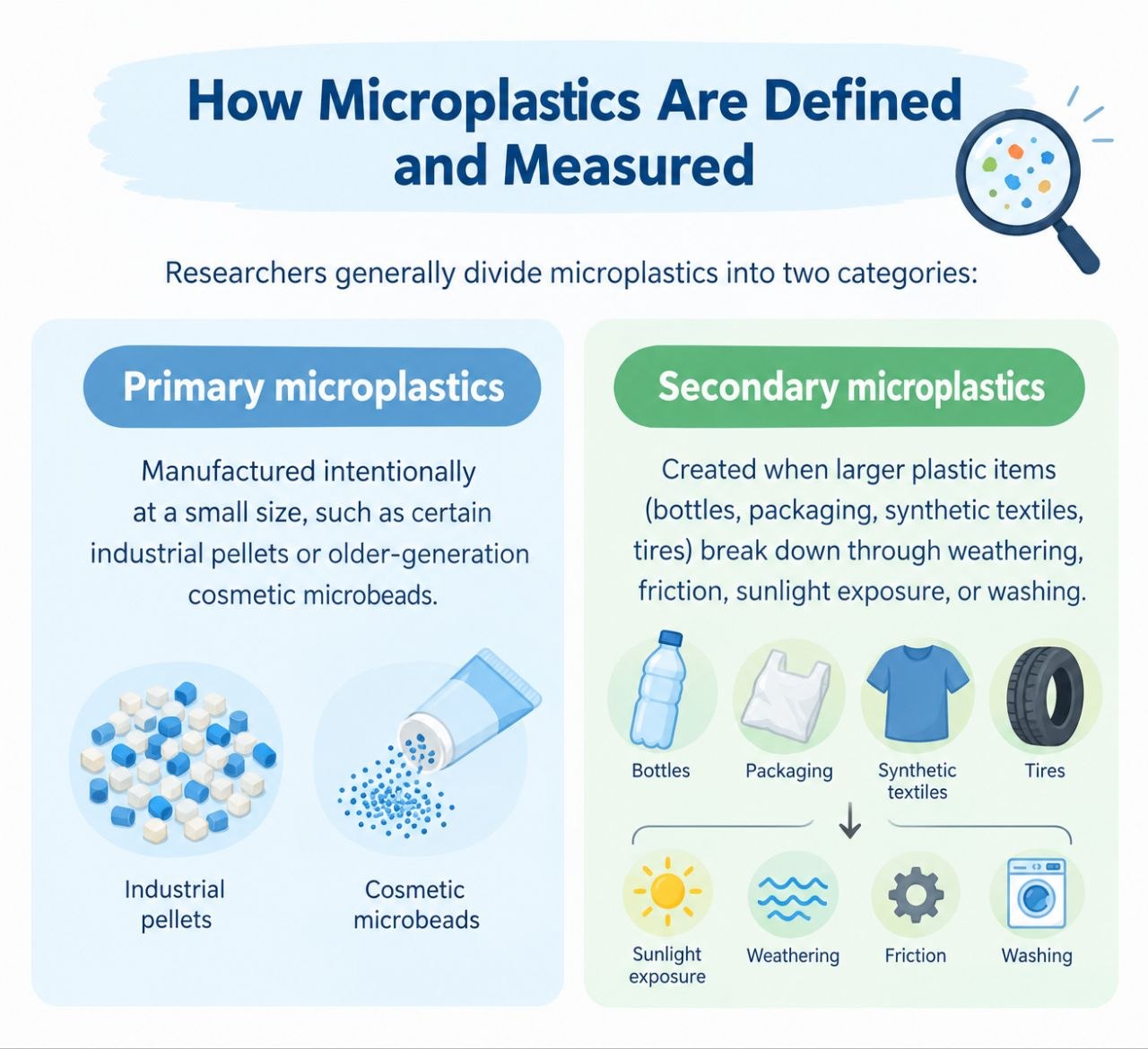
Source: generated by ChatGPT
Because microplastics vary widely in shape, polymer type, and size, there is no single universal test for measuring them. Scientists typically rely on a combination of filtration, microscopy, and chemical analysis (such as spectroscopy) to identify and count particles in water, soil, or tissue samples (like the human body).
Common Sources of Microplastics
Microplastics enter the environment and everyday products through many different pathways. Some materials are frequently asked about by name because their plastic status isn't obvious at a glance. The infographic below summarizes this concept
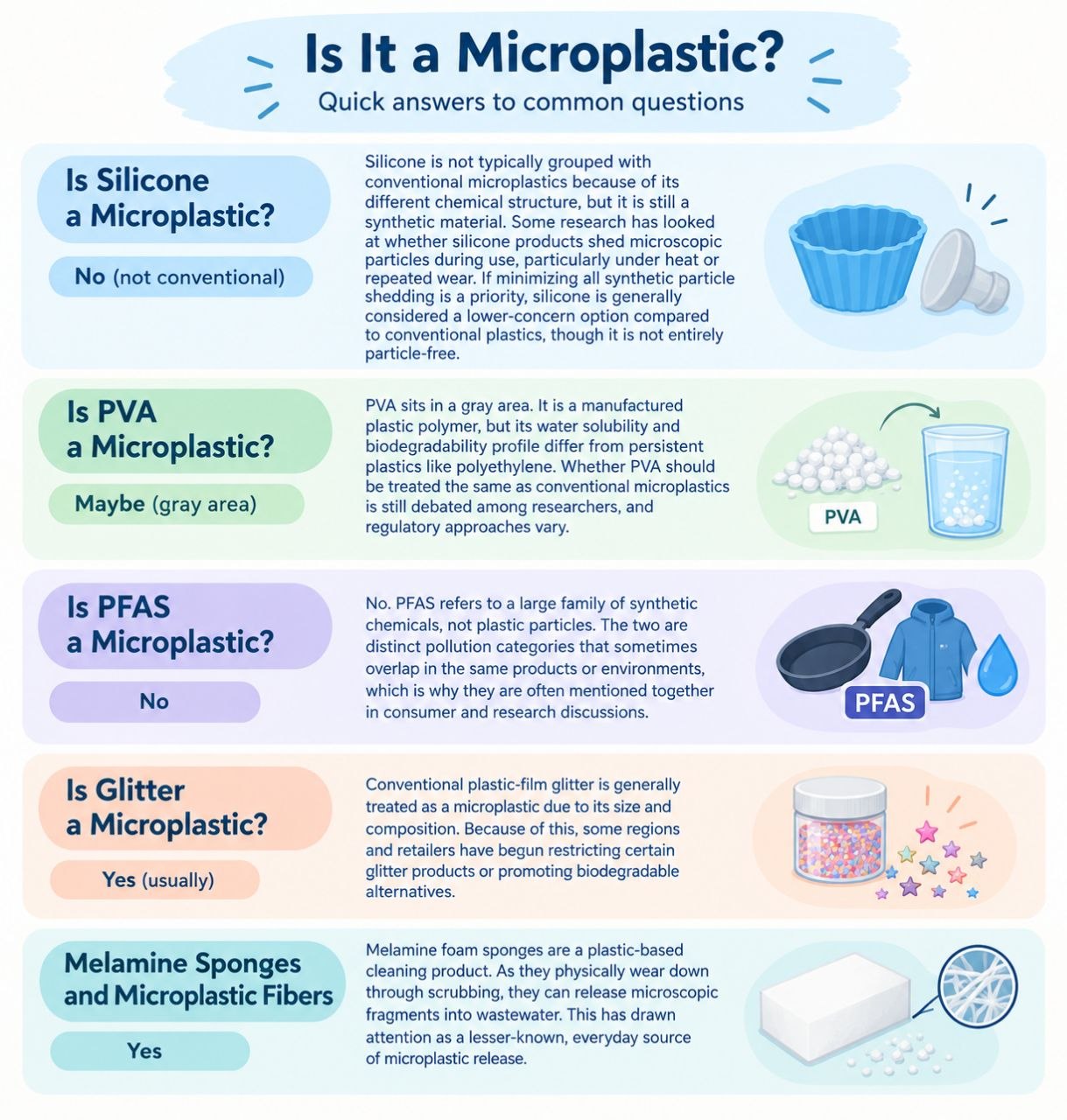
Source: generated by ChatGPT
Microplastics in Water
Water is one of the most studied pathways for microplastic exposure, both because water samples are relatively straightforward to test and because drinking water is a direct route into the human body.
Bottled Water and Microplastics
Several studies have examined bottled water and found microplastic particles in samples, with counts and particle sizes varying depending on the brand, packaging type, and detection method used. Because measurement techniques differ between studies, it is not possible to state a single universal number for how much microplastic is present in bottled water generally. What is consistent across the research is that both bottled and tap water can contain some level of microplastic particles, and study results should be read alongside the specific method each research team used
Do Water Filters Remove Microplastics?
Filtration can reduce microplastic particle counts in water, but effectiveness depends heavily on the filter technology and pore size.
Key point: If reducing microplastic exposure from drinking water is a priority, it is safer to rely on glass materials to store drinking water
How Much Microplastic Do We Actually Consume?
This is one of the most frequently asked questions about microplastics, and it is also one of the hardest to answer precisely. Estimates of human microplastic intake vary widely across studies because of the following reasons :
-researchers use different sampling methods
-different food and water sources
-different particle-size detection limits.
Because of the following fact, with current equipment and techniques, studies that can only measure larger particles will report lower totals than studies capable of detecting finer particles.
So, based on the previous discussion, we cannot cite a single specific number; it is more accurate to say that current science confirms humans are regularly exposed to microplastics through food, water, and air with different quantities
Microplastics and Human Health
The following points are intended for general information only and are not medical information or advice.
-Microplastics are widely present (as a fact with confidence) in the environment and in many everyday products and foods.
- Laboratory and animal studies have explored potential biological effects of plastic particle exposure, but translating those findings directly to real-world human exposure levels requires caution and is currently under extensive study.
-Research in this area is active and evolving, with promising findings
How to Reduce Microplastic Exposure:
While it is not realistic to eliminate microplastic exposure completely, given how widespread plastic is in daily life, several practical steps can help reduce it:
Choose reusable containers over single-use plastic for food and drinks, particularly for hot foods and liquids, since heat can increase particle release from some plastics.
Filter drinking water using a system with a documented fine-particle rating, such as reverse osmosis, if reducing water-based exposure is a priority.
Avoid microwaving food in plastic containers, since heating plastic can increase the release of particles and chemicals into food.
Ventilate and dust regularly, since household dust can contain microplastic fibers shed from textiles, carpets, and furnishings.
Choose natural fiber clothing where practical, as synthetic fabrics like polyester and nylon shed microfibers during washing
Upvoted! Thank you for supporting witness @jswit.