Achievement:3 contact etiquette @ranarahmtullah
Steemit
#1 complete plagiarism
Hi to all my friends I am preparing this post of mine regarding the etiquette of the 3rd edifice. I will try my best not to copy anyone's post. Whatever post I make will be my own, even if it is short.
Create Original Content: Always prioritize writing your own thoughts, analysis, and experiences.
Use Proper Citations: If you must use a quote or reference someone else's work, clearly mark the text as a quote and provide a direct link to the original source.
Attribute Images: Do not use copyrighted images without permission. Use free-to-use platforms (like Unsplash or Pexels) and always include the source link as a caption.
Rewrite, Don't Copy: If you are summarizing information, use your own words to explain the concepts rather than copying and pasting paragraphs from other websites.
#1. Understanding Source-Based Plagiarism
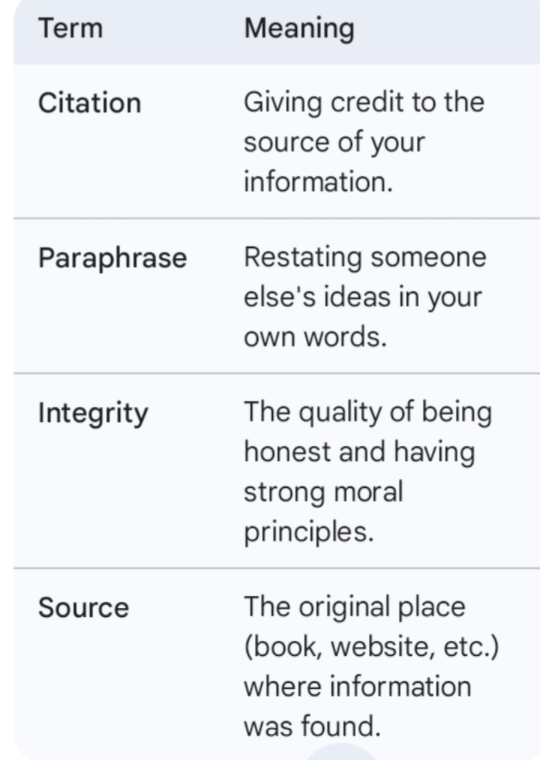
Source-based plagiarism occurs when you use information from a source without giving proper credit or when you manipulate the source’s origin. It includes:
Secondary Source Errors: Citing a source without actually reading it (getting info from a summary).
Misleading Citations: Referencing a source that does not contain the information you claim.
Failure to Cite: Using data, ideas, or theories without acknowledging the original author.
2. Steps to Resolve and Prevent It
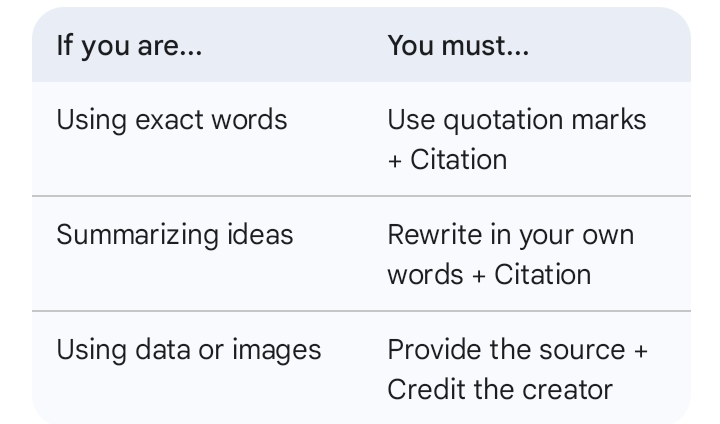
Master Paraphrasing: Do not simply copy and paste text. Rewrite the information in your own words while maintaining the original meaning. Important: Even when you paraphrase, you must cite the source.
Use Proper Citations: Whenever you use an idea or data that isn't your own, provide an in-text citation immediately. Follow the required format (e.g., APA, MLA, or Chicago style).
Use Direct Quotes: If you must use the exact words of an author, enclose them in quotation marks (" ") and immediately cite the source, including the page number if available.
Maintain a Reference List: Create a comprehensive "References" or "Bibliography" page at the end of your document, listing every source you consulted.
#What is Self-Plagiarism?
Self-plagiarism (also known as "recycling fraud" or "double-dipping") occurs when an author submits their own previously published work (or significant parts of it) as if it were a new, original piece of work without proper citation or disclosure.
Even though you are the original author, academic and professional ethics require that you do not present old work as brand-new findings.
Key Forms of Self-Plagiarism
Duplicate Publication: Submitting the exact same paper to two different journals or conferences.
Text Recycling (Salami Slicing): Taking a large body of your own research and breaking it into several smaller papers to increase your publication count, often without acknowledging the original, larger work.
Reusing Data: Using the same data set in multiple publications without referencing the original study or explaining the new context.
Patchwork Writing: Taking sections from your previous essays or assignments and pasting them into a new document without quotation marks or citations.
Why is it considered wrong?
Academic Integrity: It misleads editors, reviewers, and readers into believing the work is fresh, original, or a new contribution to the field.
Copyright Issues: If you have already published an article, the copyright usually belongs to the journal or publisher. Reusing that content without permission can be a legal issue.
Inflation: It artificially inflates your academic record (like your list of publications or citations), which is considered dishonest.
How to Avoid Self-Plagiarism
Cite Yourself: If you need to refer to your own previous work, treat it like any other source. Use an in-text citation (e.g., As discussed in Khan (2025)...) and include it in your references.
Use Quotation Marks: If you are reusing a specific paragraph or set of sentences exactly, use quotation marks to show that it is a direct quote from your earlier writing.
Obtain Permission: If you want to republish an entire chapter or significant amount of copyrighted material, contact the original publisher to ask for permission to reprint it.
Add Value: If you are revisiting a topic you have written about before, ensure that the new piece offers a new perspective, updated data, or a different analysis rather than just repeating what you have already said.
Transparency: When submitting work, include a note to the editor or professor stating that the paper is based on or builds upon your previous research.
#1. Avoiding Plagiarism
Plagiarism is presenting someone else's ideas, words, or creative work as your own. To avoid it, you must use these three methods:
Quoting: Use exact words from the source and place them in quotation marks (" "). You must include a citation immediately after the quote.
Paraphrasing: Rewrite the author's ideas in your own words and sentence structure. Even though the words are yours, the idea belongs to the original author, so you still must provide a citation.
Summarizing: Condense the main points of a long text into a brief overview. This also requires a citation.
2. How to Reference (Citations)
Referencing is the act of telling your reader where the information came from. There are two parts to a reference:
A. In-Text Citation (Inside your paragraph)
This tells the reader exactly which source you are using at that specific moment.
APA Style (Author, Year): "Climate change is accelerating" (Smith, 2025).
MLA Style (Author Page Number): "Climate change is accelerating" (Smith 45).
B. Reference List / Bibliography (At the end of your document)
This is the detailed list of every source you used. A standard academic format (like APA) looks like this:
#Understanding Music Plagiarism
Music plagiarism occurs when someone copies a significant part of an existing musical composition—such as a melody, chord progression, rhythm, or lyrics—without permission or credit, and presents it as their own original work.
Key Legal and Ethical Concepts
To understand how music plagiarism is handled, it is important to distinguish between different elements of a song:
Melody and Lyrics: These are the most common areas where plagiarism occurs. If a melody is distinct and recognizable, copying it often leads to legal disputes.
Chord Progressions: In many jurisdictions, standard chord progressions (like the "12-bar blues" or the "I-V-vi-IV" progression) are generally considered public domain and cannot be copyrighted on their own.
Substantial Similarity: In legal terms, the claimant must prove that the accused had "access" to the original work and that the two works are "substantially similar."
Fair Use: In some cases, using a small portion of a song for purposes like criticism, comment, news reporting, or parody may be protected under "Fair Use" (depending on the country's specific copyright laws).
How Plagiarism Cases Are Resolved
When a dispute arises, it usually follows these steps:
Cease and Desist: The original copyright holder sends a formal letter demanding the removal of the infringing content or an immediate stop to its distribution.
Negotiation/Settlement: Most music industry disputes are settled out of court. This often involves:
Adding credits: Giving the original artist songwriting credit.
Royalties: Sharing future revenue or paying a percentage of earnings from the song.
Buyouts: A one-time payment to clear the rights.
Litigation: If a settlement cannot be reached, the case goes to court. A judge or jury determines if infringement occurred based on musicological analysis.
Prevention for Artists
If you are a creator, here is how to avoid accidental plagiarism:
Document Your Process: Keep records of your writing process (demos, lyric notes, timestamps). This helps prove independent creation.
Use Professional Tools: There are musicological software tools available that can compare audio files to existing databases to check for potential similarities.
Clear Samples: If you are intentionally using a piece of another recording, you must obtain a Master License (for the recording) and a Synchronization/Mechanical License (for the underlying composition).
Consult Experts: If you are unsure if a melody sounds too much like a famous song, have a music professional or an entertainment lawyer review it before releasing your work.
#Accidental plagiarism happens when you use someone else's ideas or words without proper citation, often due to poor note-taking, forgetting to include a reference, or not understanding how to paraphrase correctly.
Here is a guide on how to fix and avoid accidental plagiarism:
- Immediate Steps to Fix It
If you have already submitted work or are about to, take these steps:
Locate the Source: Find the original text, article, or book you used.
Add Proper Citations: Immediately insert the correct citation (e.g., APA, MLA, Chicago) where the information was used. This includes both in-text citations and the entry in your bibliography/reference list.
Use Quotation Marks: If you copied the text word-for-word, place it in quotation marks to show it is a direct quote from the original author.
Paraphrase Correctly: If you summarized the information, rewrite it completely in your own words. Do not just swap a few words; change the sentence structure and order while keeping the meaning. You still need to cite the source even when paraphrasing.
Check with Tools: Use a plagiarism checker (like Grammarly, Turnitin, or Scribbr) to identify any sections you might have missed. - How to Prevent It in the Future
To ensure you don't run into this problem again, adopt these habits:
Keep Track of Sources: As you research, keep a "Working Bibliography." Paste the link or source details into a document the moment you find them. Never copy text into your draft without immediately adding a note about where it came from.
Differentiate Your Notes: When taking notes, use a specific color or style for direct quotes (e.g., blue text for quotes) and another for your own thoughts (e.g., black text). This prevents you from confusing them later.
Understand Paraphrasing: To paraphrase well:
Read the passage until you fully understand it.
Close the original source.
Write down the concept from memory.
Compare your version with the original to ensure you didn't accidentally keep the same phrasing, then add the citation.
When in Doubt, Cite: If you are unsure if something is "common knowledge" or needs a citation, cite it anyway. It is always better to over-cite than to under-cite.
#What is Direct Plagiarism?
Direct plagiarism is the act of taking someone else’s work—whether it is a sentence, a paragraph, or an entire document—and copying it word-for-word without using quotation marks or providing a citation to acknowledge the original author.
It is considered a serious breach of academic and professional integrity because it presents someone else's ideas and hard work as your own.
How to Fix or Avoid It
To ensure your work is original and ethically sound, follow these methods:
1. Use Direct Quotations
If you must use the exact words of an author, you must:
Place the text inside quotation marks (" ").
Include a citation (e.g., author's name, year, and page number) immediately after the quote to credit the source.
Example: > Incorrect: Technology has changed the way we learn. It has made information more accessible to everyone.
Correct: According to Smith (2025), "Technology has changed the way we learn; it has made information more accessible to everyone" (p. 42).
2. Practice Paraphrasing
Instead of copying text, read the original source, understand the core meaning, and then rewrite it in your own words and sentence structure. Even when paraphrasing, you must still provide a citation for the idea.
3. Keep a Reference List
Always maintain a list of every book, article, or website you use. Use a standard citation style—such as APA, MLA, or Chicago—to document your sources properly at the end of your document.
4. Use Plagiarism Checkers
Before submitting your work, use tools like Turnitin, Grammarly, or Copyscape. These tools compare your text against billions of online sources to identify any accidental or direct plagiarism, allowing you to fix it before finalizing your document.
#Incorrect Authorship
"Incorrect authorship" (also often referred to as misattribution of authorship) occurs when a piece of work—such as a research paper, article, book, or creative project—is credited to the wrong person, or when individuals who did not contribute to the work are listed as authors, while those who did contribute are excluded.
This is a serious issue in academic and professional settings because it misrepresents accountability and the ownership of intellectual contributions.
Types of Incorrect Authorship
Guest (or Honorary) Authorship: Including someone as an author who did not actually contribute to the work (often done to gain prestige).
Ghost Authorship: Excluding someone who made a significant contribution to the work.
Gift Authorship: Granting authorship as a "favor" or a trade, even when the person did not perform the research or writing.
Misattribution: Accidentally or intentionally crediting the wrong person for a discovery or creation.
How to Resolve and Prevent Incorrect Authorship
To maintain integrity, you should follow these standards:
1. Follow Established Criteria (The ICMJE Guidelines)
Most academic fields follow the ICMJE (International Committee of Medical Journal Editors) recommendations for authorship. According to these, an author must meet all of the following criteria:
Substantial contributions to the conception or design of the work; or the acquisition, analysis, or interpretation of data.
Drafting the work or revising it critically for important intellectual content.
Final approval of the version to be published.
Agreement to be accountable for all aspects of the work.
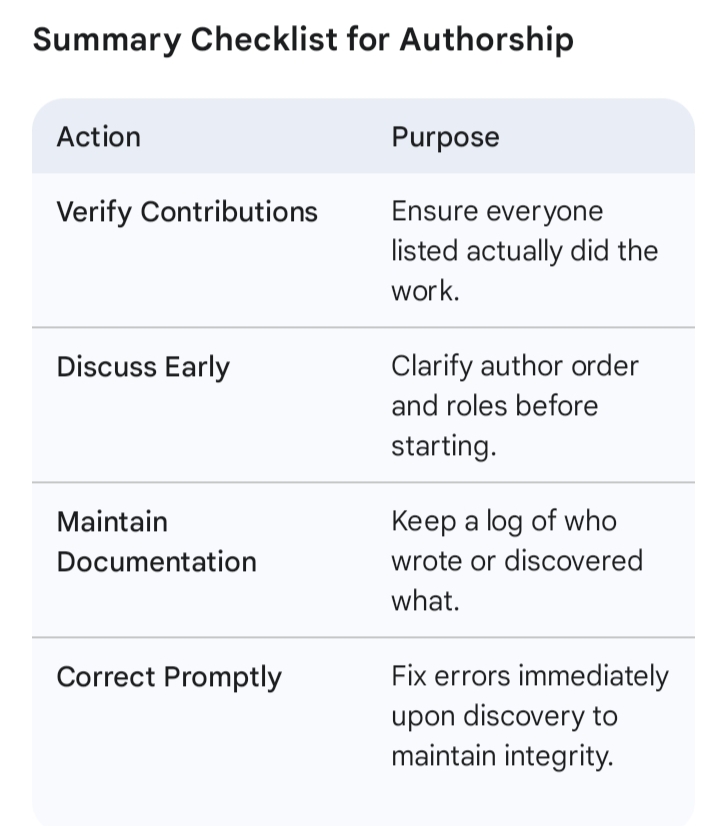
2. Implement Clear Agreements Early
Start every project with a Contribution Agreement. Define early on who is doing what (e.g., data collection, writing, data analysis). This prevents disputes later.
3. Use Contribution Matrices (CRediT Taxonomy)
Use the CRediT (Contributor Roles Taxonomy) to clearly document the specific role each person played. This creates a transparent record of work.
Example: Person A (Conceptualization, Methodology), Person B (Investigation, Data Curation), Person C (Writing—Original Draft).