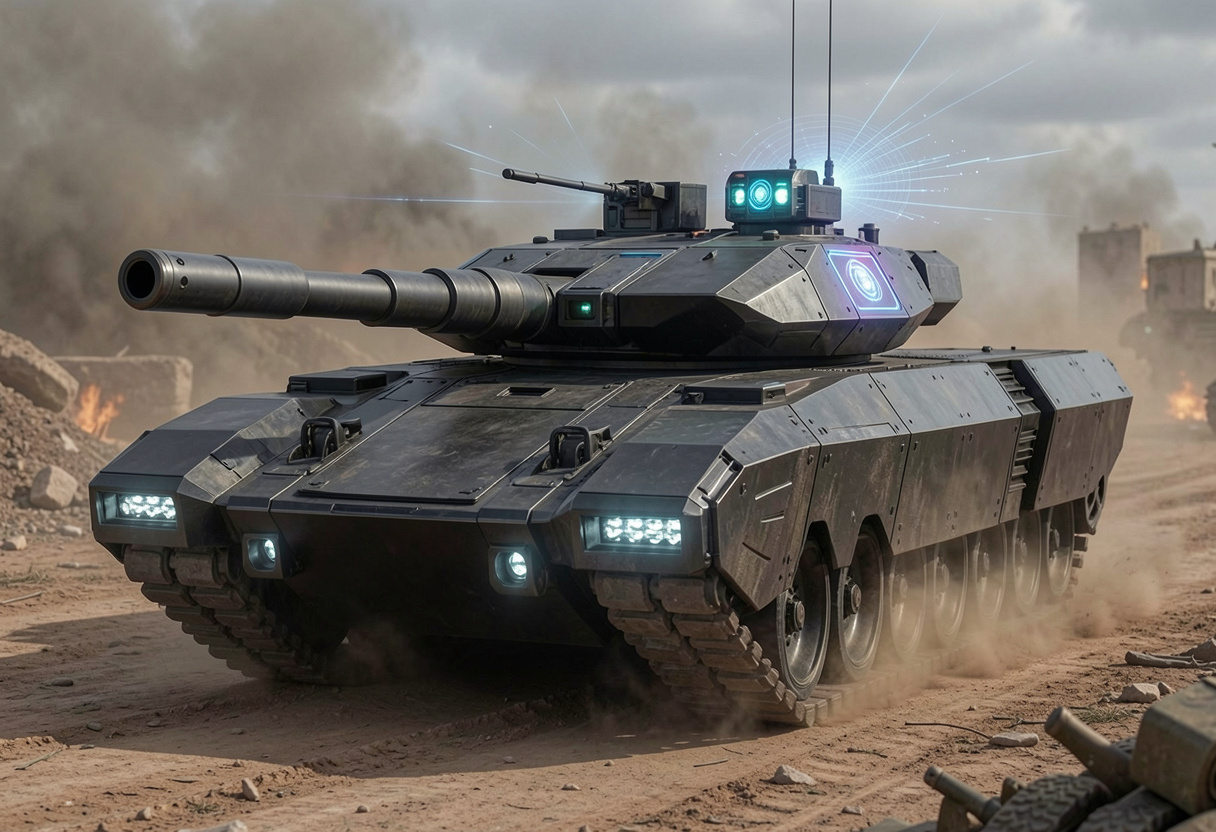
The smartest weapon of war

in Popular STEM15 hours ago

The smartest weapon of war


IA


What would you do if you discovered that technology is driving the greatest military race of the century and that perhaps it is already underway, and almost no one has noticed, without explosions, without tanks in the streets, without dramatic headlines, because in the laboratories of China and the United States, a new generation of machines is being trained to operate in scenarios of war, defense and strategic control.


They are not just robots, they are systems that do not feel afraid, do not get tired, analyze thousands of variables per second and make decisions in milliseconds, the military dispute of 2026 does not revolve solely around bombs or missiles, it revolves around artificial intelligence, on the one hand, the United States is committed to deep technological integration.


Companies like NVidia help create virtual environments where machines are trained before even entering the real world, instead of programming each movement manually, engineers build simulations where robots learn on their own to navigate, react and cooperate, they don't receive orders to run, they learn to run.


And at the same time the Pentagon is accelerating projects that involve swarms of autonomous drones, coordinated groups of machines capable of saturating traditional defenses and acting together with a speed impossible for human operators, but on the other side of the board, China plays a different game, while Washington seeks the maximum sophistication Beijing offers through industrial scale.


With enormous manufacturing capacity and an integrated production chain, the country manages to quickly transform civilian thefts into experimental platforms, test mass versions and reduce costs at an aggressive pace. That matters more than it seems, because in technological disputes the one who creates first does not always win, many times the one who produces thousands wins. International reports indicate a growing interest in AIs capable of coordinating synchronized attacks, automatic logistics and distributed decision making.


Tasks that would overload human commanders in real combat, but there is an even more delicate point, when autonomous systems begin to identify threats, prioritize objectives and react alone, a global ethical line begins to fade. Who is going to answer for a future mistake? Because there will be mistakes.


Who controls an escalation initiated by algorithms? Who stops a machine that calculates war faster than diplomats calculate peace? And the most important phrase may be simple. Whoever masters intelligence applied to conflict can redefine the balance of the planet?


We haven't seen battles between armies of robots yet, but perhaps we are seeing something more decisive, their silent construction. The world used to have big guns, now it's starting to fear smarter guns. Only for now no robot thinks for itself, behind every intelligent machine there is an even bigger dispute.


Sort:  

Congratulations!

Your post has been selected and upvoted by the SteemPro Team 🚀

Explore more on SteemPro:
🌐 https://www.steempro.com
🎮 Play SteemHeights: https://www.steempro.com/games/steem-heights
💬 Join our Discord: https://discord.gg/Bsf98vMg6U

💪 Supporting the growth of the Steem ecosystem together.

🟩 Vote for witness faisalamin:
https://steemitwallet.com/~witnesses
https://www.steempro.com/witnesses#faisalamin

steempro-cover-black.png
This is an automated message.