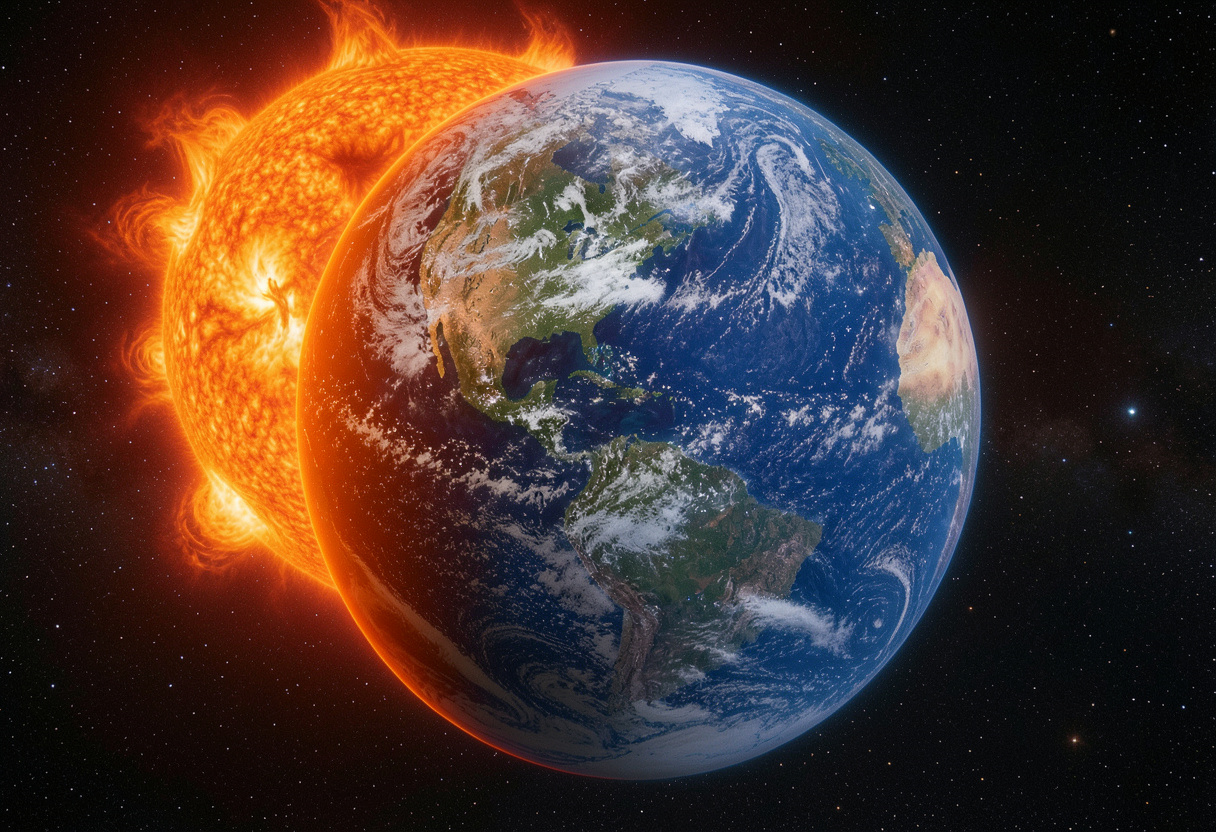
Earth's perihelion and aphelion

in Popular STEM2 days ago

Earth's perihelion and aphelion


On July 6, 2026, Earth reached aphelion during its orbit around the Sun—the point where it is farthest from our star and also traveling at its slowest speed. You may well have learned about this in school or heard it mentioned in a documentary. You might also have heard it noted as a paradox that summer in the Northern Hemisphere occurs precisely when Earth is farthest from the Sun.


In reality, however, distance is irrelevant; the seasons are determined by the 23-degree tilt of Earth's axis, which causes variations in daylight hours. This factor, combined with ocean currents and geographical features—such as mountains and vast landmasses—is what truly shapes the climates of Earth's various regions. It is a lovely, simplified, and accurate explanation, yet it glosses over certain details—some intriguing, others rather grim due to their impact on human health.


Aphelion does not always occur on the same day of the year; it varies from year to year, but it falls within the window of July 3 to July 6. In 2026, it occurred on July 6 at 17:30 Coordinated Universal Time—approximately 13:30 in Chile and Argentina (and Miami), 12:30 in Mexico, and 19:30 in Madrid. At that moment, the Sun was 152,877,774 km away from Earth. That is 2,487,774 km farther than the average distance between the Sun and Earth, or about six and a half times the distance separating Earth from the Moon.


This is the first of two crucial details in this story. On that July 6, we will be nearly 5 million kilometers farther from the Sun than at the point of closest approach—known as perihelion—which in 2026 occurred on January 3. Incidentally, these distances are measured from the center of the Sun. The solar radius is nearly 700,000 km.


Aphelion is also the point in our orbit around the Sun where we travel the slowest, whereas at perihelion, we travel the fastest. The difference is 1 km per second—which might not sound like much, but it amounts to a difference of 3,600 km/h. Together, these two factors—distance and speed—result in Northern Hemisphere summers being slightly milder and longer than those in the Southern Hemisphere (I say "milder" in terms of the average). Of course, local climates can vary from region to region due to the factors I mentioned earlier, such as geography, ocean currents, and so on.


But on average, summers in the Northern Hemisphere are slightly milder. In the Northern Hemisphere, summer lasts about 93 to 94 days; the Earth moves more slowly because this period coincides with aphelion, making the season last a little longer. Winter is slightly shorter—89 days—because the Earth moves faster, coinciding with perihelion. The situation is the reverse in the Southern Hemisphere: summer is shorter (89 days) and winter is longer (93 or 94 days).


As for the difference in heat received by Earth and its effect on the climate, it is very small—minuscule, in fact. As I mentioned earlier, it slightly moderates summers and winters in the Northern Hemisphere on average; this is because the effect is diluted by ocean currents and the geographical differences between the two hemispheres. There are crucial factors at play. For instance, while the North Pole is situated over an ocean, the South Pole sits atop a continent, creating Earth's largest ice sheet. Consequently, it is colder at the South Pole than at the North Pole.


We are fortunate, because the situation regarding these differences—the distance gap between aphelion and perihelion—has not always been this way. There were times when the eccentricity of Earth's orbit was greater; compared to the current 5-million-kilometer difference, there were periods when the gap was 15 or possibly even 20 million kilometers. Earth's orbit varies over millions of years, shifting from a circular shape—which is the direction we are currently heading—to a much more elliptical one. This follows Milankovitch cycles; specifically, we undergo two cycles—one lasting about 100,000 years and another 400,000 years—driven primarily by the gravitational influence of the gas giants Jupiter and Saturn.


This implies that when the orbit is more elliptical, Earth can experience a variation of approximately 20% in the amount of solar radiation received between the point of closest approach to the Sun and the point where it is farthest away. Consequently, one hemisphere would experience much hotter summers and much harsher, colder winters—depending on where the perihelion occurred—a situation amplified by the effects of Earth's axial tilt, which contributes to the formation of ice ages.


The images without reference were created with AI
Thank you for visiting my blog. If you like posts about #science, #planet, #politics, #rights #crypto, #traveling and discovering secrets and beauties of the #universe, feel free to Follow me as these are the topics I write about the most. Have a wonderful day and stay on this great platform :) :)


! The truth will set us free and science is the one that is closest to the truth!


Sort:  

Congratulations!

Your post has been selected and upvoted by the SteemPro Team 🚀

Explore more on SteemPro:
🌐 https://www.steempro.com
🎮 Play SteemHeights: https://www.steempro.com/games/steem-heights
💬 Join our Discord: https://discord.gg/Bsf98vMg6U

💪 Supporting the growth of the Steem ecosystem together.

🟩 Vote for witness faisalamin:
https://steemitwallet.com/~witnesses
https://www.steempro.com/witnesses#faisalamin

steempro-cover-black.png
This is an automated message.