The second country in history to recover an orbital rocket booster.
in Popular STEM9 hours ago

The second country in history to recover an orbital rocket booster.


Souce


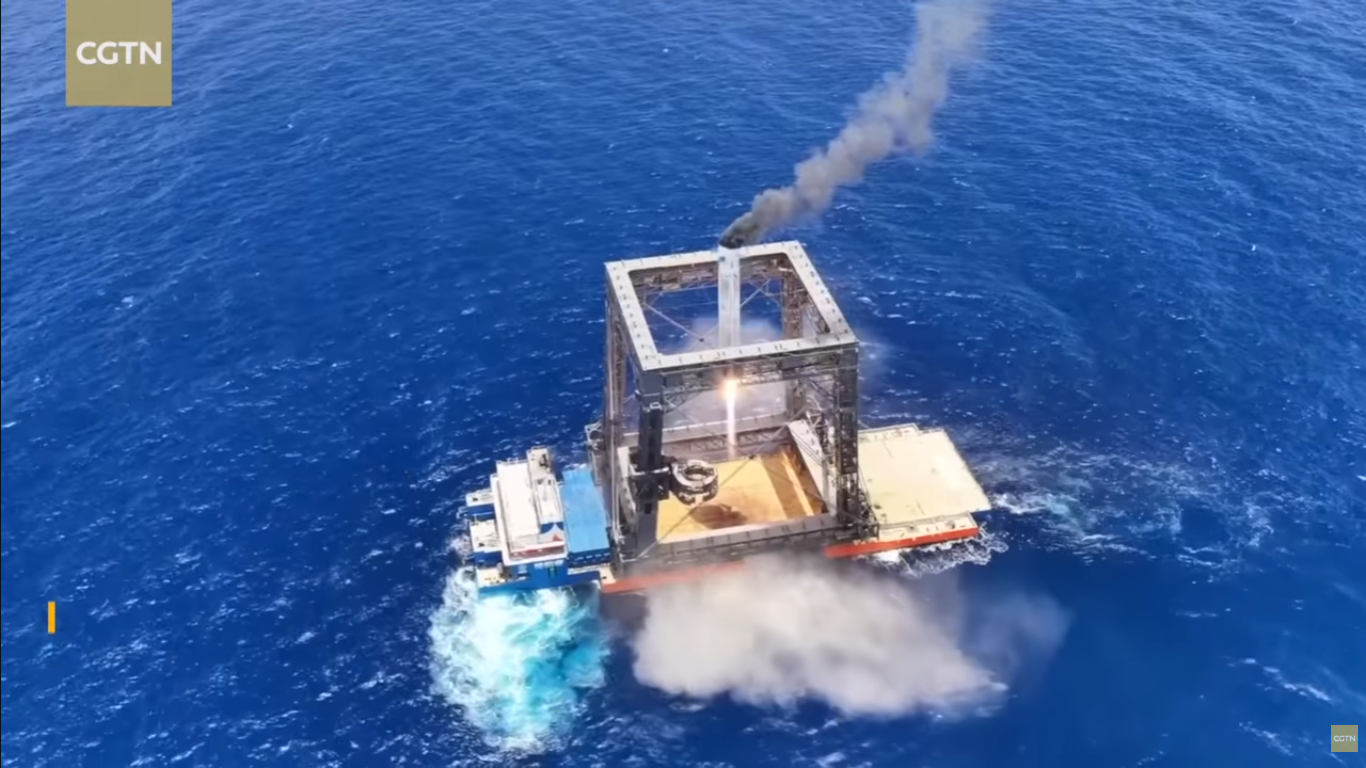
This took place on July 10; China became the second country in history to recover an orbital rocket booster. It involved the Long March 10B, which successfully completed its maiden flight from Hainan, placing a satellite into orbit; its first stage returned and was recovered using a net-and-cable system aboard a ship, the *Yangang ZE*.


The ship measures 144 meters in length and weighs 25,000 tons. The key point is that China is the second nation to achieve this—following the United States and SpaceX—but the system differs; the landing mechanism isn't like SpaceX's—which uses "chopsticks" (or mechanical arms) to catch the rocket—but rather relies on these cables.


The Long March 10 family comprises three variants: one using kerosene and oxygen for crewed missions (designed to launch Chinese astronauts to the Chinese space station); the 10B version (the one used here), which mixes Kerolox in the first stage and Methalox in the second; and the 10C, which will run entirely on Methalox. The Methalox configuration is particularly interesting because it uses liquid methane and oxygen—the same fuel type SpaceX uses and the propellant that will power the massive Long March 9 currently in development. Although the "9" might sound like an earlier model, it is actually a later, more advanced vehicle than the "10."


Clearly, this represents competition for SpaceX—as you can see, the capture system is completely different—and China possesses tremendous ambition to press ahead; they are going to build the Long March 9. In other words, the "10" is smaller—the one we saw earlier—whereas the "9" will be a colossus standing 110 to 114 meters tall.


SpaceX’s approach is more practical; the "chopsticks" system enables a launch cadence that is 1,000 times higher. Instead of using barges, the rocket is caught and positioned for reuse right at the launch site itself. In contrast, a ship-based recovery requires transporting the rocket to the facility, unloading it, prepping it, and mounting it back onto the launch pad.


These Chinese rockets will enter into competition; it is a race driven by the many satellite services currently in development—and those yet to come—as well as the future space stations, laboratories, and factories that will be built in space. We will see all of this unfold over the coming decades. In the next decade alone, we will see multiple space stations, not just one; the United States—or rather, NASA—has a different plan, as there will no longer be a single International Space Station.


The dream of the International Space Station—with nations united in a shared space project—is destined to become a thing of the past. The current station is set to be de-orbited in 2030, and there won't be another one quite like it; instead, NASA plans to lease space on private space stations, a strategy that the European Space Agency and others appear poised to adopt as well.


While a multinational station might still be built, the trend for the coming decade points toward the construction of multiple private space stations, with space agencies contracting room in these modules to conduct their experiments. In fact, several companies are already developing projects and modules for such stations. So, the era of the International Space Station—symbolizing global unity for the good of humanity—is, unfortunately, coming to an end.


The images without reference were created with AI
Thank you for visiting my blog. If you like posts about #science, #planet, #politics, #rights #crypto, #traveling and discovering secrets and beauties of the #universe, feel free to Follow me as these are the topics I write about the most. Have a wonderful day and stay on this great platform :) :)


! The truth will set us free and science is the one that is closest to the truth!