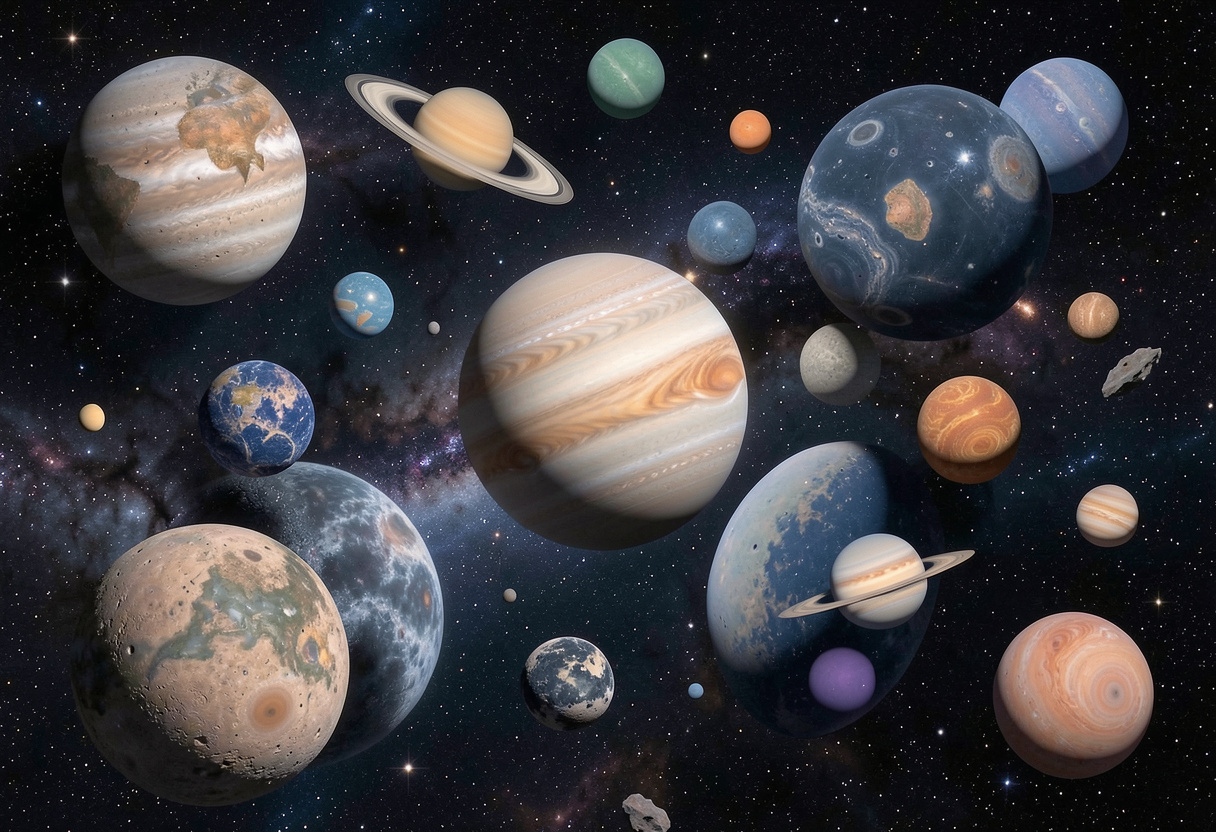
Travel outside planet Earth.

in Popular STEM2 days ago

Travel outside planet Earth.


Most exoplanetary worlds are very far away, even Mars is currently very far away, but that can change, try to see a little perspective, human life is short, but even if it is short, if we see this in perspective of a century that within the scale of human life, it can fit within the memory of our ancestors, a century ago thinking about traveling to the Moon was something unimaginable for people, by the way, today we return to the Moon after 50 years, the launch. It was a success, a big one for those involved.


And all thanks to scientists and people who imagined this fact as something possible, especially scientists who speculated with the theory of being able to travel to the Moon and the expansion of humanity, but I believe that until the 1920s, rockets were not launched that had the theoretical capacity to be able to expand and create the rockets that have now allowed us to travel to or send instruments to Mars, to the Moon and in the case of the Apollo missions to take humans to the moon, but everything is an evolution, and spaceships do not escape it, in fact, because The nuclear ship that NASA is preparing to travel to Mars is very promising, it is a prototype that can scale and end up developing something prodigious, such as a colonial ship to travel to other exoplanets.


And we are in the moment in a magical moment, we are in the magical moment of discovering those new worlds, of discovering those objectives, we may not be able to travel, none of us who are reading this publication right now, none of us may be able to travel to them, although I think so, I think that people who are under 20 years old may have a chance, that may happen, but at least no one is going to take away the pleasure of discovering those new worlds and naming them.


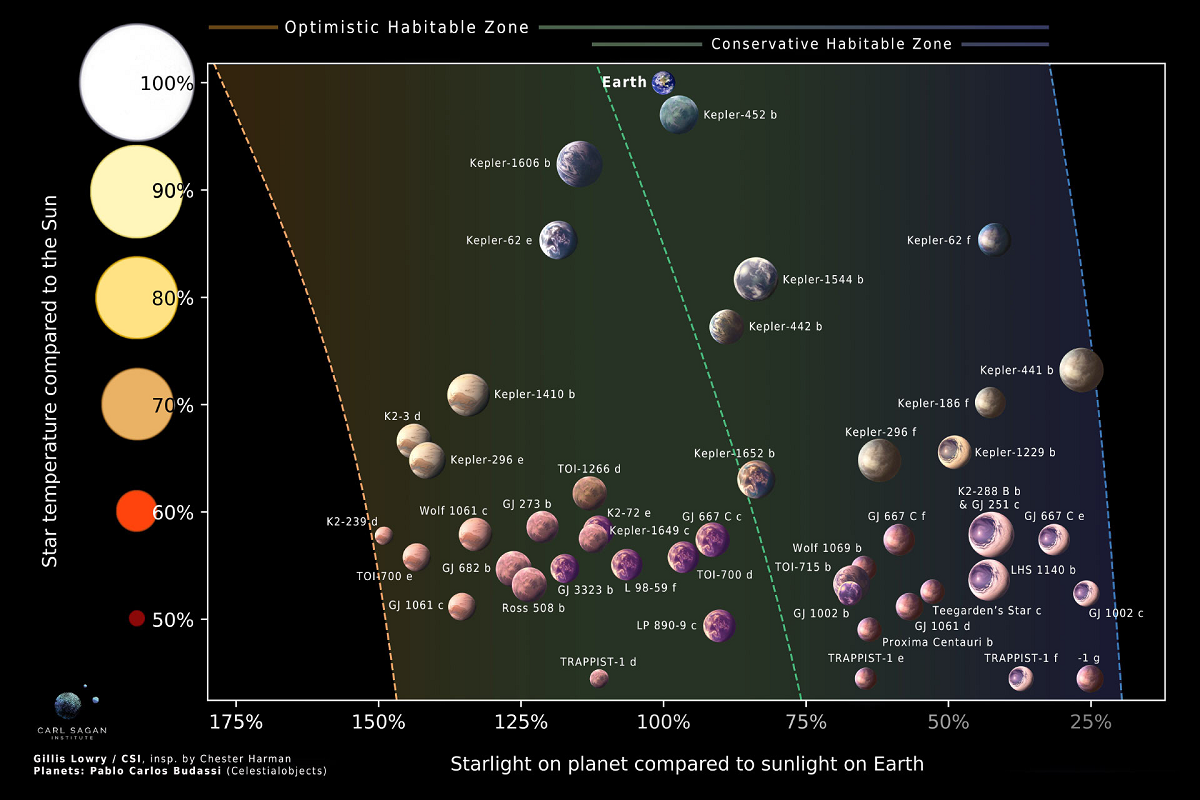
And there are 45 magnificent worlds, it has recently been published in a catalogue, the 45 worlds selected from the little more than 6000 exoplanets discovered to date, which would be in the habitable zone and which would have the possibility of having life or being habitable by perhaps a human colony that reached them, the researchers limited their list of planets to rocky planets, this is an important detail, they do not include aquatic worlds or oceanic worlds like the famous one. K218v, that tiny world K218B, which a little over a year ago, a biosignature was detected in its atmosphere.

A biosignature is a gas produced by life forms, in this case it coincided with a gas produced here on Earth en masse by basically marine life forms, and of course, this era is an aquatic world or it has all the qualifications to be an ocean world, basically because they have been debating for a year because there is a percentage of chance that the same gas can be produced by natural reactions and then here is the thing. The issue of biosignatures is still under debate, let's be honest, there is still no rule that tells us that this gas in this quantity is a biosignature and if we detect this gas in this quantity, in this world with these characteristics, there is life there, that time will come when we have that list and we can determine it with this certainty of what I just told you right now, but at the moment there is a tremendous debate about what is a biosignature, what is not a biosignature, because it also happened with Venus.


A biosignature was detected in the clouds of Venus which could indicate that bacteria could potentially have survived in the upper atmosphere of Venus. I remind you that around 45 to 60 km high the atmosphere of Venus is very dense and very hot with sulfuric acid rain, but there is a layer of atmosphere where the atmospheric pressure is similar to the atmospheric pressure on Earth and the temperatures are also similar around 30º, it is even believed that there is a little bit of humidity, water vapor and what has happened is a scientific saga of findings, denials and new evidence since 2020.


Souce A diagram depicting habitable zone boundaries across star type with rocky exoplanets


And by the way, when referring to an ocean planet, we are not talking about a planet like the Earth that has oceans, it is a planet that is globally covered by water, a large part of these worlds is made up of water, they are oceans, in principle, which can be more than 100 km deep, I say in principle because at certain pressures the water begins to behave in curious ways, so I tell you that no, it is a different composition, although with a tremendous amount of water, this does not mean that the water does not also have elements, materials that can promote the development of life in those worlds.


And the fact is that with the catalog prepared by Cornwell University in the United States of rocky planets similar to Earth, the possibilities of searching for life and possible trips to the nearest exoplanets are opened, this of course within centuries, all of them are found in the habitable zone of their stars, not all of them ideal, because most of the selected planets are in red dwarf stars, well, their special characteristics where their problem is that since they live so long, their juvenile and stormy stage is also very long and the juvenile stage and stormy of these stars because it causes very powerful calls.


This problem causes that the habitable area, being colder stars, is much closer to the star, but much closer, closer than Mercury is to the Sun, this has the disadvantage that, if the star has powerful flares because it is unstable, it will be constantly scorching those planets, as is happening with Proxima Cintauri, the star closest to us, which is a red dwarf, has very powerful flares and is chirping the rocky planet it orbits, If it weren't for that it would be within the habitable zone, then there is the other problem and that is that being so close to the star they are tied by tidal forces and this implies that there is one hemisphere that is always looking at the star and another hemisphere that is completely at night forever and ever, it is a bit like what happens to the Moon, which always has one hemisphere looking at the Earth.


The point is that they have identified 45 planets and of them 24 are in a more conservative habitable zone, not all of these 24 are in red dwarfs, there are four that are not, which would be in stars more similar to the sun, so within what is possible there is room to study this matter, because the point is that this catalog is made to point our most powerful telescopes such as the James Web and the next ones that will be towards these worlds and try to characterize the atmosphere they have, look for those biosignatures and also look for possible technosignatures.


Study Source


The images without reference were created with AI
Thank you for visiting my blog. If you like posts about #science, #planet, #politics, #rights #crypto, #traveling and discovering secrets and beauties of the #universe, feel free to Follow me as these are the topics I write about the most. Have a wonderful day and stay on this great platform :) :)


! The truth will set us free and science is the one that is closest to the truth!


Sort:  

Congratulations!

Your post has been selected and upvoted by the SteemPro Team 🚀

Explore more on SteemPro:
🌐 https://www.steempro.com
🎮 Play SteemHeights: https://www.steempro.com/games/steem-heights
💬 Join our Discord: https://discord.gg/Bsf98vMg6U

💪 Supporting the growth of the Steem ecosystem together.

🟩 Vote for witness faisalamin:
https://steemitwallet.com/~witnesses
https://www.steempro.com/witnesses#faisalamin

steempro-cover-black.png
This is an automated message.

Coin Marketplace

STEEM 0.06
TRX 0.32
JST 0.062
BTC 67215.18
ETH 2054.02
USDT 1.00
SBD 0.48