Voyager 1's eighth instrument turned off
in Popular STEMyesterday

Voyager 1's eighth instrument turned off


Souce


Every approximately 175 years, and sometimes 176, Jupiter, Saturn, Uranus and Neptune align in such a way that a ship can visit the four giant planets using gravitational assists. This alignment does not mean that we see them in a straight line, it is not a typical conjunction. 1977, they took advantage of that very rare planetary alignment to make their multi-year trip to Jupiter, Saturn, Uranus and Nepuno, which also, by the way, Uranus and Neptune are the only two ships that have visited them so far, because I don't think the new horizons have passed there.


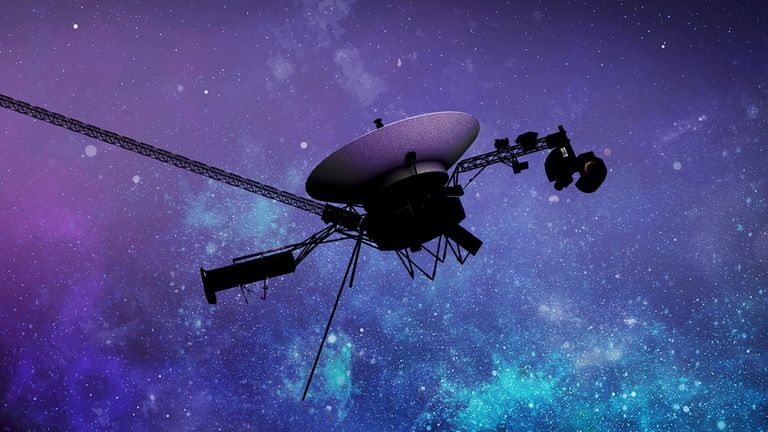
On April 17, NASA published a statement saying that it had to turn off an instrument on Voyager 1. The ship was launched in 1977 and was in space for 49 years. Specifically, it explored Jupiter in 1979 and Saturn in 1980, receiving the gravitational pushes of these two giant planets. Parker Solar Probe.


The point is that this ship managed to take photos of the moons of Saturn, of Jupiter, well, of the rings of Saturn, of its fields, it obtained data on the magnetic fields of these planets, it obtained the first images of the active volcanoes of IO and also detailed images of the dense atmosphere of Titan, thanks to its pushes it is the most distant human-made object in history, it surpasses its twin, the Vogager 2. The Vogager 1 is currently located 172 astronomical units, an astronomical unit is the distance that separates the Earth from the Sun or in kilometers it would be about 25.8 billion kilometers, which is not bad, and it continues to move away from us at about 17 km per second, in fact, in November a milestone will occur and that is that in November of this year the probe will reach the light day distance, that is, the radio signal will take 24 hours to arrive and another 24 to return, this can be done because It has an antenna more than 3 m long and because its signal is directed towards the Earth.


If it moved a little, or if it lost orientation, we would not be able to capture the Vogager's signals, which are also quite weak. To capture them you need a huge radio telescope and the Vogager would not be able to capture the command signals from the Earth either, so it needs to be perfectly oriented. If Voyeger could see the Earth in detail, it would see us as we were a day before, which is quite curious.


The instrument that they had to turn off measured low-energy charged particles, ions, electrons, cosmic rays in the interstellar medium, which seems a bit boring, but it served, for example, to know that the ships, one and two, are already in the interstellar medium, this causes a bit of confusion because they say that they have left the solar system, they have left the heliosphere, the heliosphere is the area where the influence of the solar wind reaches, it would be like the atmosphere of the Earth, when A ship travels towards the Moon, leaves the Earth's atmosphere and is in space, but it does not abandon the gravitational influence of the Earth, because in fact the gravitational influence of the Earth is what allows the Moon to orbit the Earth, the same thing happens with the solar system.


These two ships have left what would be the solar atmosphere as far as the solar wind reaches and are now sailing through interstellar space, the same space that separates the stars, but gravitationally they are still within the solar system and they will be for a long time. The point is that they have had to deactivate this instrument because the ship is losing energy, little by little it is losing energy. The ship works, like its twin, thanks to three thermoelectric generators powered by plutonium 238, a total of about 4 kg in 24 spheres, it is a material that disintegrates slowly, producing less and less electricity, it loses about 4 W a year and obviously there is no way to go and place new spheres to recharge, so it will end up turning off.


It is the eighth instrument that is deactivated from Vogager 1, it is expected that the ship can continue operating with at least one instrument, sending some data of what it finds, seeing, not because the cameras should not work anymore, but at least the data that it is collecting, it is believed that until 2030 and depending on the maneuvers that the engineers can do to save a little energy here and there or how good or quality the plutonium balls were, it could have energy until 2036. But beyond 2036, the ships will turn off and they will only be two pieces of metal traveling through space, but they have given us a lot.


Source


The images without reference were created with AI
Thank you for visiting my blog. If you like posts about #science, #planet, #politics, #rights #crypto, #traveling and discovering secrets and beauties of the #universe, feel free to Follow me as these are the topics I write about the most. Have a wonderful day and stay on this great platform :) :)


! The truth will set us free and science is the one that is closest to the truth!