They get mouse brain tissue to regain functional activity after being vitrified at -196 °C/Consiguen que tejido cerebral de ratón recupere actividad funcional tras haber sido vitrificado a -196 °C

Source
Although it seems to have been forgotten now, at least by the general public, there was a time a few decades ago when it became fashionable to "freeze" the bodies of the wealthy, hoping to revive them in a future where medicine could bring them back to life. Perhaps the most famous case was that of Walt Disney, whose body was rumored to have been cryogenically frozen for this purpose, but it seems that it was all just an urban legend. In any case, it appears that the trend hasn't completely disappeared.
Aunque ahora parece que ya se ha olvidado, al menos por parte del gran público, hubo un tiempo hace unas décadas en que se puso de moda "congelar" los cuerpos de los económicamente poderosos, en espera de poder volverlos a la vida en un futuro en el que la medicina pudiese volverlos a la vida. Quizá el caso más famoso haya sido el de Walt Disney, de quien se dijo que su cuerpo había sido criogenizado con este fin, pero finalmente parece que todo ha sido una leyanda urbana. En cualquier caso, parece que la moda no ha desaparecido del todo.
Along these lines, a team from the University of Erlangen-Nuremberg (Germany) has succeeded in restoring functional activity to mouse brain tissue after it has been vitrified at -196 °C. The study demonstrates that it is possible to recover key functions of the hippocampus (the brain region associated with memory and learning) after a freezing process at cryogenic temperatures. The key lies in vitrification. Unlike traditional freezing, where ice crystals form that pierce and destroy delicate cellular structures, vitrification transforms the tissue into a glassy, vitreous state.
En esta línea, un equipo de la Universidad de Erlangen-Núremberg (Alemania) ha logrado que tejido cerebral de ratón recupere actividad funcional después de haber sido vitrificado a -196 °C. El estudio demuestra que es posible recuperar funciones clave del hipocampo (la región del cerebro asociada con la memoria y el aprendizaje) después de un proceso de congelación a temperaturas criogénicas. La clave está en la vitrificación. A diferencia de la congelación tradicional, donde se forman cristales de hielo que perforan y destruyen las delicadas estructuras celulares, la vitrificación convierte el tejido en un estado vítreo, similar al vidrio.

Source
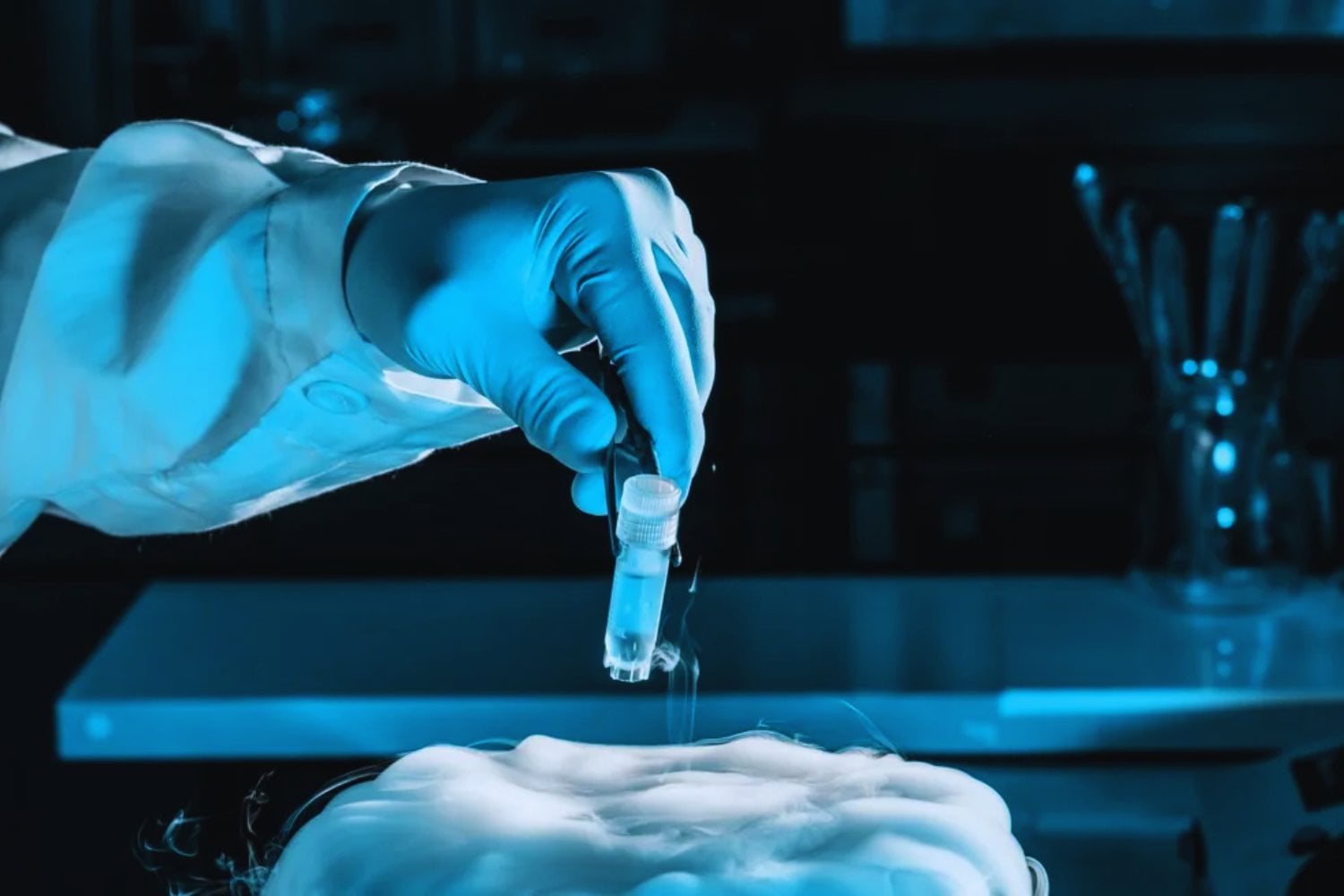
To achieve this, the water in the cells is replaced with a solution of cryoprotectants (such as DMSO, formamide, and ethylene glycol). The tissue is then cooled at an extreme rate using liquid nitrogen (-196 °C). This prevents the water molecules from having time to organize into ice crystals, leaving them fixed in a disordered, glass-like state. The "thawing" process is also critical; it is carried out gradually using specific solutions to remove the cryoprotectants and prevent damage from osmotic stress or the formation of ice crystals during rewarming.
Para lograrlo se reemplaza el agua de las células por una solución de agentes crioprotectores (como DMSO, formamida y etilenglicol). El tejido se enfría a una velocidad extrema usando nitrógeno líquido (-196 °C). Esto impide que las moléculas de agua tengan tiempo de organizarse en cristales de hielo, quedando fijas en un estado desordenado, similar al vidrio. El proceso de "descongelación" también es crítico, se realiza de forma gradual y con soluciones específicas para eliminar los crioprotectores y evitar daños por estrés osmótico o la formación de cristales durante el recalentamiento.
The result was that, after thawing, the hippocampal neurons not only maintained their structure but also regained their ability to generate electrical and metabolic activity. Specifically, long-term potentiation (LTP), the cellular mechanism underlying learning and memory, was preserved. This achievement is a major step forward, but it is important to understand its scope and limitations. The study opens several promising avenues, but the "resurrection" of entire organisms remains science fiction.
El resultado fue que, tras la descongelación, las neuronas del hipocampo no solo mantuvieron su estructura, sino que recuperaron su capacidad de generar actividad eléctrica y metabólica. Específicamente, se conservó la potenciación a largo plazo (LTP) , que es el mecanismo celular que subyace al aprendizaje y la memoria. Este logro es un gran paso, pero es importante entender su alcance y sus limitaciones. El estudio abre varias puertas prometedoras, pero la "resurrección" de organismos completos sigue siendo ciencia ficción.
Source
This is a crucial step toward the cryopreservation of whole organs for transplantation. If the technique can be scaled up to human organs, hearts, livers, or kidneys could be stored indefinitely, eliminating waiting lists and allowing for better donor-recipient compatibility. In the long term, this research could lay the groundwork for preserving the brain after trauma or serious illness, "buying time" for doctors to treat it. But we must be cautious because challenges remain.
Este es un paso crucial para la criopreservación de órganos completos para trasplantes. Si se puede escalar la técnica a órganos humanos, se podrían almacenar corazones, hígados o riñones de forma indefinida, acabando con las listas de espera y permitiendo una mejor compatibilidad donante-receptor. A largo plazo, esta investigación podría sentar las bases para preservar el cerebro tras un traumatismo o enfermedad grave, "ganando tiempo" para que los médicos puedan tratarlo. Pero hemos de ser prudentes porque aún quedan retos por superar.
The technique has been successfully tested on thin slices of mouse brain and on whole mouse brains in situ, but scaling this process up to a whole human brain, which is thousands of times larger, presents enormous challenges. It is much more difficult to uniformly cool and heat a large organ without crystallization or cracking from thermal stress. The path from mouse to human is immense; significant advances in the formulation of (less toxic) cryoprotectants and in heating techniques will be needed to make this a reality in humans.
La técnica se ha probado con éxito en finas rebanadas de cerebro de ratón y en cerebros completos de ratón in situ pero, escalar este proceso a un cerebro humano completo que es miles de veces más grande, presenta desafíos enormes. Es mucho más difícil enfriar y calentar uniformemente un órgano grande sin que se formen cristales o se agriete por el estrés térmico. El camino desde un ratón hasta un humano es inmenso, se necesitarán avances significativos en la formulación de crioprotectores (menos tóxicos) y en las técnicas de calentamiento para que esto sea una realidad en humanos.
More information/Más información
https://www.zmescience.com/ecology/animals-ecology/mouse-brain-tissues-recover-key-activity-after-deep-freeze-but-cryonics-remains-far-off/
Researchers have successfully recovered an electrical signal associated with memory (LTP) from mouse brain tissue that had been stored using the method of vitrification (-196C). Applications to human brains face technical hurdles that must be overcome before use: maintaining uniform cooling/rewarming without fractures, mitigating damage due to cryoprotectant, and proving long-term recovery from vitrification. While these studies will have immediate applications with regard to organ banks for transplant, they will not be utilized for whole-body cryonics in the near term.
0.00 SBD,
0.77 STEEM,
0.77 SP