No one survives alone.

in Popular STEM22 hours ago

No one survives alone.


Image source:


Nowadays, people are obsessed with the end of the world, forgetting that the apocalypse has already occurred—and that we have overcome it several times. Perhaps the fear of the apocalypse exists because we know it has happened in the past and had to be surmounted; ultimately, these are challenges, and if we manage to overcome them, we take a step forward as a civilization—though, of course, I hope we never have to face an actual apocalypse.


Consider the current issue of earthquakes: imagine if we could overcome the threat they pose anywhere in the world—if we could actually predict them. It wouldn't just be about building earthquake-resistant structures, but about prediction. I believe that day will come, when we can issue an alert to the population—giving at least a few minutes' or even hours' warning before a major earthquake strikes. I think we will reach that point someday and advance as a civilization.


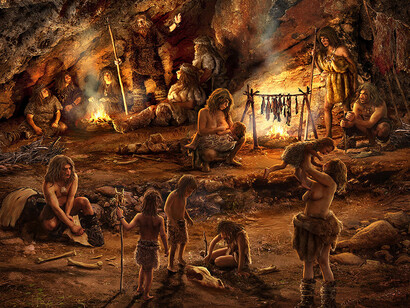
Just imagine the challenges our ancestors faced—*Homo sapiens* and Neanderthals—and the struggles between the species. Perhaps we prevailed because *Homo sapiens* were more numerous; a typical group or clan is estimated to have consisted of 30 to 50 people, whereas Neanderthal groups were smaller. Neanderthal clans likely numbered between 10 and 15 people, or at most 30 individuals in areas rich in fishing and hunting resources.


It is also believed that their capacity to create exchange networks was more limited—an important factor because, at a certain point, if you can trade, you can survive. For instance, if there is no game in your territory but you have high-quality flint for making spearheads, you can trade them for meat or food from a territory where hunting and fishing are productive. Without such exchange, however, you are done for.


There was a fundamental advantage.


There is also a key factor: nature makes no allowances for physical impairments or disabilities. An individual with a disability might be cast aside or eliminated. While it is *thought* that Neanderthals cared for their sick, what has been *confirmed* is that *Homo sapiens* did so. They cared not only for the sick but also for the elderly and for those with conditions from which they would not recover. After all, there is a difference between caring for someone who recovers in a few days or weeks and caring for someone who, for example, has lost a leg or an arm and whose foraging ability is consequently diminished.


However, in these larger *Homo sapiens* groups, other qualities were valued. Someone with a physical impairment or an elderly person might not be useful for hunting and might gather very little, yet they could be skilled at making tools, processing hides, or looking after children. This last point is crucial: if the mother is foraging and the father is hunting—or if both are hunting—who looks after the children? There were dangers like saber-toothed tigers and cave bears. The elderly could fulfill that role, even if they were no longer of reproductive age.


In other species, the norm is that once an individual reaches an age where it can no longer reproduce, it enters a period of rapid decline. Dental health, for instance, plays a major role here; it is a critical factor that often leads to death shortly thereafter. However, among *Sapiens*—our species—we cared for the elderly, enabling them to survive.


There is evidence—remains of elderly individuals who lacked teeth—showing that someone must have mashed their food so they could eat; they lived for many years. They likely possessed accumulated wisdom—remember, there were no computers or books back then. Someone who knew how things were done, where resources were located, or simply possessed the capacity for reflection to make decisions—they were essentially a living computer. So, caring for them was essential. I believe this detail was fundamental: it wasn't just about having larger groups, but about knowing how to derive value from individuals who would have perished in the wild—the elderly or those with disabilities—who ultimately proved to be valuable members of our group.


And I believe that was the fundamental advantage.


Follow my publications with the latest in artificial intelligence, robotics and technology.

If you like to read about science, health and how to improve your life with science, I invite you to go to the previous publications.


Sort:  

Congratulations!

Your post has been selected and upvoted by the SteemPro Team 🚀

Explore more on SteemPro:
🌐 https://www.steempro.com
🎮 Play SteemHeights: https://www.steempro.com/games/steem-heights
💬 Join our Discord: https://discord.gg/Bsf98vMg6U

💪 Supporting the growth of the Steem ecosystem together.

🟩 Vote for witness faisalamin:
https://steemitwallet.com/~witnesses
https://www.steempro.com/witnesses#faisalamin

steempro-cover-black.png
This is an automated message.