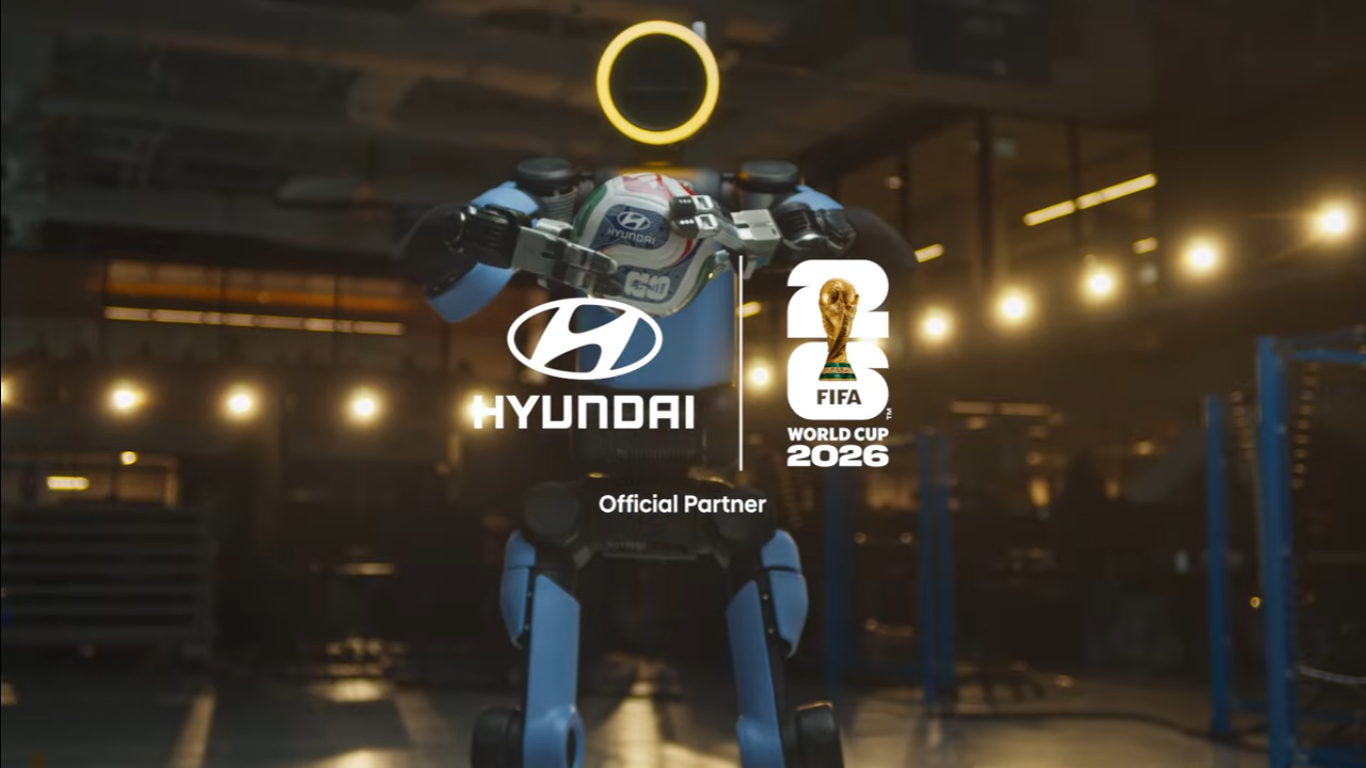
Now Atlas plays soccer.

Now Atlas plays soccer.


There is something curious about football, for a human being, dominating a ball seems natural, but behind every pass, every change of direction and every shot there is an extremely complex sequence of calculations that the brain performs without us realizing it, balance, strength, coordination, movement anticipation and constant adaptation, second violations happen.


And that is precisely why football has become one of the new training grounds for the physical intelligence of machines. In May 2026, Boston Dynamics introduced new experiments with the Atlas, its most advanced humanoid robot. The goal was not to transform him into a professional gamer, but to teach him something much more important, the ability to observe complex human movements and reproduce them adaptively in the real world.


At first glance, this may seem like just a technological curiosity, but what is being developed goes far beyond sports. In the coming years, space agencies and private companies plan to begin construction of the first permanent infrastructures outside of Earth. The Moon is no longer just an exploration destination to become a possible construction site, and in that hostile environment marked by reduced gravity and extreme temperatures and constant radiation, most of the heavy lifting will have to be done by robots.


The problem is that carrying materials, assembling structures and operating equipment in such a different environment requires much more than strength, it requires adaptation, a simple shift of weight can determine whether a machine remains stable or loses balance, a seemingly light object can behave in unpredictable ways when transported over uneven terrain. And it's exactly this kind of challenge that systems like Atlas are learning to solve.


The tests presented by Boston Dynamics, the robot analyzed human movements and reproduced complex patterns of body displacement, the focus was not on the ball itself, but on the way the body reacts to sudden changes in direction, weight distribution and fine control of movement. Behind this there is a technology called proprioception, it is the robotic equivalent of the sense that humans have of knowing where each part of the body is without having to look at it directly.


The Atlas continuously monitors your joints, applied forces and balance and physical resistance, creating a detailed perception of your own body. To achieve this result, Boston Dynamics used large-scale reinforcement learning. Before executing movements in the real world, Atlas accumulated millions of hours of training within virtual environments; in those simulations, engineers constantly altered the weight of objects, ground friction, and environmental conditions, forcing the robots to find new solutions with each attempt.


The result is a machine that not only executes programmed movements, but also learns to adapt when reality does not correspond exactly to what was expected. I think the real story behind these tests is different, football is just a tool, the final objective is much greater because the same physical intelligence that allows us to control a ball on a field will in a few decades be able to help build structures on the lunar surface, repair satellites in orbit or build the first permanent bases of humanity outside the Earth and if humans are sent along with these machines, we will need those to take care of us when an injury or illness appears.


Sorry for my Ingles, it's not my main language. The images were taken from the sources used or were created with artificial intelligence


Sort:  

Congratulations!

Your post has been selected and upvoted by the SteemPro Team 🚀

Explore more on SteemPro:
🌐 https://www.steempro.com
🎮 Play SteemHeights: https://www.steempro.com/games/steem-heights
💬 Join our Discord: https://discord.gg/Bsf98vMg6U

💪 Supporting the growth of the Steem ecosystem together.

🟩 Vote for witness faisalamin:
https://steemitwallet.com/~witnesses
https://www.steempro.com/witnesses#faisalamin

steempro-cover-black.png
This is an automated message.
