The AI ​​that teaches different robots

The AI ​​that teaches different robots


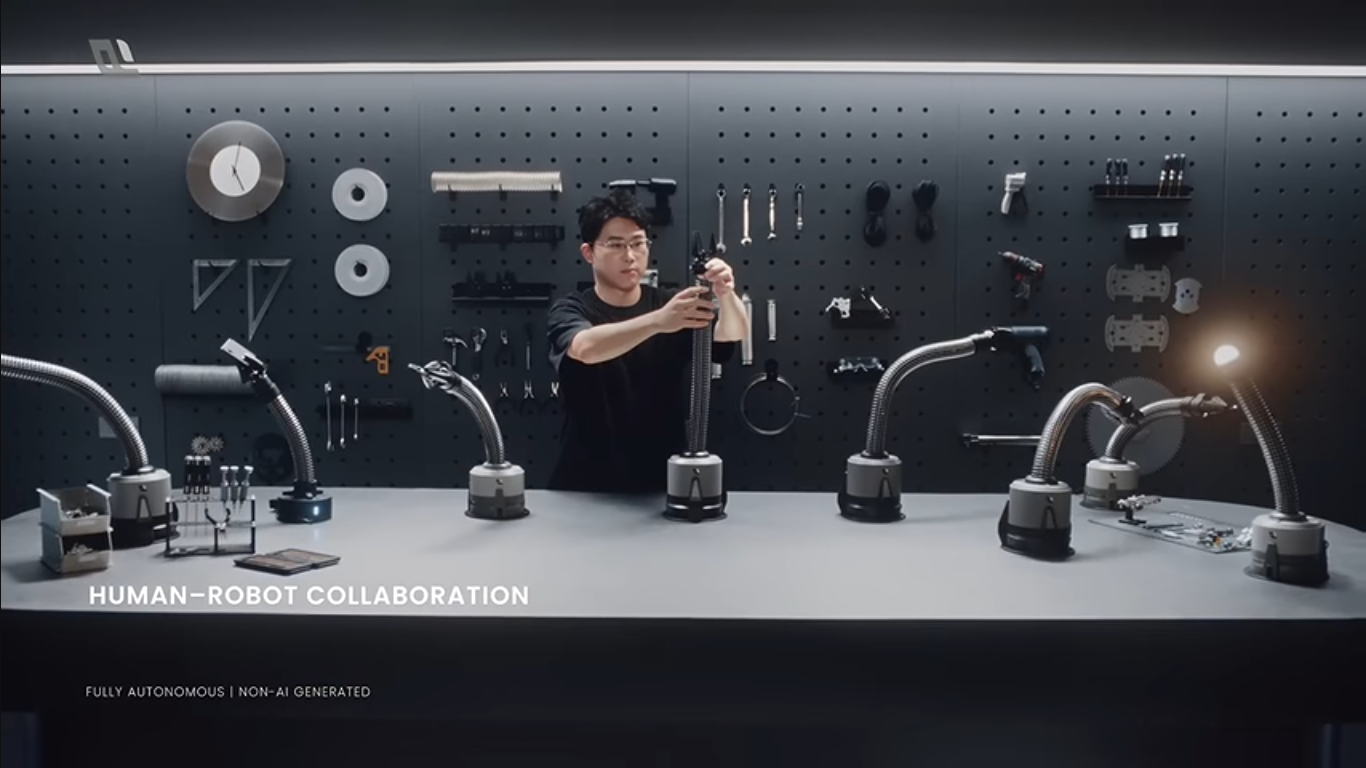
A Chinese startup called Feagine Robotics claims to have created a system that, when installed in a robot, does more than just learn how to move a specific arm; it learns the task's objective and automatically adapts its movements to any compatible mechanical structure. To demonstrate this capability, the researchers used three completely different robotic arms.


The first has only one flexible segment and two degrees of freedom; the second doubles that complexity with two articulated segments; and the third uses three continuous segments, seven degrees of freedom, and a structure resembling a tentacle more than a conventional arm. Despite these physical differences, all of them successfully performed tasks using the same artificial intelligence model. Instead of simply seeing motors and joints, the Fi0 system transforms the robot's entire body into a graph—a type of digital map describing how each part of the structure connects to the others. Consequently, when faced with a new mechanical configuration, the system does not need to relearn everything from scratch; it simply interprets the new body via that map and adapts its movements to the available format.


Another interesting feature is that training may require only a single human demonstration; if a novel task arises, an operator simply needs to perform it. Once the system observes the sequence of movements, it identifies the ultimate goal and calculates how to replicate that result using any other compatible robot—even one with a completely different anatomy. This approach effectively decouples intelligence from hardware.


To date, the industry has focused much of its investment on attempting to build the perfect humanoid—one capable of doing absolutely everything. However, Feagine Robotics is pursuing a different strategy: instead of a single universal robot, they envision a future made up of various specialized bodies. Some might use soft tentacles to manipulate delicate objects, others might employ industrial arms to lift heavy loads, and some could even operate high-precision surgical instruments. For them, the key is that all these robots share the same artificial intelligence.


Sorry for my Ingles, it's not my main language. The images were taken from the sources used or were created with artificial intelligence


Sort:  

Congratulations!

Your post has been selected and upvoted by the SteemPro Team 🚀

Explore more on SteemPro:
🌐 https://www.steempro.com
🎮 Play SteemHeights: https://www.steempro.com/games/steem-heights
💬 Join our Discord: https://discord.gg/Bsf98vMg6U

💪 Supporting the growth of the Steem ecosystem together.

🟩 Vote for witness faisalamin:
https://steemitwallet.com/~witnesses
https://www.steempro.com/witnesses#faisalamin

steempro-cover-black.png
This is an automated message.