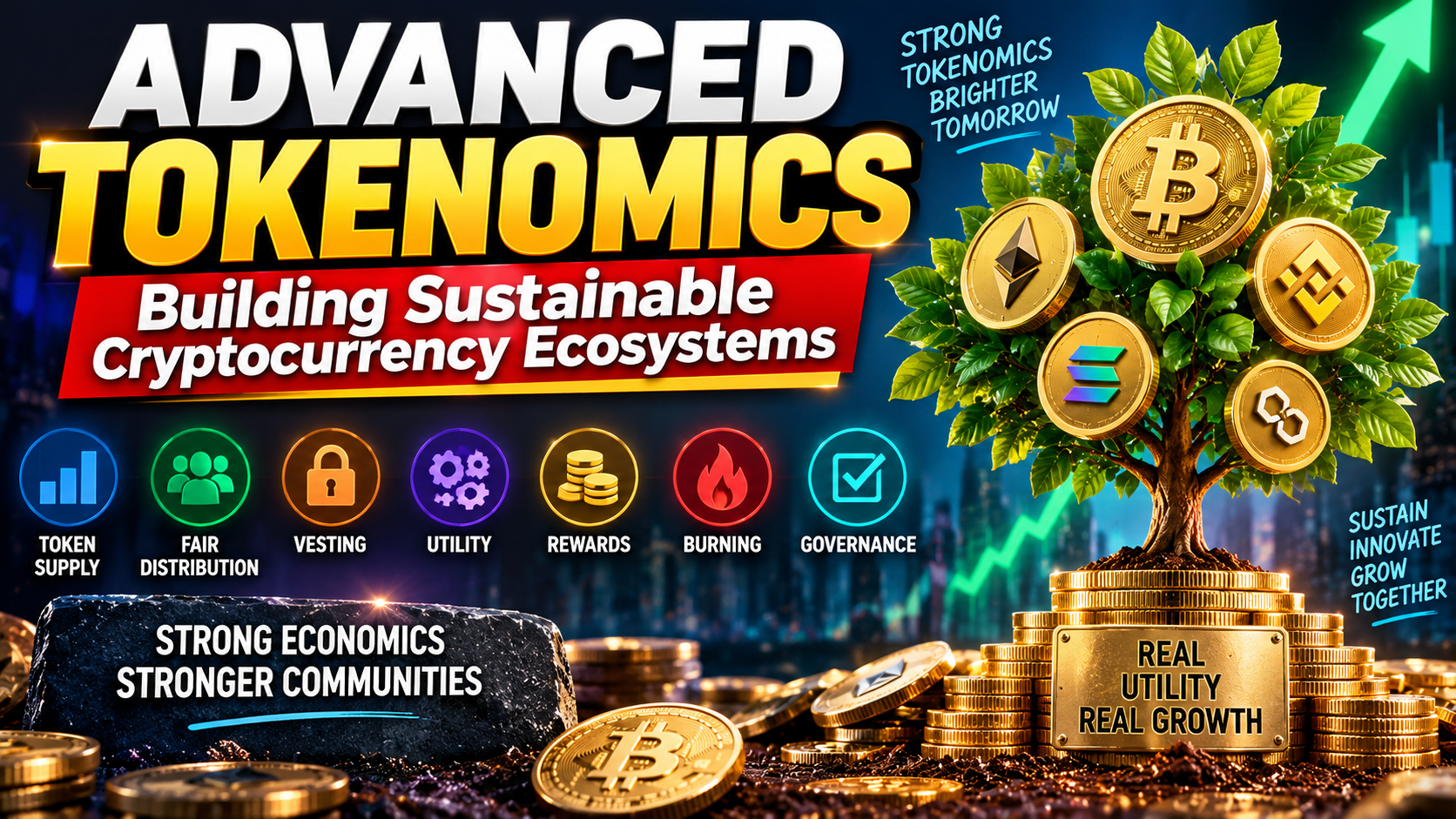
Advanced Tokenomics: Building Sustainable Cryptocurrency Ecosystems
Cryptocurrency has gained great popularity in numerous countries. There are new coins and tokens which are developed annually for various uses. Some are used for payments, some are utilized in blockchain ventures, and some are utilized for speculation. But there is more to it than just creating a new token to make a cryptocurrency. The project had to also have a good economic system behind it. This is where the tokenomics comes into play. The term tokenomics refers to the economic system of any cryptocurrency or token.
Advanced tokenomics is an in-depth analysis of the evolution of a token's creation, distribution, utilization, management, and control over time. It zeroes in on the methods of sustaining, expanding, and remaining valuable for a cryptocurrency project. A strong tokenomics can ensure that the project continues to be robust over the years, whereas a weak one can lead to the project's failure within a short period of time.
Among the most crucial aspects of tokenomics is token supply. Supply of token is the maximum number of tokens that are/available to be in existence. There are some cryptocurrencies that have a capped supply. In other words, just so many coins are permitted to be made. Bitcoin is a good example, as its total supply is capped. Other cryptocurrencies could enable new tokens to be minted over time.
The value of a token can be influenced by the quantity of supply. Overproduction of tokens without enough demand can lead to a drop in value. This is because there will be a lot of tokens out there. When the supply is small and the demand is high, the price would rise. I believe project developers have to be very prudent in determining the amount of their total supply. They should not generate too many tokens than what the ecosystem would need.
A critical aspect of advanced tokenomics is token distribution. A token distribution describes how the tokens are divided up between various individuals. Certain tokens can be sold to the project's founders, investors, workers, community and the general public. Importance of good distribution is that one small group should not have most of the tokens.
Too many tokens held by the founders or initial investors could give them excessive control over the project. They can also sell a lot of their tokens all at once, resulting in a drop in the price. This can take a bite out of normal investors. A viable crypto ecosystem should have equal distribution of rewards which means that everyone can be a part of it.
Vesting is also a crucial aspect of tokenomics. Vesting means that some tokens are locked for a certain period of time before the owners can sell them. Project founders, for instance, might be able to get hold of tokens, but they may not be able to sell all of the tokens at the same time. Some may be released after 1 year, others may be released over a period of several years.
Vesting can help to prevent a sudden sale of the project. It also makes the founders and developers stick with the project for long durations. I think it's critical to have the vesting in place since it will make it less likely that others will take quick profits and exit the project.
Utility is another critical component of a sustainable cryptocurrency ecosystem. Utility is the use of a token, which means the thing itself. There should be a clear why for a token. It should be used for something useful by people. For instance, a token can be employed to purchase services, pay fees, access specific features, vote about choices, acquire rewards, or be involved in a blockchain network.
If there's no real value in a token, people can just purchase it for the purpose that the price will go up. This can be hazardous as the project could be hyped up with no real substance. Once the buzz fades away, folks can cease purchasing the token, and prices can drop. A decent cryptocurrency ecosystem must provide users with tangible benefits in holding and using the underlying token.
Another crucial aspect of advanced tokenomics is token rewards. A few projects compensate users for their involvement in the network. Users can stake for example to earn tokens. Staking involves securing tokens in a network to aid its functioning. In exchange, players can win additional tokens.
Rewards can be a good way to get users, but they must be handled correctly. Too many rewards in a project could lead to an increase in the number of tokens issued. This can lead to inflation. Inflation in cryptocurrencies is the process of increased number of tokens being produced faster than their value, which might lead to lowering the value of every token.
To control inflation, some projects use token burning. Token burning is the process of removing a certain number of tokens from circulation. During a project, for instance, a portion of the revenue can be allocated to purchase tokens at the market and eliminate them. This decreases the amount of tokens. Sometimes burning tokens can aid the token valuation.
Governance is also crucial in the modern tokenomics. Governance provides an opportunity for token holders to participate in key decisions. They can vote for changes to the project, new features, new fees, or on spending money. This can help to involve the community in the project's success.
But governance also needs to be 'fair. If one individual or entity has a majority of the tokens, they can have majority of the votes. This may decrease the decentralization of the system. A good governance should aim to avoid the concentration of power in the hands of only a few individuals.
The liquidity is also a significant consideration. Liquidity refers to the ease with which tokens can be traded without that having a significant impact on the price. Good liquidity is associated with a high number of buyers and sellers of a cryptocurrency. This simplifies the trading process and can also put investors at ease.
A good ecosystem should also have a treasury. A treasury is the money held by the project for future development, marketing, security, partnership and other important activities. If the project's funds are consumed too rapidly, then the project could not have enough money for future operation.
https://x.com/Sloaneoluchi/status/2098825757136961930
https://coinmarketcap.com/currencies/pussfi/
https://x.com/i/status/2088342261742580216
Note:-
Regards, @adeljose