Blockchain-Powered Identity Management Systems and Digital Privacy Protection
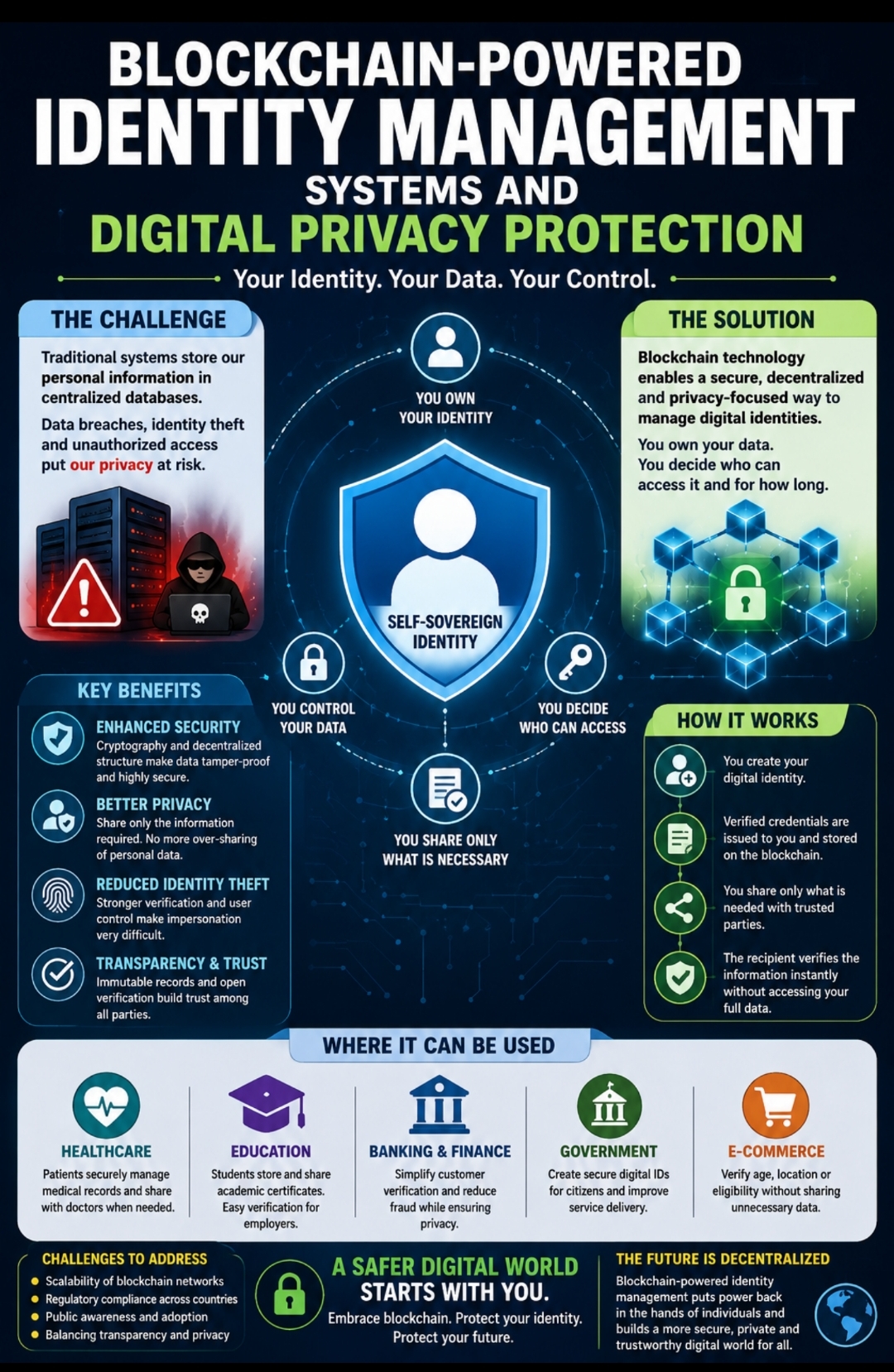
Today identity management is a critical issue in the digital world. Individuals rely on online services each day, including social media sites, banking apps, online education resources, health care platforms, and ecommerce sites. In order for them to access these services, they must enter personal information like their name, address, phone number, email addresses and other sensitive information. But with the rise in digital platforms, so have the chances of data security breaches, identity theft, and access to personal information. Given these issues, blockchain-based systems for identity management are gaining traction as a means to safeguard digital privacy better.
Blockchain is a decentralized (not centralized) digital ledger technology that records transactions across multiple computers. Blockchain stores information in a distributed manner, as opposed to traditional databases, which are controlled by a single organization. This implies that no one or any company owns the data altogether. All transactions on the blockchain are secured with cryptographic methods, making it extremely hard to alter or alter the info. Thanks to these distinct characteristics, blockchain has been the subject of interest as a potent solution in the field of identity management.
Typical identity management systems are mostly based on centralized database systems. Organizations gather and store a great deal of personal data in such systems. This may be convenient, but it is a huge security problem. Hackers can steal millions of users' personal information from the central database if they have access to it. There have been numerous examples of large businesses falling prey to data breaches in which they lost sensitive data about their customers. In my view this demonstrates that the current identity management systems have great flaws that must be overcome.
Blockchain-based ID management systems are another way. Users are not required to keep all of their personal data in a centralized repository, but rather have control over their own digital identity. It's sometimes referred to as self sovereign identity. According to this model, people are responsible for their own data and run it themselves. They determine who'll have access to the information, who can access it, and for how long. However, this provides users with more control over their online identity and decreases the reliance on third-party entities.
One of the major benefits of blockchain-based identity systems is enhanced security. Blockchain is secured with cryptographic techniques, making it difficult for unauthorized users to alter or access the information. A chain of transactions, each of which is associated with the preceding one, forms a sequence of records that is very difficult to tamper with. A hacker, even if he tries to modify the record, can be rapidly identified. The robust security measures prevent cybercriminals from gaining access to personal information.
One other key benefit is privacy protection. In a traditional system, users will be required to enter excessive data. For instance, a person could provide proof of age and provide their full personal information. Blockchain technology can allow selective disclosure, allowing users to only disclose the information needed to the transaction. This reduces the risk of unneeded exposure of personal information and enhances privacy. This feature is particularly useful in an era where data collection is commonplace.
Blockchain-based identity management systems help curb identity theft, as well. Identity theft is the crime committed by someone using personal information to commit fraud. As blockchain is able to confirm and secure the identities of its users, it becomes much more difficult for an attacker to impersonate one. The use of digital credentials and cryptographic verification adds an extra layer of protection against fraud and unauthorized access.
There are numerous applications for blockchain identity systems. Healthcare: patients are able to safely handle their health records and share them with healthcare providers whenever essential. In education, students may store academic certificates on a blockchain node and it would be easy for any employer to check whether the certificate is valid or not. In banking and financial services, blockchain identities can streamline customer verification processes and help mitigate fraud. Blockchain technology can also be leveraged to develop secure digital identity solutions for citizens by governments.
While blockchain-based identity management solutions have several benefits, they also come with some drawbacks. Scalability is one of its challenges. The more users and transactions that are added to the blockchain network, the slower it can process transactions and the more storage space it needs. The other obstacle is that of regulation. The laws on data protection and privacy vary across different countries. Ensuring compliance with these regulations requires organizations to have blockchain identity systems that do. Also, public awareness and adoption continues to be crucial as many individuals are still not fully aware of blockchain technology.
There's also a worry about immutability of blockchain records. But because blockchain data is hard to edit or delete, the organisations have to carefully develop systems to ensure privacy protection while meeting legal requirements. Researchers and developers are still trying to find new solutions that will strike a balance between transparency, security and privacy.
In the near future, the prospects for blockchain-based identity management are looking promising. With the ongoing advancement of technology, it is expected that more organizations will be turning to decentralized identity solutions. The efficiency of these systems could be further improved by developments in cryptography, artificial intelligence and digital governance. Secure and privacy-centric identity management solutions are gaining traction with governments, businesses and individuals.
To sum up, blockchain identity management systems are a significant improvement in digital privacy protection. Blockchain technology provides a robust solution to traditional identity management approaches, offering greater control for individuals, enhanced security, a decrease in identity theft, and the ability to opt in or out of data sharing. While there are still scalability, regulatory, and adoption hurdles to overcome, the promise is great. I feel like blockchain-based identity systems will have a significant impact on the future of a more secure and privacy-forward digital landscape.
https://x.com/i/status/2038990196453126632
https://coinmarketcap.com/currencies/pussfi
https://x.com/i/status/2036134193260802100
Note:-
Regards, @adeljose