How Decentralized Exchanges Are Changing Global Finance
Technology is causing a rapid transformation of the world of finance. People used to rely heavily on banks, financial companies, stock exchanges and brokers when they needed to transfer money, trade assets or make investments. In today's modern landscape, blockchain technology is ushering in new forms of money management and exchange for people. A significant advancement is the emergence of decentralized exchanges (DEXs). I think decentralized exchanges are playing a crucial role in the future of global finance as it will enable people to trade digital assets directly with each other.
A decentralized exchange is an online trading platform that allows individuals to buy and sell cryptocurrencies without relying on a central entity to facilitate the exchange. The typical centralized exchange keeps users' funds and deals with their purchases. In a decentralized exchange, users typically log into their digital wallets directly on the exchange. This allows them to swap one coin for another without having to hand over complete control of their assets to a central entity.
Decentralized exchanges are possible with blockchain technology. A blockchain is a secure, open and digital system that records transactions. The information is stored and verified on a network of computers rather than by one company. This will help cut down on the amount of intermediaries required.
Another crucial component of decentralized exchanges is smart contracts. Smart contracts are computer programs that automatically perform certain actions when specific conditions are met. For instance, if one individual desires to swap one cryptocurrency with another, a smart contract can perform the swap independently. The transaction might not require approval by a bank employee or financial institution.
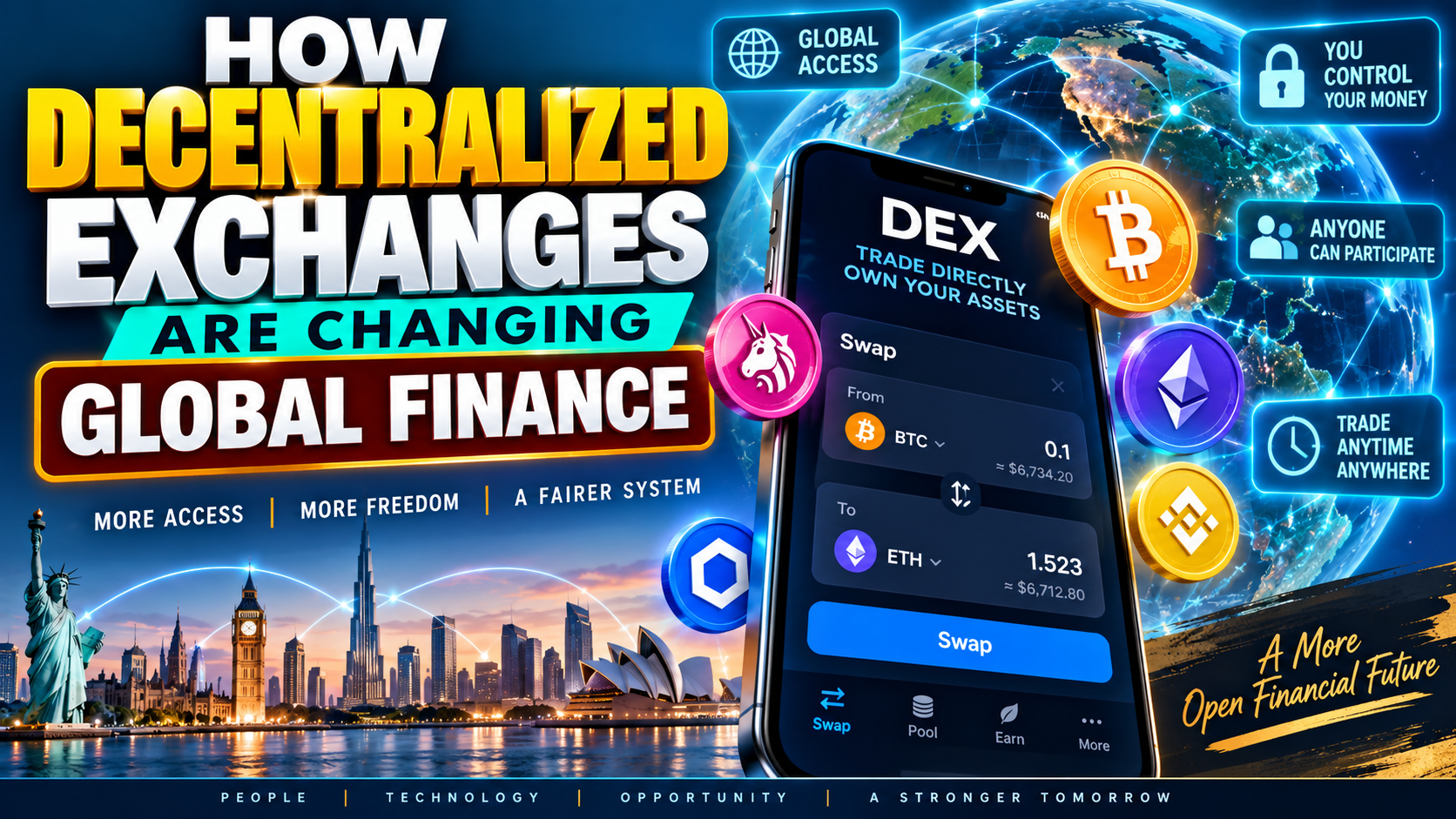
One big reason for decentralized exchanges to revolutionize global finance is the increased control they provide over people's money. In many traditional financial services websites, users are required to put their cash into an account managed by the web site owner. This means that a company may have some control over the money. Many decentralized exchanges will allow users to store their cryptocurrency in their own wallets until it is time to trade.
I believe that's one of the best arguments for decentralized finance being talked about is that a lot of people want the control over their own finances. Individuals may handle their assets without relying totally on banks or other organizations. This also means that users are responsible for protecting their passwords, wallets and private keys.
Global access is another crucial advantage of decentralized exchanges. Not all countries have the same access to traditional banking services. There are certain places in which having a bank account may be hard for some to obtain. Others might not have enough opportunities for investments, overseas. By allowing users to access digital asset markets from anywhere with an internet connection and digital assets, as well as access rights under local laws, decentralized exchanges can enable individuals across the globe to engage in these markets.
International transactions can be much easier on the decentralized exchanges too. The classic foreign exchange process can go through a variety of banks and payment companies. This slows and increases the cost of transactions. In some cases, these intermediaries can be eliminated through the use of blockchain transactions. This could enable users to transfer and switch digital assets to one another directly across the border.
Another advantage of a decentralized exchange is that they are typically open 24 hours a day. Traditional financial markets may have a fixed time of opening and closing. Banks might also be closed on the weekend or on public holidays. There are many decentralized exchanges that are available round the clock. Digital asset trading is available almost 24 hours a day.
Decentralized exchanges are also encouraging the expansion of decentralized finance, also known as DeFi. DeFi is an ecosystem of financial services that are primarily developed on blockchain networks. Services may involve borrowing, lending, trading, saving and investing activities outside of traditional banking services. The decentralized exchanges are crucial because they enable individuals to transfer in between various digital possessions utilized in the financial services.
Some other facets of a lot of decentralized exchanges are fascinating, and one of them is liquidity pools. A liquidity pool consists of a group of digital assets that users contribute to it. These assets facilitate other individuals to make trades. The people who are providing the assets, on their part, can get a part of the trading fees. This represents another avenue of involvement in financial markets for people.
But decentralized exchanges are not without their dangers, either. The primary issue is that cryptocurrency prices fluctuate rapidly. An asset purchased today can be worth a lot less tomorrow. Thus, individuals should be aware of the risks before investing.
Security concerns are also there. Errors in a smart contract can cause issues and hackers may exploit vulnerabilities in blockchain apps. Decentralised exchanges can also feature fake cryptocurrencies and scam projects. Customer service is not always available at traditional banks, which means that you might not always be able to get a transaction reversed or lost money returned.
One more issue is the trouble that newbies may have in comprehending distributed exchanges. Users might have to familiarize themselves with what a cryptocurrency wallet is, blockchain networks, transaction fees, wallet addresses, private keys, and smart contracts. Consider sending cryptocurrency to the wrong address – one small mistake and you can end up losing out on your funds permanently. I feel decentralized exchanges will need to become more accessible in order for them to be easy for everyone to use, which will require more education and simpler technology.
DeFi is also becoming an increasing focus for governments. Financial regulators have concerns related to fraud, money laundering, taxation, consumer protection and financial crime. The rules for cryptocurrencies and decentralized exchanges vary across the different countries. Governments' approach to creating regulations that balance innovation with protection for users will, therefore, be a factor in the growth of DEXs in the future.
In spite of these hurdles, decentralized exchanges are shaking up the financial services landscape and redefining the concept of money. They are demonstrating that some financial transactions don't require the participation of all financial companies/banks. They are also providing developers an opportunity to build new financial products to be accessible on the blockchain networks.
https://x.com/Sloaneoluchi/status/2097761160585974271
https://x.com/i/status/2088342261742580216
https://coinmarketcap.com/currencies/pussfi/
Note:-
Regards, @adeljose