Regulatory Frameworks for Cryptocurrency Markets in a Rapidly Evolving Digital Economy
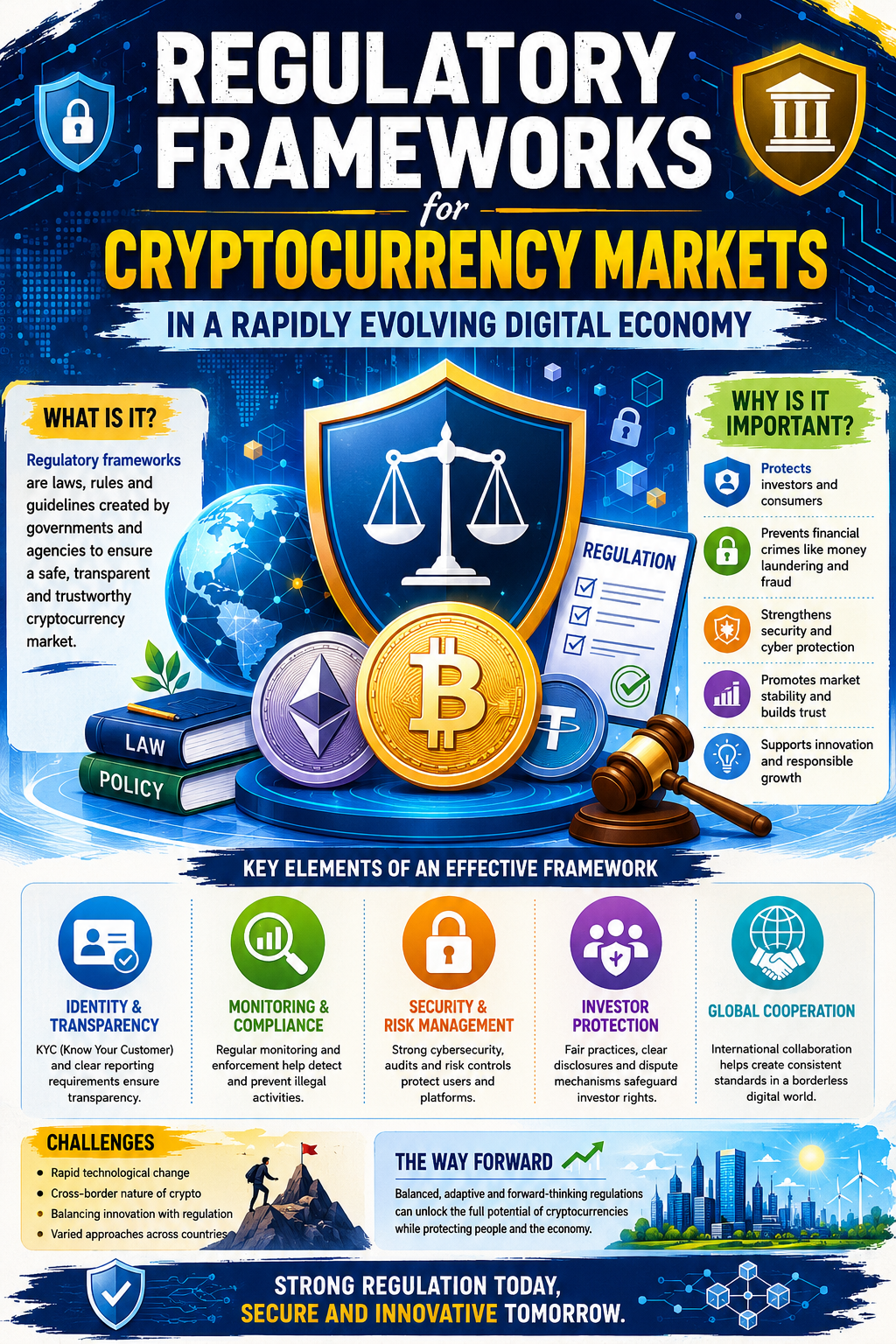
Cryptocurrency is one of the most significant innovations in the contemporary digital economy. The last decade has seen a revolution in how people view money, investments, and financial transactions with digital currencies like Bitcoin, Ethereum, and countless others. Today, millions of individuals globally are trading, investing, sending remittances, and transacting online with cryptocurrencies. The cryptocurrency market has been experiencing a rapid growth and it is now attracting more and more financial institutions and regulatory bodies to develop regulations that will guide and control the new market.
A regulatory framework is a collection of laws, regulations and guidelines put in place by governments and regulatory bodies to govern activities in a specific industry. Regulations in the cryptocurrency market serve various purposes, such as ensuring transparency, safeguarding investor interests, preventing criminal activities, and ensuring financial stability. Because of the decentralized technology of blockchain, regulating cryptocurrencies can be difficult. Cryptocurrencies operate differently from traditional banking systems in that they are not centralised and therefore not easily supervised.
Investor protection is one of the chief reasons why cryptocurrency regulations are significant. The cryptocurrency market is prone to volatility, which is characterized by the rapid swing of prices from up to down. A lot of investors have found themselves losing a lot of money when markets have crashed, they've been scammed, hacked or even misled in investment schemes. Regulatory policies contribute to setting standards which cryptocurrency exchanges and service providers need to adhere to. These standards can minimize risks and make users' environment safer. I believe that robust regulation will help build the trust of the public in digital assets and help more people to be a responsible participant in the digital asset market.
Another objective of cryptocurrency regulation is to prevent financial crimes. Some transactions may provide a degree of anonymity that could be used by criminals to launder money, fund terrorists, avoid taxation and other forms of illegality. To mitigate these worries, numerous nations mandate that cryptocurrency exchanges carry out Know Your Customer (KYC) and Anti-Money Laundering (AML) protocols. These measures involve users in the verification of identity before transactions can be made. These regulations allow authorities to keep a track of the suspicious activities and minimize misuse of digital currencies.
Consumer rights and cybersecurity are also a concern in cryptocurrency markets, which have grown in rapid pace. Cryptocurrency exchanges store vast amounts of digital currency and are frequently the targets of cyberattacks. If exchanges are hacked, users can end up losing a lot of money. In this regard, the regulatory bodies urge or mandate the exchanges to employ robust security measures, conduct frequent audits, and implement effective risk management strategies. To me, cybersecurity regulations have become a growing priority due to the critical reliance on trust and secure technological infrastructure in the digital economy.
There are various methods for regulating cryptocurrencies in various countries. Countries have taken different approaches to cryptocurrencies, with some adopting a more progressive stance and establishing detailed regulatory frameworks to foster innovation while ensuring responsible oversight. Some have tightened up or banned it entirely because of fears over financial issues and crime. The different regulatory environments pose a problem for international cooperation as cryptocurrencies can freely cross borders. The increasing globalisation of digital assets could impose a need for collaboration between countries to develop common standards and regulatory principles.
A major difficulty in managing cryptocurrency markets is staying up to date with the changing technologies. The cryptocurrency sector is dynamic and rapidly changing, with new technologies, platforms, and financial products constantly being introduced. The digital asset space has grown with new technologies such as decentralized finance (DeFi), NFTs, and stablecoins. In an ever-changing technology landscape, regulators frequently have trouble developing laws that are relevant. On the other hand, regulations that are too strict will stifle innovation and investment. If however, regulations are too lax, then the consumers and financial systems may be exposed to higher risks.
In particular, the regulatory focus has shifted to the stablecoins. Stablecoins are cryptocurrencies whose price is fixed or pegged by tying it to another asset like national currencies. They can be employed to make payments and exchange in the cryptocurrency space. Stablecoins could have a broader impact on financial systems, which is why regulators are studying and considering the regulatory framework for their supervision to guarantee stability and consumer protection.
International organizations are also playing a more prominent role in cryptocurrency regulation. International financial institutions and regulators are trying to arrive at proposals and guidelines to be followed by national governments. International cooperation is a solution to issues of cross-border transactions, regulatory arbitrage, global financial risks, etc. A coordinated process can enhance the effectiveness of the regulations and contribute to innovation of the digital economy.
In the future, the balance between innovation and security and accountability are likely to be the primary areas of focus in the regulation of cryptocurrencies. Governments have an awareness of the potential for blockchain technology and digital assets as economic opportunities. Concurrently, they need to make sure that these innovations are not detrimental to the financial stability or public trust. Regulatory mechanisms need to stimulate technology development while providing consumer protection and market integrity.
To sum up, the regulatory landscape in the cryptocurrency sector is highly important in the present rapidly changing digital economy. They play a vital role in safeguarding investors, preventing financial crimes, enhancing cybersecurity, and fostering trust in digital financial systems. The decentralised and innovative nature of cryptocurrencies poses numerous challenges for regulation, however, it is important to regulate it for sustainable growth. In my view, a nuanced and flexible regulatory framework will be fundamental to the future of cryptocurrency markets and to ensuring that cryptocurrency digital innovations can be safely and responsibly enjoyed by individual, business and governmental users around the world.
https://x.com/i/status/2038990196453126632
https://coinmarketcap.com/currencies/pussfi
https://x.com/i/status/2036134193260802100
Note:-
Regards, @adeljose