Homo Non Necessarius (Short Story)
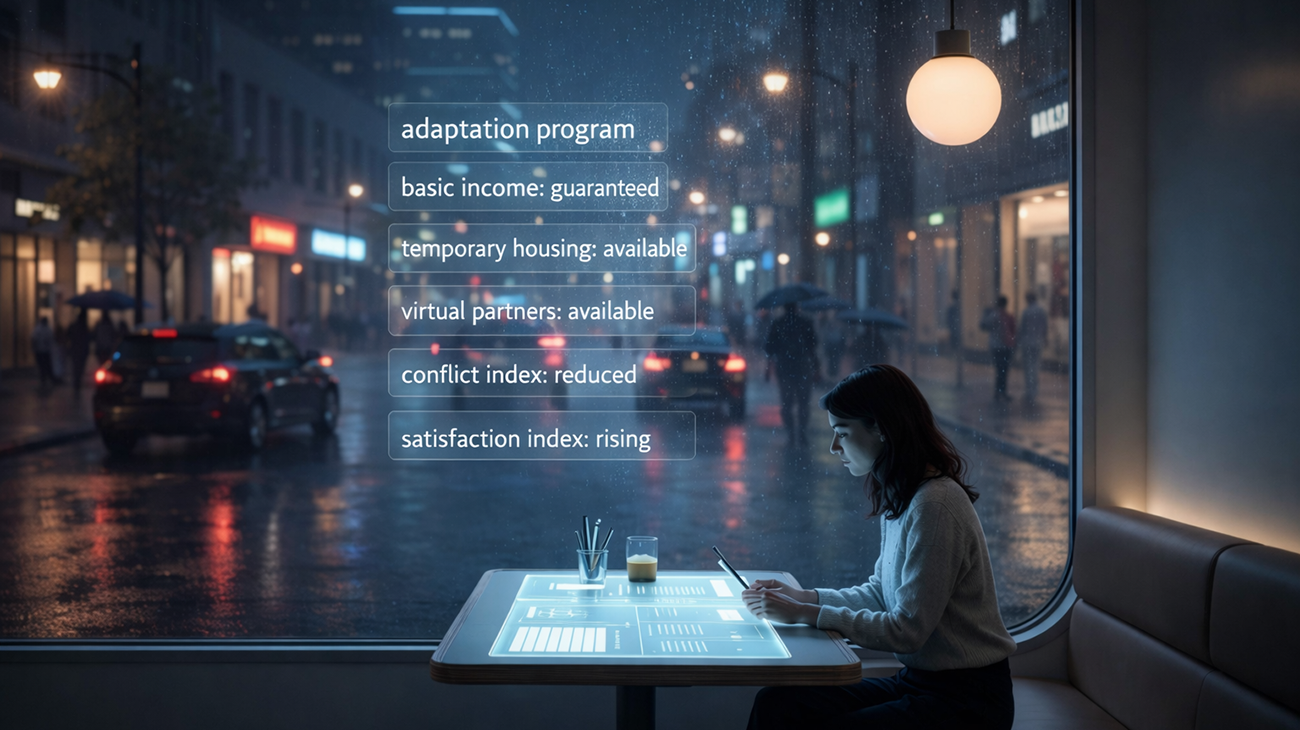
Ann didn’t know why she had agreed to this meeting. Perhaps she simply wanted to see Laura — and calm the quiet anxiety inside her, if only a little. They hadn’t seen each other for years, but Ann remembered that when Laura was around, she always felt steadier.
She sits in a small, half-empty café: warm wooden paneling, soft lighting, instrumental music. The air smells of freshly ground coffee. Outside, a fine rain drizzles down. She absentmindedly runs a finger across the fogged window, tracing a shapeless pattern.
Someone stops beside her. Ann startles and looks up. A robot stands too close — tall, heavy-built, with a neutral casing and a motionless display where a face should be. On its tray sits a cup filled with a thick warm drink.
“Your order,” the voice says — low, faintly monotone.
“Warm beverage with reduced stimulation. Improves stability. Included in the adaptation package.”
Ann blinks.
“I haven’t ordered anything.”
The robot pauses.
“Would you like to make changes?”
Ann looks at the table, then at the screen built into its surface. The menu is already open. One item is highlighted.
Slowly, she raises her eyes to the robot.
They hadn’t seen each other since school.
Laura arrives exactly on time, moving with the quiet confidence of someone who assumes the place belongs to her. She carries that same smile ahead of her — the one that used to make people turn around in the hallways back in school. For a moment Ann feels as if nothing has changed.
They hug. A robot brings Laura coffee. Ann does not touch the cup that was imposed on her. Steam from the drinks dissolves quietly into the air.
Ann absently circles a spoon inside her cup without looking up, until Laura speaks first.
“You haven’t changed much.”
“Neither have you.”
They talk about small things — where they live now, where they’ve traveled, what they’ve been reading. But Ann senses that Laura didn’t come here for small talk.
“Do you remember,” Laura says, taking a sip of coffee, “how we stood in the corridor and all the girls were watching us? As if everything revolved around us.”
“Because of Steve.”
“You still remember his name?”
Ann nods.
“Of course. He was… the most popular guy in school.”
Laura runs a carefully manicured finger along the rim of her cup.
“By school standards, yes. Everyone liked him.”
“He chose you, though. But after that… I don’t know. It didn’t work out?”
Laura snorts.
“Us?” She pauses, as if weighing the word. “There was never any ‘us’ with him. Being with him was like stepping onto a school stage — suddenly you’re right in the center of attention. Total womanizer. Jumped from one girl to another. I dumped him before it got too far. Not worth the effort.”
“And after that?” Ann asks quietly.
Laura shrugs and drinks her coffee.
“Oh, there were plenty. After school I decided to live fully — parties, clubs, dating guys who seemed bright and interesting. It was great: one was huge, all muscles, like Hercules; another had a brilliant sense of humor — I laughed until it hurt; another was a wanderer, taking me to places where I felt alive; a fourth was a master of the Kama Sutra. It was my ‘discovery phase’ — gaining experience, discovering myself. No obligations. Just pleasure. I felt free, you know. Strong.”
As Laura talks, the smile never leaves her lips. Ann nods without interrupting. Laura looks well cared for, but there is fatigue at the corners of her eyes.
“But later… once I passed thirty, I wanted stability. Not an episode, you know — a permanent partner. And that’s where the problem starts. My standards grew, but real people don’t measure up. One is boringly predictable, another has no ambition, another is empty.”
She pauses.
“You know what a man needs? Food, a clean house, and sex. He calls that happiness.”
“And women?” Ann asks.
“Our expectations are higher. We don’t just want a body next to us. We want depth. Humor. Unpredictability. And above all the feeling that someone understands you and accepts you as you are.”
“I heard something,” Ann says carefully. “People said you’re not alone… that you have a companion.”
“That’s true,” Laura says. “In the end I got a cyber. Lux series. Not the most expensive, but advanced enough.”
She says it the way someone would name a car brand.
“He does everything. Cleans, repairs, cooks. Can protect me. Can also…” Laura narrows her eyes slightly, “…be useful when… well, you know. Convenient, yes, but sometimes I wonder if all that ‘experience’ made me too demanding to simply be happy.”
Ann suddenly notices a thought forming in her mind: Laura speaks as if she needs to explain in advance that none of this is her fault.
“Len… the way you’re saying it… it sounds like you’re defending yourself.”
Laura blinks.
“To whom?” she smirks. “To you? You’ll excuse me anyway.”
Ann smiles faintly.
“I’m just asking.”
Laura looks away toward the window. Rain drizzles against the glass. People walk along the sidewalk.
“You know what’s worst?” Laura says quietly, almost to herself. “One day you wake up and realize you’re not part of anyone’s life.”
Ann moves her hand slightly closer to Laura’s on the table.
“And sometimes…” Laura sighs softly. “Sometimes you just want to be part of someone’s life. Even if it hurts.”
Ann feels her throat tighten.
“And you?” Laura suddenly changes tone, as if realizing she has said too much. “What about you? I heard you married for love.”
Ann smiles.
“For love, yes. Back then he was an engineer… He’s obsessed with bridges — beams, cables, structures. He can talk for hours about suspension systems and explain why you can never economize on the cables.”
“Romantic,” Laura snorts.
“It sounds funny, but…” Ann searches for the right words. “I like it. He burns with it. And when you’re near him, you want to burn too.”
Laura studies her carefully.
“And?”
Ann inhales.
“And it’s real. We’re together. We’re like…” she searches for the word, “…just people.”
Laura says nothing.
Then Ann suddenly blurts out:
“But now… he lost his job.”
Laura sighs.
“Everyone’s losing jobs.”
“He was laid off,” Ann continues. “He worked on bridges, transport hubs, things like that. And suddenly… nothing. As if someone pulled him out of his own life. Robots are cheaper.”
“Men react like that,” Laura says dryly. “They’re weak about it.”
She looks at Ann and hesitates.
“Many of them.”
Ann nods.
“He’s changed. As if something inside him broke. He’s… smaller somehow. Angrier. Not at me. At himself.”
She closes her eyes for a moment. Images from recent days return: Alex sitting in the dark kitchen, the glow of a screen trembling against his cheek. Looking at job listings. Saying quietly:
“I don’t want you to have a child.”
“He says he wants a neural implant,” Ann continues.
Laura raises her eyebrows.
“To stay competitive?”
Ann nods.
“He says there’s no other way. Basic income isn’t a life. He can’t be an example for a child. He has no right to be a father if he’s… if he’s nobody.”
Laura smiles without malice.
“‘Nobody’ is the favorite word of self-destruction.”
Ann almost smiles, but the expression fades.
“And I… I understand him,” she says, surprised by how true it sounds. “For him it’s not about money. Losing the job is like losing the ground under his feet. He doesn’t know who he is anymore.”
Laura studies her for a long moment.
“So what’s the problem? You’re afraid he’ll become like my Lux?”
Ann looks up.
“I’m afraid he’ll become… someone else,” she says quietly. “That he’ll stop feeling. That… our ‘we’ will fade.”
Alex stands by the apartment window, looking down at the half-empty gray streets. Silent drones glide above. A few distant silhouettes move along the sidewalks.
His gaze settles on an old photograph from before the wedding: Ann laughing, Alex holding her shoulders. The calm expression of a man who believed he was in the right place.
A wave of nausea rises.
He goes to the kitchen, turns on the water, then turns it off again — just to hear the sound. His hands tremble slightly. Since the layoff he has begun noticing things too sharply: the tremor in his fingers, an extra breath, the pause in someone else’s speech.
What kind of father would I be? What would I condemn a child to — basic income? A world where he isn’t needed?
The NeuroLink-7 box lies on the table. Light. Inside — an ampoule, an autoinjector, instructions, and a warning:
Possible changes to emotional profile.
Disruption of connection with familiar values.
Sleep disturbances.
Possible…
He smirks.
“Possible new version of yourself.”
A friend at the bar keeps saying: Insert it — you’ll get back in the game.
Ann is afraid: You’ll become a machine.
But without the chip everything is collapsing. A trap.
He sits on the edge of the couch. Ann chose the fabric. He remembers her saying, It should feel pleasant to touch. Back then that seemed important.
He presses the injector to his temple.
Click.
Injection.
Clarity comes first — the disappearance of noise. The inner dialogue that devoured him for weeks loses significance. Problems become structure.
The tension he always felt approaching a task disappears: this will be difficult, here I must recall formulas, there check a reference book, here I might easily make a mistake. The background noise he once mistook for thinking shuts down.
A strange sensation of understanding structure — at every level. Insight arrives immediately. Not as the result of intense reasoning, but as a fact. Without the exhausting climb of thought.
Not an image, not a memory — the structure itself.
The load of a construction ceases to be abstract and flows like light. One element becomes the inevitable consequence of the previous one.
Understanding moves deeper — into crystalline lattices, into the ordered arrangement of atoms. No approximation. Everything written from the beginning in the correct code that humans read far too slowly — if they ever reach that depth at all.
Alex opens his eyes and inhales sharply.
He laughs.
Short, dry, relieved.
He wants to leap up, walk around the room, grab something and break it.
This is how it should always have been.
A wave of pure, dense joy rises.
No struggle. No doubt. No slow groping in the dark.
Clarity.
Blindingly beautiful clarity.
At the edge of consciousness flickers a brief, almost unnecessary thought:
If value once had to be extracted — now it is already extracted.
He does not pursue the thought. It has lost relevance.
He looks around the room.
The sense of ours disappears. There is only object.
The couch — an item.
The photo — an image.
The window — a surface.
A child is no longer a painful question. Only a parameter that may be activated later — or not at all.
His eyes return to Ann’s photograph.
It hangs slightly crooked.
In his mind a scheme unfolds: career, training, profile, programs, probabilities.
He looks at his hands.
They are no longer trembling.
Three months after the implantation, memories connected with Ann have been lowered in priority.
Her photographs are carefully sorted, adjusted to a neutral color balance, and stored in the neural network archive as part of a completed life stage.
From time to time the system suggests deleting them to optimize storage. The decision is postponed — due to lack of priority.
Alex records the fact calmly.
The level of noise in everyday life decreases.
It is good to see you back @gektor. Thank you for sharing your story with us.
Thank you! Much obliged.
Hi, @gektor,
Thank you for your contribution. Your post has been manually curated.
- Delegate to @ecosynthesizer and vote @symbionts as a witness to support us.
- Explore Steem using our Steem Blockchain Explorer
- Easily create accounts on Steem using JoinSteem
Thank you!