Crypto Markets Don't Lack Data. They Lack Context.
Open almost any crypto analytics platform and you'll find an overwhelming amount of information.
Price charts. Trading volume. Open interest. Funding rates. Liquidations. Wallet activity. Social sentiment. News. On-chain metrics.
The problem isn't finding data anymore.
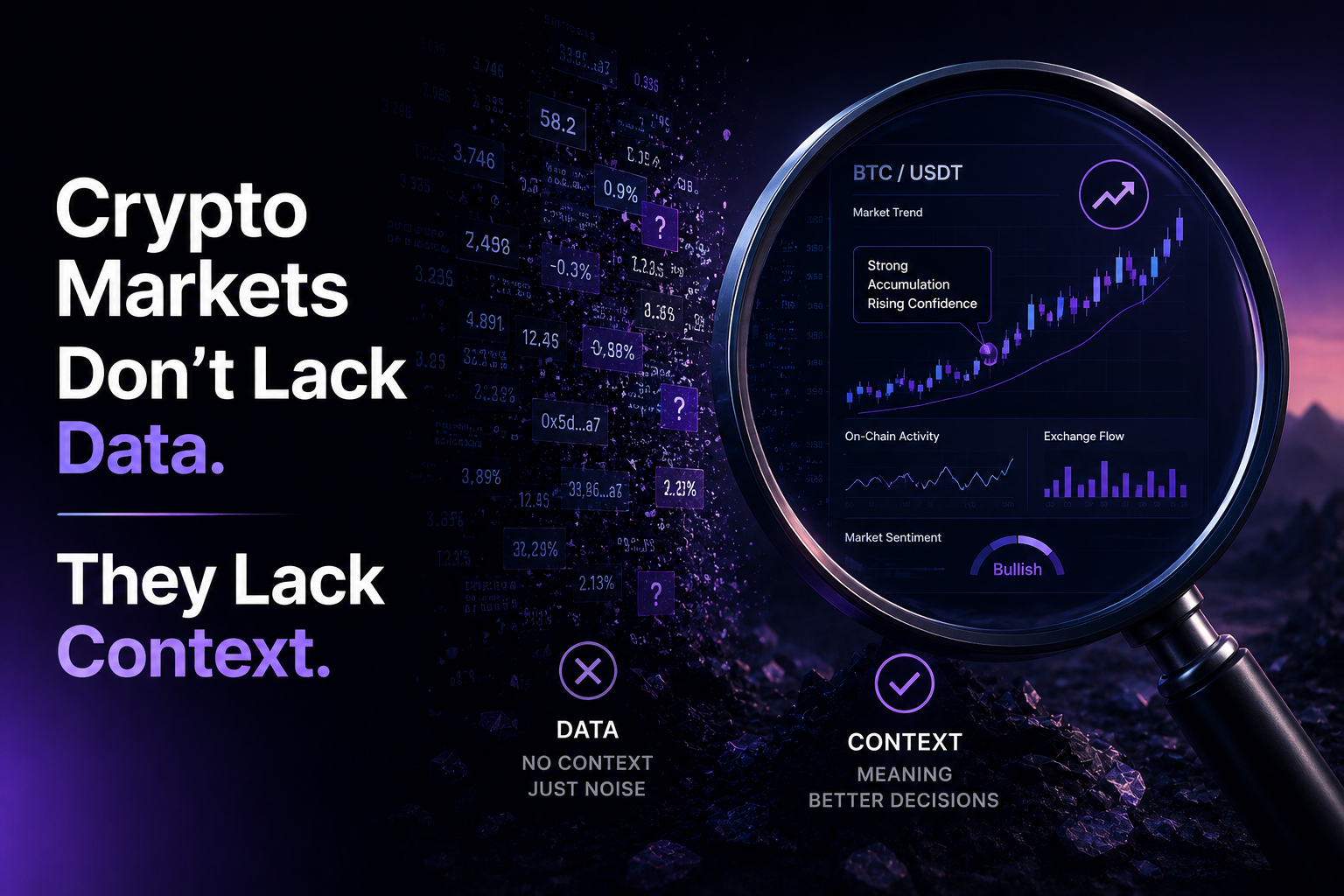
The problem is knowing what to do with it.
A trader can have ten dashboards open and still miss the reason behind a market move. A volume spike might look bullish until you discover it came from a short-lived event. A breakout might appear convincing until liquidity starts disappearing underneath it.
Raw information can tell you what changed.
Context helps explain why it changed and whether it actually matters.
The Crypto Market Has Become an Information Problem
Crypto generates an enormous amount of data every day.
There are spot markets, perpetual futures, options, on-chain transactions, exchange flows, social conversations, governance activity, and constant news.
Modern analytics platforms reflect this complexity. For example, Glassnode aggregates market, derivatives, on-chain, capital-flow, and macro data into a unified data layer.
Having access to all that information sounds like an advantage.
But information only becomes useful when you can connect it.
Otherwise, traders end up doing something surprisingly inefficient:
Jumping from one dashboard to another, trying to figure out what is actually important.
A Number Doesn't Explain a Market Move
Consider a simple example.
Bitcoin suddenly moves 7% higher.
That's the data.
Now ask:
Why?
Maybe institutional demand increased.
Maybe short positions were liquidated.
Maybe macro conditions changed.
Maybe regulatory expectations improved.
Maybe several factors happened at the same time.
Recent market movements demonstrate why this matters. Today's Bitcoin rally, for example, has been attributed to a combination of institutional inflows, short covering, changing Treasury-yield expectations, regulatory developments, and broader investor demand. (The Wall Street Journal)
The price chart shows the result.
The surrounding information helps explain the move.
Data Is the Ingredient. Context Is the Recipe.
Think about crypto market data as individual ingredients.
Price is one ingredient.
Volume is another.
Liquidity is another.
Derivatives data adds another.
News adds another.
None of these necessarily tells the complete story by itself.
Put them together intelligently, though, and you can start to understand the market environment.
For example:
Price rising + volume rising + healthy liquidity + supportive catalyst
tells a different story from:
Price rising + weak volume + falling liquidity + no obvious catalyst.
The price may look identical at first glance.
The context isn't.
Why Volume Alone Can Be Misleading
Volume is one of the most commonly watched metrics in crypto.
But high volume doesn't automatically mean strong demand.
A market can experience large turnover because of aggressive buying and selling, liquidation events, short-term speculation, or other temporary activity.
Recent discussion around India's crypto market has highlighted a similar issue: high futures turnover alone doesn't necessarily demonstrate deeper participation or market maturity.
"India's crypto market has a Futures problem: Why volume is not the same as maturity")
So instead of asking:
"Is volume high?"
a better question is:
"What is driving the volume?"
That's a context question.
Liquidity Changes the Meaning of Price
Price movement also needs to be viewed through liquidity.
Imagine two tokens both rise by 10%.
One trades billions of dollars a day.
The other has a relatively thin market.
Those two moves shouldn't necessarily be interpreted in the same way.
In a thin market, comparatively small orders can have a much larger impact on price.
This is why market-quality measures matter alongside reported volume. CoinMarketCap, for example, distinguishes reported volume from liquidity and uses its Liquidity Score to help users assess whether activity is backed by usable market depth.
Price tells you what happened. Liquidity helps tell you how much weight to give the move.
Derivatives Can Change the Story
Crypto derivatives markets add another layer.
Open interest, funding rates, futures basis, and liquidation activity can reveal how traders are positioning themselves.
Suppose Bitcoin rises sharply while open interest also increases.
That's worth investigating.
Now suppose the same price move happens while open interest falls and a large number of short positions are liquidated.
The underlying mechanics may be quite different.
Neither scenario automatically predicts what happens next.
But they provide context that a price chart alone cannot show.
News Can Arrive Before the Chart Makes Sense
Sometimes the market moves first and the explanation becomes obvious later.
A token can jump because of a listing announcement, protocol upgrade, partnership, regulatory decision, or security incident.
If a trader sees only the price movement, they may mistake the move for technical momentum.
Once the catalyst is identified, the move can look very different.
This is one reason real-time crypto market intelligence matters.
The faster a trader can connect market activity with relevant events, the less likely they are to interpret a move in isolation.
Social Sentiment Is Useful, But It Needs Filtering
Crypto has always been heavily influenced by narratives.
A project suddenly becomes popular.
A sector starts trending.
A particular token dominates social conversations.
That information can be valuable.
But social attention can also be noisy.
A large number of posts doesn't necessarily mean that capital is flowing into an asset.
Likewise, negative sentiment doesn't always mean that the underlying market structure is weak.
Sentiment becomes more useful when compared with actual market behavior.
Are people talking about it?
Are they trading it?
Is liquidity increasing?
Is capital actually moving?
That's the difference between monitoring attention and understanding the market.
Signals Are Helpful. Context Makes Them Useful.
A trading signal is designed to highlight something.
Maybe it detects unusual volume.
Maybe price has crossed a technical level.
Maybe open interest has changed significantly.
That's useful because it tells you where to look.
But a signal doesn't necessarily explain the environment around the event.
This is why traders should be careful about treating signals as instructions.
A better process is:
Signal → Investigation → Context → Decision
The signal gets your attention.
The context helps determine whether it deserves more attention.
The Problem With Too Many Dashboards
More data can create an unexpected problem.
Information overload.
A trader might have one screen for price, another for derivatives, another for on-chain activity, another for social sentiment, and another for news.
Each dashboard may be useful.
But the trader is still responsible for putting everything together.
That's where time becomes a problem.
By the time you've checked five different sources, the market may have already moved again.
The challenge isn't simply collecting more information.
It's connecting relevant information quickly enough for it to matter.
AI Can Help With the Context Problem
This is one area where AI-powered trading intelligence can become useful.
AI can process large volumes of information much faster than a person manually switching between multiple dashboards.
More importantly, it can help identify relationships between different types of data.
Imagine a system detecting:
BTC price breakout
alongside:
Rising volume
Changing liquidity
Increasing derivatives activity
Relevant market news
Instead of receiving five disconnected alerts, a trader gets a more complete picture of what is happening.
That doesn't mean AI can predict the market perfectly.
It means the trader can spend less time collecting information and more time evaluating it.
Context Doesn't Mean More Data
This distinction is important.
Adding another metric doesn't automatically create better context.
Context comes from relevance and relationships.
For example, knowing that Bitcoin's volume is rising is useful.
Knowing that Bitcoin's volume is rising while liquidity is changing, short positions are being liquidated, and a major catalyst has just emerged is much more informative.
The goal isn't to build the biggest dashboard.
It's to build a better understanding of the market.
What Traders Should Ask When a Market Moves
The next time you see a major crypto move, don't stop at the chart.
Try asking:
What changed?
Look at price, volume, volatility, and market structure.
What caused it?
Search for relevant news, events, or market catalysts.
Who is participating?
Look at liquidity, trading activity, and derivatives positioning.
Is the broader market confirming it?
Compare Bitcoin, Ethereum, major sectors, and overall market conditions.
Is anything contradicting the move?
Conflicting signals can be just as valuable as confirming ones.
These questions can turn a quick reaction into a more structured analysis.
This Is Where I5 Fits In
This idea is closely aligned with what i5.xyz is building.
I5 is an AI-powered trading intelligence platform focused on helping traders understand fast-moving crypto markets through multiple layers of information.
Instead of treating price movements, signals, news, liquidity, and derivatives as completely separate pieces of information, the platform is designed around bringing those layers together.
The goal isn't simply to tell traders that something happened.
It's to help answer the more useful question:
"What is happening around this move, and why should I care?"
For traders dealing with an always-on market, that distinction can make information much easier to work with.
The Future of Crypto Trading May Be Less About More Data
The crypto industry spent years building better ways to collect and display data.
That work isn't finished, but the next challenge is becoming clearer.
How do we turn all that information into something understandable?
The winning tools may not necessarily be the ones with the most metrics.
They may be the ones that help traders quickly separate:
Important information from background noise.
A real market shift from temporary volatility.
A signal from the context surrounding that signal.
That's a very different problem from simply finding more data.
Final Thoughts
Crypto markets don't have an information shortage.
They have a context shortage.
There is no shortage of numbers, charts, alerts, headlines, and indicators. The difficult part is connecting those pieces quickly enough to understand what is actually happening.
A price move is useful.
A signal is useful.
A headline is useful.
But when you understand how those pieces relate to each other, they become much more valuable.
That's ultimately what good market intelligence should do.
Not give you more information.
Give the information you already have more meaning.
Explore I5
The I5 testnet is coming soon, bringing its approach to AI-powered crypto trading intelligence closer to traders.
Join the I5 Testnet Whitelist:
https://shorturl.at/khXrD
Join I5 on Telegram for updates:
https://t.me/I5Labs