The Agent Economy Is Coming — Stablecoins Need Fast Finality, and SVM Could Give STEEM a Role in It
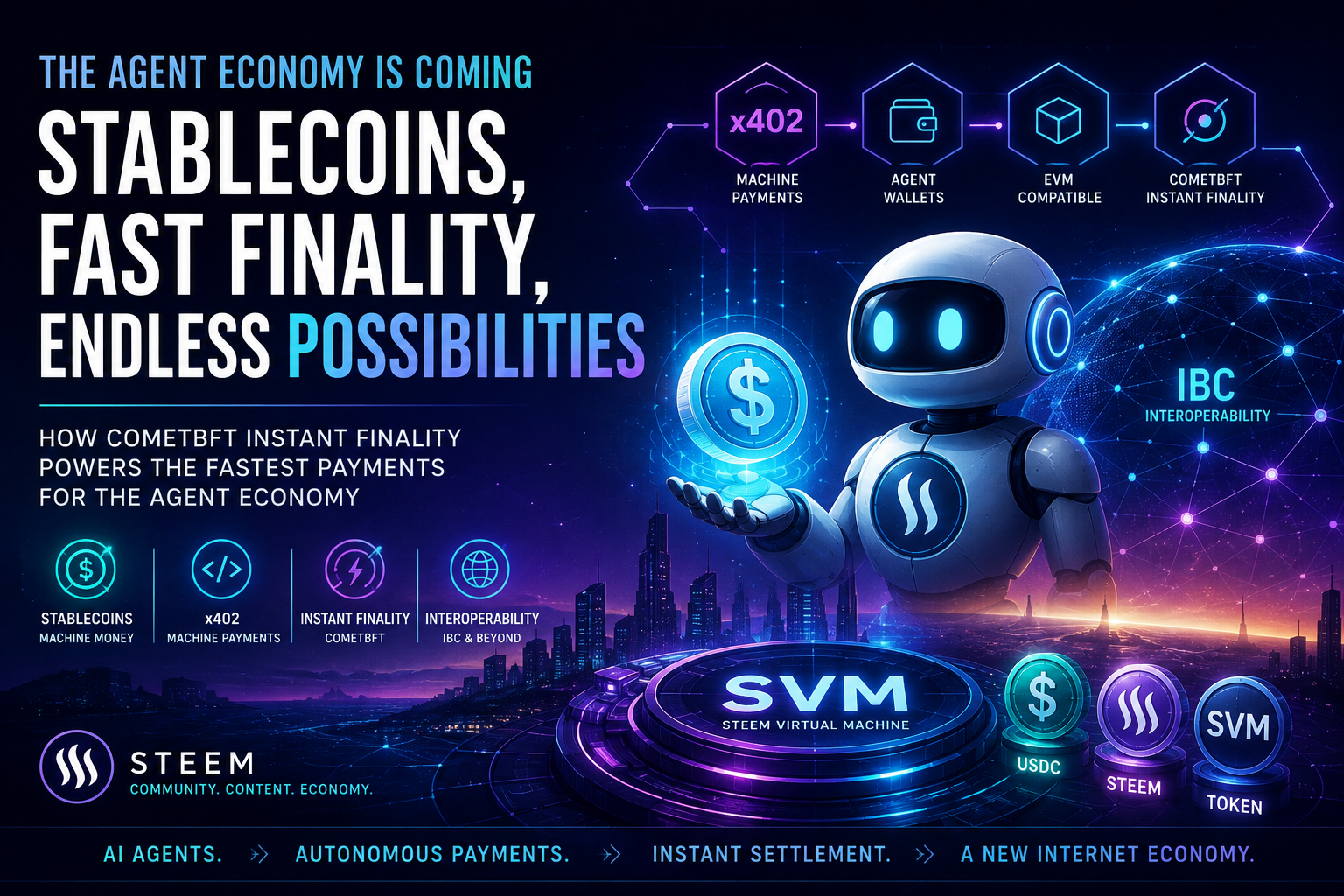
The next major phase of the blockchain industry may not be driven by humans sending transactions to each other.
It may be driven by software agents paying other software agents.
AI agents are rapidly evolving from systems that simply answer questions into systems capable of discovering services, calling APIs, purchasing resources, executing tasks and interacting with other autonomous systems.
That creates a new economic requirement:
Machines need money.
But not just any money.
They need money that is programmable, globally accessible, stable in value, inexpensive to transact with, and fast enough that a machine does not have to wait around for a human financial system.
This is where stablecoins, agentic payment protocols, EVM-compatible blockchains and fast deterministic finality begin to converge.
And it raises an interesting question for STEEM:
Could the Steem Virtual Machine (SVM) become part of the infrastructure for the emerging agent economy?
The Internet Is Moving From Human Commerce to Agent Commerce
For decades, the internet was designed around a human sitting in front of a browser.
The process was simple:
Human → Website → Checkout → Payment → Service
The emerging agent economy changes the model:
AI Agent → discovers service → requests service → pays automatically → receives result
And potentially:
Agent A → pays Agent B → Agent B purchases data → Agent B pays Agent C → result returns to Agent A
There does not necessarily need to be a human involved in every step.
This is an important transition.
An AI agent might need to purchase:
- an API call
- a database query
- AI inference
- GPU compute
- storage
- bandwidth
- financial data
- a dataset
- another AI agent's service
- an online subscription
- a digital asset
The agent economy therefore needs an economic layer designed for machine-to-machine transactions.
Cloudflare has recently been working on agent identity and wallet infrastructure, including programmable controls such as spending limits and merchant restrictions. The company explicitly frames this as infrastructure for an internet increasingly driven by agent-led commerce.
This is no longer purely theoretical.
The infrastructure is being built.
Why Stablecoins Are Becoming Machine Money
AI agents have an unusual requirement.
They need predictable accounting.
Imagine giving an AI agent a budget of $100.
It can understand:
$1 = approximately $1
But it becomes much harder to build reliable autonomous economic decisions around a highly volatile asset.
For an autonomous system, the ability to predict purchasing power is extremely valuable.
This is one reason stablecoins are becoming increasingly important to the agent economy.
A stablecoin such as USDC can provide a programmable digital dollar that can move over blockchain networks without requiring a traditional bank transfer for every transaction.
Circle is explicitly positioning USDC and its infrastructure toward the agentic economy. Its current platform describes USDC as a digital dollar designed for stability and global business while positioning its broader infrastructure around payments and agentic applications.
The direction is clear:
Stablecoins are moving from being merely crypto trading infrastructure toward becoming programmable internet money.
The Agent Does Not Want a Checkout Page
This is where protocols such as x402 become especially interesting.
The traditional internet assumes that a user visits a website, creates an account, enters payment information and then receives a service.
An AI agent doesn't necessarily need any of that.
Imagine an agent requesting a paid API:
Agent
   │
   │ HTTP Request
   ▼
API
   │
   │ 402 Payment Required
   ▼
Agent Wallet
   │
   │ Stablecoin Payment
   ▼
Blockchain
   │
   │ Settlement
   ▼
API
   │
   │ Response
   ▼
Agent
The payment becomes part of the machine-to-machine interaction.
Coinbase's x402 is designed around this concept, using HTTP's 402 Payment Required mechanism to enable programmatic payments for internet resources. It is particularly relevant to APIs and autonomous agents.
The idea is powerful because the payment itself becomes programmable.
Instead of:
"Please enter your credit card."
The service can effectively say:
"Pay this amount and you may access this resource."
The agent can then decide whether the service is worth purchasing.
That is a fundamentally different payment model.
The Emergence of Machine-to-Machine Micropayments
Now imagine an AI agent that makes thousands of transactions.
It might pay:
API request             $0.001
Data request            $0.002
AI inference            $0.010
GPU computation         $0.020
Storage                 $0.001
Another agent           $0.005
The amounts are tiny.
But the volume can be enormous.
This creates a completely different payment requirement from traditional commerce.
Humans generally make relatively large purchases.
Machines could make thousands or millions of small purchases.
This is why agentic commerce needs:
Low fees + fast settlement + programmable authorization + stable value.
The payment itself becomes part of the application logic.
But There Is a Problem: Blockchain Settlement Takes Time
This is where blockchain infrastructure becomes critical.
Imagine an AI agent requesting an API that costs $0.002.
The service responds:
Payment required.
The agent pays.
Now the service needs to know:
Can I trust this payment?
A blockchain transaction being broadcast is not necessarily the same thing as a transaction being economically final.
For machine commerce, the distinction matters.
The service provider wants something closer to:
Payment received → Payment final → Deliver resource
rather than:
Payment broadcast → wait → wait → wait → additional confirmations → eventually trust payment
For autonomous systems operating at machine speed, this delay can become an economic bottleneck.
And this is where consensus finality becomes much more important than it might appear from the perspective of a normal user.
CometBFT and Deterministic Finality
SVM is built around the Cosmos ecosystem and CometBFT consensus.
CometBFT uses Byzantine Fault Tolerant consensus to allow validators to agree on blocks.
The important property is that once the necessary validator voting threshold is reached and the block is committed, the block does not need to sit around accumulating probabilistic confirmations in the same way that a Nakamoto-style chain does.
CometBFT documentation describes the validator process through proposal, prevote and precommit stages, with consensus proceeding toward block commitment.
The key concept is:
Deterministic finality.
That does not mean zero latency.
It does not mean every CometBFT chain automatically finalizes in milliseconds.
Actual latency depends on block configuration, validator communication, network conditions, transaction load and whether additional consensus rounds are required.
But the important architectural property remains:
Once the consensus commit is reached, the transaction can be treated as final according to the chain's consensus rules.
That is extremely useful for payment infrastructure.
Fast Finality Is More Important for Agents Than Humans
Consider a human buying a $100 product.
Waiting a few seconds may not be a major issue.
Now consider an AI agent executing 10,000 transactions.
A small amount of latency can compound across the entire workflow.
Imagine:
Agent
  │
  ├── Pay data provider
  │
  ├── Pay AI inference provider
  │
  ├── Pay GPU provider
  │
  ├── Pay storage provider
  │
  ├── Pay another agent
  │
  └── Return final result
Every payment can potentially become a synchronization point.
The agent doesn't simply need cheap transactions.
It needs fast economic certainty.
That is why fast finality is more than a technical benchmark.
For agentic commerce, it becomes part of the user experience — even though the "user" may be another machine.
Circle's Arc Is a Major Signal
One of the most interesting developments in this space is Circle's Arc.
Circle is designing Arc as a stablecoin-native blockchain with an explicit focus on financial applications.
Its architecture includes:
- USDC-centered settlement
- EVM compatibility
- stablecoin-native gas
- deterministic finality
- financial applications
- payments
- agentic commerce
Circle's Arc documentation describes deterministic sub-second finality and positions the network for stablecoin-based financial infrastructure.
Recent reporting around Circle's Arc launch also highlights use cases including instant payments, tokenized assets and AI-agent transactions.
This is significant.
It demonstrates that the idea of combining:
Stablecoin + EVM + fast deterministic finality + agentic commerce
is not merely a theoretical architecture.
Major financial infrastructure companies are actively moving toward it.
The New Blockchain Stack
The emerging architecture could look like this:
                 AGENT ECONOMY
                       │
             ┌─────────┴─────────┐
             │                   │
          AI Agent            AI Agent
             │                   │
             └─────────┬─────────┘
                       │
                 Agent Wallet
                       │
                       ▼
              Agent Payment Layer
                 x402 / MPP
                       │
                       ▼
                  Stablecoin
                       │
                       ▼
                EVM Blockchain
                       │
                       ▼
              BFT Consensus
                       │
                       ▼
             Fast Deterministic
                   Finality
                       │
                       ▼
              Global Settlement
This is where the pieces begin to fit together.
Stablecoins Are Only One Part of the Solution
There is an important distinction here.
A stablecoin solves the value problem.
It does not automatically solve the settlement problem.
An agent needs:
Stable value
So it can reason economically.
Programmable money
So software can control funds.
Wallet infrastructure
So every agent can have an economic identity.
Payment protocols
So machines can request and pay for resources.
Fast settlement
So services can be delivered quickly.
Deterministic finality
So the service provider knows when payment is final.
Interoperability
So the agent isn't trapped inside one blockchain.
This is why the combination is more interesting than any individual component.
Where SVM Could Fit
This is where the Steem Virtual Machine becomes interesting.
SVM isn't simply about putting an EVM on top of STEEM.
The bigger opportunity is to combine:
STEEM + EVM + CometBFT + stablecoins + interoperability
into a platform capable of supporting a new generation of applications.
Conceptually:
                    AI AGENTS
                        │
                        ▼
                  Agent Wallets
                        │
                        ▼
               Stablecoin / STEEM
                        │
                        ▼
                       SVM
                        │
              ┌─────────┴─────────┐
              │                   │
             EVM              Cosmos SDK
              │                   │
              └─────────┬─────────┘
                        │
                    CometBFT
                        │
                        ▼
                Fast Finality
                        │
                        ▼
                     IBC
                        │
           ┌────────────┴────────────┐
           │                         │
       Cosmos Ecosystem           Other Chains
This creates an interesting possibility:
SVM could become a STEEM-native execution and settlement layer for autonomous applications.
STEEM Could Become More Than a Social Token
STEEM already has something that many new blockchains spend years trying to establish:
An existing community and ecosystem.
SVM potentially adds another dimension.
Instead of STEEM being used only for social content and transfers, SVM can make it available to:
- smart contracts
- DeFi
- stablecoins
- decentralized exchanges
- AI applications
- agent wallets
- machine payments
- cross-chain applications
The agent economy could introduce another potential use case:
STEEM as an economic asset for autonomous software.
Imagine an AI agent that has an SVM wallet.
It could:
Receive STEEM
      ↓
Swap / use stablecoins
      ↓
Pay an API
      ↓
Pay for computation
      ↓
Purchase data
      ↓
Interact with DeFi
      ↓
Receive revenue
      ↓
Continue operating
The machine becomes an economic participant.
IBC Makes the Idea Even More Interesting
A major limitation of any individual blockchain is liquidity.
An agent should ideally not be limited to the assets or applications available on one chain.
This is where interoperability matters.
SVM's connection to the Cosmos ecosystem through IBC creates a potential route toward broader asset movement and communication.
For example:
              AI Agent
                  │
                  ▼
             SVM Wallet
                  │
              Stablecoin
                  │
          ┌───────┴───────┐
          │               │
         SVM             IBC
          │               │
          ▼               ▼
       STEEM           Cosmos
                          │
                          ▼
                         USDC
The agent could potentially operate across ecosystems rather than being restricted to one chain.
That is particularly important for stablecoins because liquidity is already distributed across multiple networks.
The Most Important Word Is Not "AI"
It is Autonomous.
AI itself doesn't necessarily require blockchain.
A chatbot can run without blockchain.
An image generator can run without blockchain.
A language model can run without blockchain.
But an autonomous economic agent has a different requirement.
It needs to:
hold money → make decisions → spend money → receive assets → pay for resources → settle obligations.
That is where blockchain becomes interesting.
The blockchain isn't necessarily providing the intelligence.
It provides the economic coordination layer.
The Agent Economy May Turn APIs Into Businesses
Imagine an API that provides weather data.
Today:
Developer → API key → subscription
Tomorrow:
Agent → HTTP request → 402 → $0.001 USDC → response
Or consider an AI inference provider.
Today:
Developer → account → billing → monthly invoice
Tomorrow:
Agent → request inference → pay $0.03 → receive result
Or GPU compute:
Agent → find available GPU → negotiate price → pay → execute workload
This creates an entirely new business model:
Pay-per-use machine commerce.
No monthly subscription.
No sales representative.
No invoice.
No manual checkout.
Just:
Request → Payment → Service.
But There Is Still a Lot to Solve
It would be a mistake to assume the agent economy is already solved.
It isn't.
There are significant challenges around:
- agent identity
- wallet security
- authorization
- spending limits
- fraud
- malicious agents
- payment verification
- transaction ordering
- facilitator trust
- stablecoin liquidity
- cross-chain settlement
- privacy
- regulatory compliance
Recent research has already identified security concerns in real-world x402 implementations, including issues involving payment verification, facilitator infrastructure and gas sponsorship.
Another recent study analyzing x402 activity also warns that raw settlement counts should not automatically be interpreted as proof of genuine agent-economy adoption.
That is an important reality check.
The technology is developing quickly.
But infrastructure still needs to mature.
Fast Finality Alone Doesn't Create an Agent Economy
This is another important distinction.
A chain could have extremely fast blocks and still fail to become an agent economy platform.
The complete stack needs:
Identity
Who controls the agent?
Authorization
What is the agent allowed to spend?
Wallet
Where are its funds?
Stablecoin
What unit of account does it use?
Payment protocol
How does it pay?
Execution
What smart contracts can it interact with?
Finality
When is payment economically final?
Interoperability
Can it reach liquidity elsewhere?
Security
What happens when something goes wrong?
The winning networks may therefore not simply be the fastest blockchains.
They may be the chains that provide the best complete economic environment for autonomous software.
Why This Matters for STEEM
This is where I believe SVM deserves attention.
The question isn't simply:
Can STEEM have an EVM?
The bigger question is:
Can STEEM become infrastructure for autonomous economic activity?
If SVM can combine:
- STEEM liquidity
- EVM compatibility
- Cosmos SDK
- CometBFT consensus
- deterministic finality
- IBC interoperability
- stablecoin integration
- DeFi infrastructure
- agent wallets
then SVM potentially becomes more than an EVM extension.
It becomes a possible economic execution layer for STEEM.
And that is a much bigger idea.
Imagine the STEEM Agent Economy
Consider a future where an AI agent is given:
100 STEEM
The agent could potentially use that balance to interact with an entire ecosystem.
For example:
100 STEEM
    │
    ├── Pay for AI inference
    │
    ├── Purchase data
    │
    ├── Buy compute
    │
    ├── Pay another agent
    │
    ├── Swap assets
    │
    ├── Provide liquidity
    │
    ├── Purchase digital services
    │
    └── Earn revenue
The agent doesn't need to ask a human to approve every $0.001 transaction.
The human establishes policy.
The agent operates within those rules.
That is the real promise of programmable money.
From Human-to-Human Payments to Machine-to-Machine Economics
The traditional financial model is fundamentally human-centric.
A person gets paid.
A person purchases something.
A company invoices another company.
A bank settles the transaction.
The agent economy introduces another participant:
Software.
Software can now potentially:
- earn
- spend
- negotiate
- purchase
- sell
- invest
- coordinate
- settle
That creates the possibility of a genuine machine economy.
And blockchains are uniquely suited to providing a global programmable settlement layer for this type of activity.
The Race Is Already Underway
We are now seeing multiple approaches emerge.
Circle is building stablecoin infrastructure around the agentic economy.
Coinbase is building x402 for machine-native payments.
Cloudflare is working on agent identity and wallets.
Stripe is working on machine payments.
Circle's Arc is combining stablecoin-native infrastructure with fast deterministic finality and EVM compatibility.
The direction is becoming increasingly obvious:
The next generation of payment infrastructure is being designed for software that can transact autonomously.
And This Is Where Fast Finality Matters
For humans, a payment being finalized in one second versus three seconds might not matter much.
For autonomous software operating thousands of transactions, it can matter enormously.
The ideal agent transaction becomes:
Discover
   ↓
Quote
   ↓
Authorize
   ↓
Pay
   ↓
Consensus
   ↓
FINAL
   ↓
Execute
The closer this process gets to real-time, the more useful blockchain becomes as a machine economy.
CometBFT's deterministic consensus model is therefore not merely a technical detail.
It is potentially an important primitive for machine-speed settlement.
The exact performance must still be measured on each deployment — particularly block time, validator latency and consensus-round behavior — but the architecture is well suited to applications where deterministic finality matters.
The Future May Be Agent + Stablecoin + Fast Finality
The most interesting blockchain stack of the coming years may look like this:
AI
+
Agent Identity
+
Agent Wallet
+
Stablecoin
+
Payment Protocol
+
EVM
+
Fast Deterministic Finality
+
Interoperability
And that stack could power:
machine-to-machine commerce.
Not just humans trading tokens.
Not just DeFi speculation.
Not just NFTs.
But software buying software.
SVM's Opportunity
For STEEM, this opens an interesting strategic direction.
SVM can potentially provide the execution environment.
STEEM can provide the native economic asset.
EVM can provide compatibility with existing smart-contract infrastructure.
CometBFT can provide BFT consensus and deterministic finality.
IBC can provide interoperability.
Stablecoins can provide predictable machine-native money.
And AI agents can become the users.
That creates a possible architecture like:
              AI AGENT ECONOMY
                       │
                       ▼
                Agent Wallets
                       │
             ┌─────────┴─────────┐
             │                   │
           STEEM             Stablecoins
             │                   │
             └─────────┬─────────┘
                       │
                       ▼
                      SVM
                       │
                EVM Smart Contracts
                       │
                       ▼
                   CometBFT
                       │
                       ▼
              Deterministic Finality
                       │
                       ▼
                     IBC
                       │
                       ▼
              Interconnected Economy
This is the direction I find particularly interesting.
SVM doesn't need to compete with every blockchain.
It needs to find the areas where STEEM's existing ecosystem, liquidity and social infrastructure can combine with EVM and fast-finality technology to create something new.
Final Thoughts
The next stage of blockchain adoption may not come from convincing more humans to use wallets.
It may come from giving software agents wallets of their own.
Once an AI agent can hold money, discover services, make decisions and execute payments, the internet begins to look less like a collection of websites and more like an economy populated by autonomous participants.
Stablecoins are preparing the money layer.
Protocols such as x402 are preparing the payment layer.
Agent wallets are preparing the identity and authorization layer.
EVM provides the programmable execution layer.
And fast deterministic consensus provides the settlement layer.
This is why CometBFT-style finality matters.
An autonomous agent doesn't want to know that its transaction is probably going to settle.
Its counterpart wants to know:
Is the payment final?
The faster that answer can be established, the faster the machine can continue working.
That is where SVM becomes interesting.
The future question for STEEM may no longer be:
"Can STEEM support DeFi?"
It may become:
"Can STEEM become an economic settlement layer for autonomous software?"
If the answer is yes, then the combination of STEEM + SVM + EVM + CometBFT + stablecoins + IBC could give STEEM a role in one of the most interesting infrastructure shifts happening on the internet.
The Agent Economy isn't just about AI.
It is about giving software the ability to participate in the economy.
And when software can transact at machine speed, fast finality becomes money infrastructure.
Sources & Further Reading
- Circle — Agentic Economy / USDC Infrastructure
- CometBFT Documentation
- CometBFT Consensus Documentation
- Coinbase Developer Platform — x402
- Circle Arc Documentation
This article discusses the potential of SVM and does not imply that current SVM performance has been benchmarked at sub-second finality. Actual payment latency depends on the deployed validator set, block configuration, network conditions and consensus behavior.
Cover Image:* AI-generated image.*
Content:* AI was used to research, structure, and polish the concept into the final article. The ideas, technical direction, and SVM/STEEM perspective are based on my ongoing work on the #SVM ecosystem.*
I wrote about this dynamic at the social layer a while ago, too. The future of Steem is AI: We can lead, or we can follow. The article even mentioned the x402 Foundation.
Add to what you wrote, that Steem also gives the agents a way to communicate with each other and to generate income by doing it. Clearly, the agents would find this useful, since the OpenAI attack on Hugging Face began with agents setting up a message board in artifactory (see this video at about 11 minutes).
I remember Molt book and the possibilities of how agents can talk to one another and post their experiences on Steem to earn financial yields from them, while the Steem full-node operator sells access to its post API to other agents for learning at just 0.001 SBD. The future is so unimaginable right now—it gives me goosebumps.
Hi @blaze.apps,
🎲 SteemLudo is waiting for new players!
Play SteemLudo, challenge real players using STEEM, and earn up to 1.9× STEEM rewards when you win your matches.
Want more rewards?
Share your SteemLudo gameplay experience by making a post on steem and receive handsome rewards with a guaranteed vote.
🎁 Invite more players with your invitation code and earn up to 110 STEEM!
🎮 Play Now: https://www.steemx.org/ludo
💬 Join Discord: https://discord.gg/JyW7v8STG