History of exchange hacking
Assalamu Alaikum
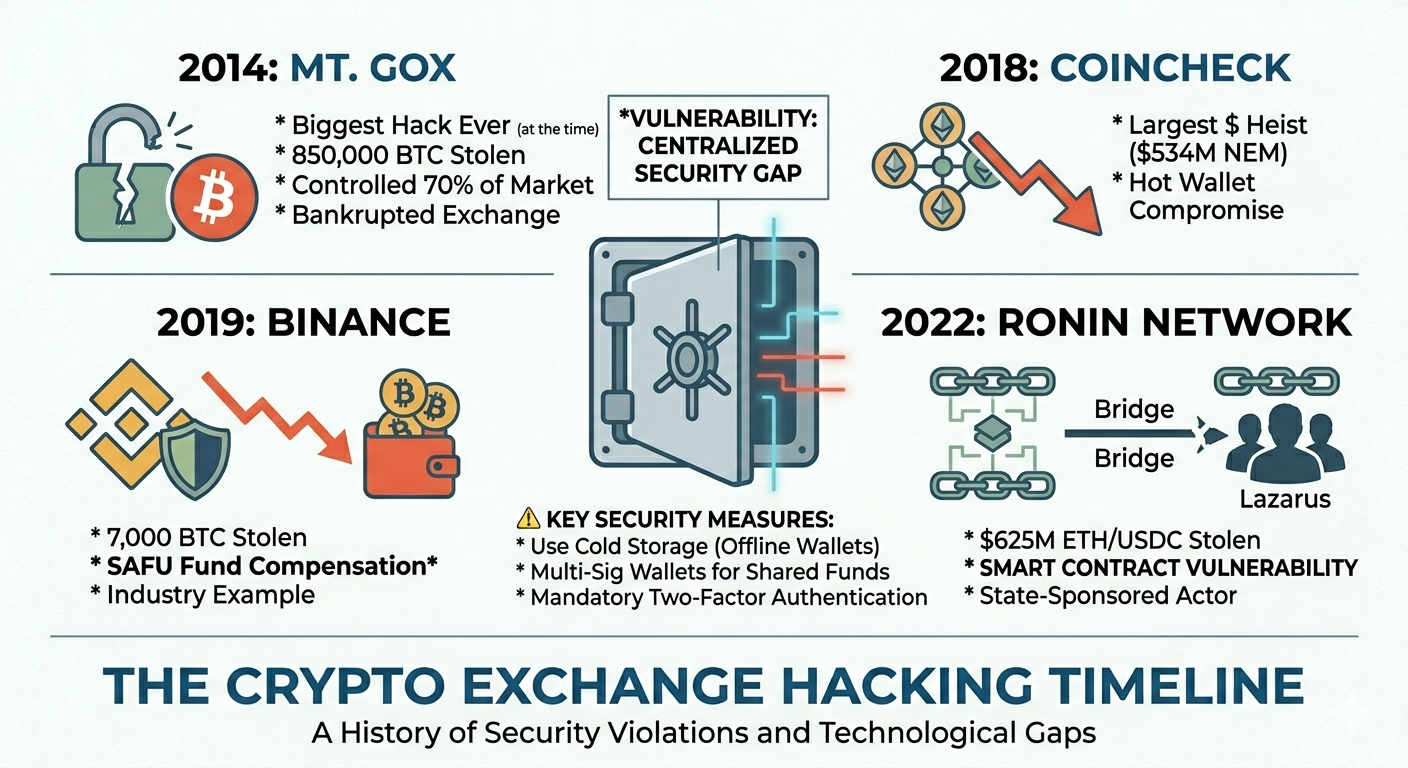
Exchange hacking is a notorious and important chapter in the history of cryptocurrency. Exchanges are platforms where tens of thousands of users store billions of dollars worth of digital assets. This huge amount of money is the main target of hackers. Several major hacking incidents in the past decade have questioned the security of the crypto world, as well as the need to strengthen technology. The most famous name in the history of crypto hacking is Mt. Gox. In 2014, when it controlled 70% of the world's Bitcoin transactions, it went bankrupt after a massive hack. Hackers exploited a weakness in the system to steal about 850,000 Bitcoins, whose market value at the time was about $450 million. This incident devastated the entire crypto market and proved that no centralized exchange is ever 100% secure.
In 2018, Japanese exchange Coincheck was hacked for nearly $534 million worth of 'nem' tokens. It is considered one of the largest crypto heists in history. The hackers carried out the attack by breaching the security of hot wallets (internet-connected wallets). Just a year later, in 2019, 7,000 bitcoins were stolen from the world's largest exchange Binance. However, Binance has shown its trust by compensating all users through their 'safu' fund, which is a big example in the crypto world.
In 2022, the type of crypto hacking became more sophisticated. Around $625 million worth of Ethereum and USDC was stolen from the popular sidechain Ronin Network for gamers. The North Korean hacker group 'Lazarus' is believed to have been involved in the theft. This proves that not only exchanges, but also blockchain bridges and smart contracts are now at great risk.
In short, the history of exchange hacking teaches us a harsh lesson—there is no room for laziness when it comes to protecting digital assets. Hackers are constantly changing their tactics, so exchanges also have to improve their security measures (such as cold storage, multi-sig wallets, and two-factor authentication). As a conscious user, using a personal cold wallet instead of keeping all your funds on major exchanges is the best way to avoid the risk of theft. This battle in the crypto world is a constant race between security and crime, where awareness is the only winner. Today's discussion concludes here. I hope you've found it interesting. Please share your thoughts on today's topic. Prayers for everyone. May everyone be well. Amen.

Twitter
https://x.com/i/status/2053315204948316375
https://x.com/i/status/2053109783448994174
https://x.com/i/status/2053315353460277720