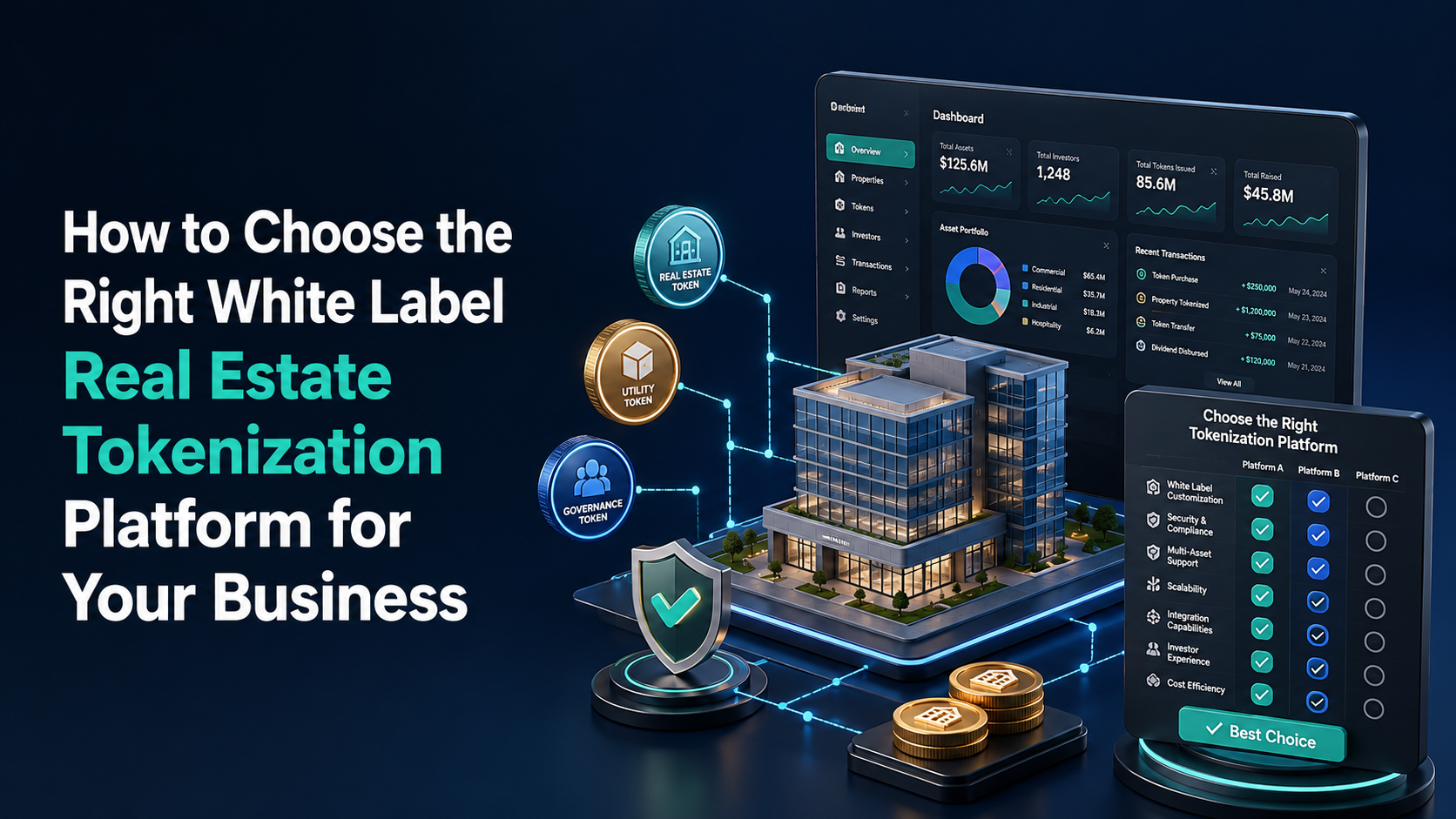
How to Choose the Right White Label Real Estate Tokenization Platform for Your Business
Real estate tokenization is becoming a practical option for businesses that want to represent property ownership, investment interests, or income rights through blockchain-based tokens. Instead of creating an entire technology stack internally, businesses can use a White Label Real Estate Tokenization Platform and launch a branded platform with the required tokenization, investor, compliance, and administration functions.
However, selecting a platform is not simply about comparing features or choosing the lowest development price. The right solution should fit the business model, property types, target investors, regulatory requirements, blockchain preference, and future operating plans. A poor choice can create difficulties with investor onboarding, asset management, token issuance, reporting, and secondary trading.
This guide explains the main methods businesses can use to assess a White Label Real Estate Tokenization solution before making a decision.
1. Define Your Real Estate Tokenization Business Model
Start by deciding what the platform is expected to do. A real estate company may want to tokenize individual properties, create investment funds, offer fractional ownership, manage property portfolios, or provide a marketplace for tokenized assets.
The business model affects almost every technology decision. For example, a platform focused on fractional property investment may need investor dashboards, token allocation, payment processing, compliance checks, and distribution management. A platform serving institutional clients may require more sophisticated reporting, permissions, custody integration, and administrative controls.
Write down the asset types, investor groups, revenue model, geographical markets, and expected transaction process before evaluating vendors. This gives your team a practical basis for comparing different White Label Real Estate Tokenization Platform options.
2. Check the Tokenization Model
Different real estate projects can use different token structures. Tokens may represent ownership interests, economic rights, debt claims, shares in a special purpose vehicle, or other legally defined interests.
Ask the provider how its White Label Tokenization Platform handles different token models. Find out whether token supply, ownership records, transfer rules, investor restrictions, and distribution schedules can be configured according to the project's legal structure.
The platform should also support proper links between off-chain legal agreements and on-chain token records. Blockchain records alone do not establish the legal rights associated with a property. The technology therefore needs to work alongside the business's legal and compliance framework.
3. Review Blockchain Support
Blockchain selection can affect transaction fees, transaction speed, wallet compatibility, smart contract standards, and investor access. Some businesses may prefer Ethereum, while others may consider networks such as Polygon, Avalanche, BNB Chain, or permissioned blockchain environments.
When reviewing White Label Real Estate Tokenization Development options, ask which networks are supported and whether the platform can work with more than one network. Also check whether smart contracts follow recognized token standards and whether contract deployment can be tested before going live.
It is useful to ask about network migration as well. If the business changes its blockchain strategy later, the provider should explain what happens to existing token records, investor accounts, and platform integrations.
4. Examine Smart Contract Functions
Smart contracts govern many activities within a tokenized real estate platform. These can include token issuance, transfers, investor restrictions, distributions, voting, redemption, and administrative actions.
Do not judge smart contracts only by the number of functions listed in a product brochure. Ask for details about contract testing, audit procedures, upgrade mechanisms, access controls, and emergency procedures.
A serious vendor should be able to explain how contracts are tested before deployment and how contract permissions are managed after launch. Businesses should also understand whether smart contract upgrades can affect existing investors or tokens.
5. Evaluate Compliance Features
Real estate tokenization involves financial, corporate, property, tax, and securities considerations depending on the jurisdiction and structure. Compliance therefore needs to be considered before selecting the technology.
Review features such as KYC and AML checks, investor accreditation where applicable, jurisdiction restrictions, wallet allowlists, transaction monitoring, document collection, investor suitability workflows, and reporting.
Ask whether the White Label Real Estate Tokenization Services provider supports integrations with external compliance providers. This can be useful when the business already works with a preferred KYC or identity verification service.
The technology does not replace legal advice. Businesses should work with qualified legal and compliance professionals to determine the applicable rules for their offering.
6. Assess Investor Onboarding
Investor onboarding can have a major effect on the usability of a tokenization platform. The process should cover account creation, identity verification, document submission, investment eligibility, payment, wallet setup, and token allocation where applicable.
Review the number of steps required and determine which parts can be automated through the platform. Also check whether administrators can review applications manually when necessary.
The investor dashboard should present relevant information such as holdings, transactions, distributions, documents, property information, and account status. A simple onboarding process can reduce administrative work while giving investors a better view of their investment activity.
7. Review Property and Asset Management
A real estate tokenization platform should not focus only on tokens. The underlying properties also need to be managed within the business workflow.
Check whether the system can store property details, valuation information, ownership structures, financial documents, rental income data, distribution records, and relevant project documentation.
If the business plans to manage several properties, ask how individual assets are separated within the platform. Administrators should be able to manage each property or investment vehicle without mixing records between projects.
This is particularly important for businesses planning to expand from one tokenized property to multiple assets.
8. Examine Payment and Distribution Functions
Investment platforms need reliable payment processes. Depending on the business model, investors may purchase tokens using fiat currency, stablecoins, cryptocurrencies, or a combination of payment methods.
Review the payment integrations available and determine how deposits, purchases, refunds, fees, dividends, rental income, and redemptions are handled.
For income-producing properties, distribution management deserves special attention. Ask whether the system can calculate investor allocations and maintain records of completed distributions.
Also examine how failed payments, refunds, disputed transactions, and reconciliation are handled. These operational details can become important once the platform begins processing real investor activity.
9. Check Secondary Trading Capabilities
Some real estate tokenization businesses plan to provide secondary trading, while others intend to keep tokens restricted to primary issuance and approved transfers.
If secondary trading is part of the business model, ask whether the platform includes an integrated marketplace or can connect with an external compliant trading venue.
Review order management, investor eligibility, transfer restrictions, settlement procedures, wallet controls, transaction records, and applicable compliance rules.
A marketplace should not be treated as an automatic feature. The legal status of token trading varies by jurisdiction, so the trading architecture should follow the applicable regulatory structure.
10. Assess Security Architecture
Security should be reviewed at several levels, including user accounts, wallets, APIs, databases, smart contracts, administrative permissions, and infrastructure.
Ask whether the provider uses multi-factor authentication, role-based permissions, encryption, activity logs, secure API practices, and monitoring systems.
Smart contract audits should also be examined carefully. Request information about who performed the audit, what contracts were reviewed, whether issues were found, and how those issues were addressed.
For administrative accounts, consider whether multiple approval levels can be introduced for sensitive actions such as token issuance, contract administration, large transfers, and changes to investor records.
11. Review Branding and Platform Customization
A major reason businesses choose a White Label Real Estate Tokenization Platform is to launch under their own brand rather than presenting a third-party product directly to customers.
Review which elements can carry the company's branding. These may include the website interface, investor dashboard, emails, notifications, domain, logos, colors, and communication templates.
Ask the provider which changes are included in the package and which require additional development. This helps prevent unexpected costs later.
The platform should also maintain a consistent experience across investor-facing and administrative areas.
12. Compare APIs and Third-Party Integrations
A tokenization business rarely operates with one application alone. It may need connections to KYC providers, payment gateways, custodians, wallets, property management software, accounting systems, analytics tools, and trading platforms.
This makes API support an important part of White Label Real Estate Tokenization Development.
Ask whether APIs are documented, whether webhooks are supported, how authentication works, and whether the vendor provides sandbox access. Also check whether integrations can be added without modifying the entire platform.
A well-planned integration layer can make future system changes easier and reduce dependence on a single external service.
13. Evaluate the Administration Dashboard
The investor interface receives much of the attention, but the administrator dashboard is equally important.
Administrators may need to create properties, configure token offerings, approve investors, review transactions, manage documents, monitor distributions, control permissions, and generate reports.
Look for role-based access so that different employees can perform only the functions relevant to their responsibilities. Activity logs are also useful because they provide a record of administrative actions.
Request a demonstration of the dashboard using a realistic property tokenization scenario rather than relying only on screenshots.
14. Understand Reporting and Data Management
Real estate businesses need records for investors, accountants, auditors, compliance teams, property managers, and internal decision-makers.
Review whether the platform can generate reports covering token holdings, investor activity, transactions, distributions, property data, fees, and account status.
Also ask how data is stored and backed up. Find out whether businesses can export their data if they later move to another technology provider.
Data ownership and access should be addressed in the commercial agreement before the platform goes live.
15. Compare Development and Operating Costs
The initial platform price is only one part of the total cost. Businesses should consider development, licensing, blockchain transactions, hosting, integrations, smart contract audits, compliance tools, maintenance, support, and future feature additions.
When comparing White Label Real Estate Tokenization Services, create a five-year cost estimate instead of looking only at the launch price.
Ask providers to separate one-time fees from recurring charges. Determine whether transaction volume, investor numbers, properties, wallets, or integrations affect the price.
This approach provides a more realistic view of the financial commitment.
16. Assess Vendor Experience and Support
The technology provider becomes an important operational partner after launch. Before selecting a vendor, examine its experience with tokenization projects and real estate-related platforms.
Ask about previous deployments, development practices, maintenance procedures, response times, security processes, and post-launch support.
It is also useful to understand who will handle technical issues after launch. Determine whether support is available during business hours or around the clock and whether critical incidents have defined response procedures.
17. Test the Platform Before Making the Final Decision
A product demonstration is useful, but hands-on testing provides better evidence.
Request a demo environment and create a sample property. Test investor registration, KYC workflows, token issuance, wallet connections, investment transactions, distributions, administrative controls, reporting, and token transfers.
Ask several internal team members to test the platform because investors, compliance staff, property managers, finance teams, and administrators may use different parts of the system.
Document problems and unanswered questions during the trial. Compare vendors using the same test scenarios instead of judging each demonstration separately.
18. Review the Long-Term Technology Roadmap
Your initial requirements may change as the business gains investors and adds properties. Therefore, review the provider's product roadmap and development process.
Ask how new blockchain networks, payment methods, compliance tools, investor features, and marketplace functions are introduced.
The purpose is not to select a platform with the largest feature list. It is to select a platform that can support the business model without forcing frequent technology replacements.
19. Create a Vendor Evaluation Scorecard
Before making the final selection, score each provider across several categories. A useful scorecard can include:
- Tokenization functions
- Compliance support
- Blockchain compatibility
- Smart contract security
- Investor onboarding
- Property management
- Payment and distribution functions
- Secondary trading support
- APIs and integrations
- Security controls
- Branding options
- Reporting
- Support
- Total cost
- Development timeline
Assign each category a weight based on its importance to the business. This creates a structured comparison and reduces the chance of selecting a platform simply because it has an attractive interface or lower initial price.
Conclusion
Choosing the right White Label Real Estate Tokenization Platform requires more than comparing features and prices. Businesses need to examine the tokenization model, blockchain infrastructure, smart contracts, compliance processes, investor onboarding, property management, payment functions, secondary trading, security, APIs, reporting, branding, support, and long-term costs. A platform should fit the company's real estate model and operational requirements while leaving room for future additions. Careful testing, vendor evaluation, legal review, and cost analysis can help businesses make a more informed decision before launch. Blockchain App Factory provides White Label Real Estate Tokenization Services for businesses looking to establish branded real estate tokenization platforms with functions suited to their project requirements.
FAQs
1. What is a White Label Real Estate Tokenization Platform?
A White Label Real Estate Tokenization Platform is a pre-developed technology solution that businesses can launch under their own brand. It can include functions for property tokenization, investor onboarding, token management, payments, compliance workflows, administration, and reporting.
2. How do I choose a White Label Real Estate Tokenization Platform?
Start by defining your business model, property types, target investors, jurisdictions, token structure, blockchain requirements, and trading plans. Then compare providers based on technology, security, compliance support, integrations, pricing, and post-launch assistance.
3. What features should a real estate tokenization platform have?
Common requirements include property management, token issuance, investor onboarding, KYC and AML integrations, wallet support, payment processing, smart contracts, token transfers, investor dashboards, administration tools, reporting, and API integrations.
4. Is blockchain selection important for real estate tokenization?
Yes. The blockchain can affect transaction costs, wallet support, transaction processing, smart contract standards, and investor access. The appropriate network depends on the project's business, technical, and legal requirements.
5. Can a white-label platform support multiple properties?
Many platforms can support multiple tokenized properties. However, businesses should confirm how the provider separates property records, investment vehicles, tokens, investors, financial information, and administrative permissions.
6. Does a white-label platform handle legal compliance?
Technology can provide compliance-related functions such as KYC workflows, investor restrictions, allowlists, document collection, and transaction records. However, legal compliance depends on the project's structure and jurisdiction and requires appropriate professional advice.
7. Can a business add its own branding?
Yes. White-label solutions generally allow businesses to present the platform using their own branding. The exact branding options should be confirmed with the provider before signing an agreement.
8. What should I ask a platform provider before choosing one?
Ask about supported blockchains, smart contract audits, security practices, compliance integrations, APIs, payment systems, investor management, property administration, pricing, support, data ownership, upgrade procedures, and previous project experience.
9. How much does White Label Real Estate Tokenization Development cost?
The cost varies according to the platform's features, blockchain, integrations, compliance requirements, branding needs, smart contract work, and deployment model. Businesses should request a detailed cost breakdown covering both initial and recurring expenses.
10. Can a white-label platform support secondary trading?
Some platforms can support marketplace or secondary trading functions, either directly or through integrations. Whether trading is permitted depends on the token structure and applicable laws, so legal and compliance requirements should be reviewed before adding this function.