What Is Driving the Rapid Growth of RWA Tokenization in 2026?
Real-world assets are becoming a major area of interest in the digital asset market in 2026. Property, private credit, government securities, commodities, artwork, funds, and other physical or financial assets can now be represented through blockchain-based tokens. This approach gives businesses a way to connect traditional assets with digital markets while creating new options for ownership, settlement, and investment.
RWA Tokenization has gained attention because it addresses several limitations found in conventional asset markets. Many traditional assets involve lengthy settlement procedures, multiple intermediaries, limited trading hours, and high entry requirements. Token-based ownership can introduce digital records, programmable transactions, fractional participation, and broader market access when supported by suitable legal and financial structures.
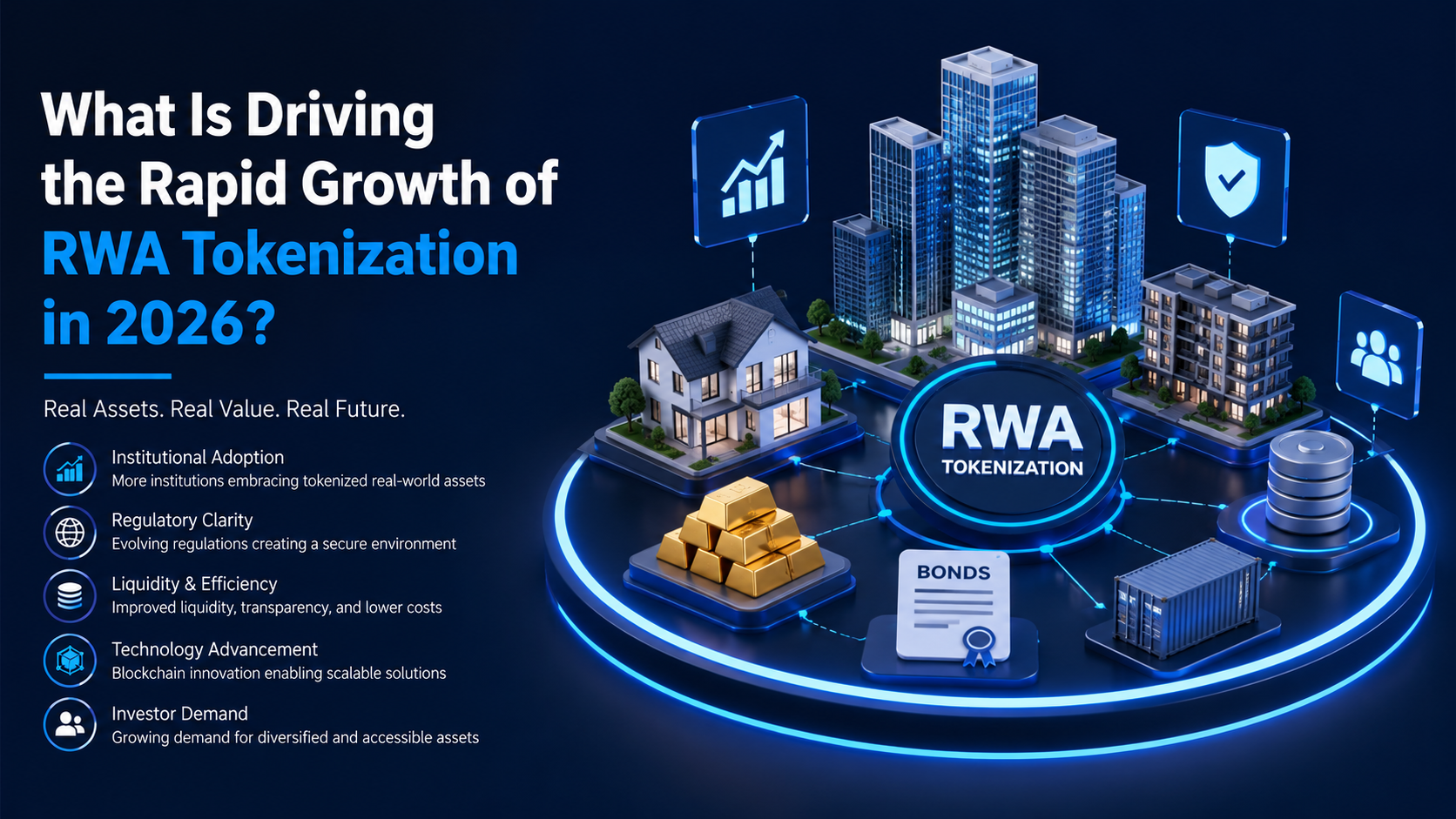
The growth is not coming from blockchain technology alone. Institutional participation, demand for digital financial products, improvements in blockchain infrastructure, regulatory progress, investor interest, and the need for more efficient asset management are all contributing to market activity. In 2026, these factors are creating a more practical environment for businesses considering Real World Asset Tokenization.
Growing Institutional Interest in Tokenized Assets
Financial institutions are showing greater interest in bringing traditional financial products onto blockchain networks. Banks, asset managers, investment firms, and financial technology companies are examining tokenized funds, bonds, credit products, and other assets as part of their digital asset strategies.
Institutional interest matters because these organizations manage large volumes of capital and operate within established financial systems. Their participation can create demand for tokenized products and encourage service providers to improve custody, compliance, investor verification, settlement, and reporting systems.
A growing number of institutions are also looking at blockchain as an infrastructure layer rather than only as a market for cryptocurrencies. This change in perspective has helped RWA Tokenization move beyond an experimental concept toward a business model with practical financial applications.
Demand for Fractional Ownership
The cost of many traditional assets prevents smaller investors from participating directly. Commercial properties, private equity interests, fine art, infrastructure projects, and other high-value assets often require substantial capital.
Tokenization can divide an asset into smaller digital units. Instead of purchasing an entire asset, eligible participants may acquire a portion represented by tokens, subject to the applicable legal and regulatory framework.
This model has particular relevance to real estate. A property worth millions can potentially be represented through a collection of digital tokens, giving investors access to a smaller economic interest. The same concept can apply to other asset classes.
Fractional ownership is therefore one of the reasons businesses are investigating Real World Asset Tokenization Services. It can create new product structures while giving asset owners additional methods for reaching investors.
Increasing Interest in Private Credit
Private credit has become another area receiving attention in tokenization. Traditional private credit markets can involve complex documentation, multiple parties, manual processes, and limited access for certain investors.
Token-based systems can represent claims linked to loans or credit instruments while recording ownership and transactions on blockchain infrastructure. Smart contracts can also support certain administrative processes, although legal agreements and human oversight remain important.
For financial companies, this creates opportunities to develop digital credit products with automated transaction records and programmable rules. As demand for alternative income products continues, tokenized private credit may become an important category within the RWA market.
Expansion of Tokenized Financial Products
The RWA market is no longer limited to physical assets. Financial instruments are becoming an important part of the discussion.
Government securities, money market funds, corporate debt, investment funds, and other financial products can be represented through blockchain-based systems. Tokenized financial products may offer faster settlement, programmable transactions, and digital ownership records.
The attraction is particularly relevant for organizations already operating in financial markets. Rather than creating an entirely separate investment category, they can use blockchain infrastructure to represent familiar financial products in a digital format.
This shift is also encouraging financial technology companies to offer RWA Tokenization Services for different asset categories, investor groups, and business models.
Better Blockchain Infrastructure
Blockchain networks have matured considerably compared with the early years of digital assets. Transaction processing, wallet infrastructure, custody solutions, smart contract frameworks, identity systems, and blockchain analytics have all developed further.
For businesses, this reduces some of the technical difficulties associated with launching tokenized asset products. Development teams can now work with established blockchain networks, token standards, wallet systems, oracle services, compliance tools, and digital identity components.
The technical environment is also becoming more diverse. Businesses can select networks based on transaction costs, speed, security requirements, ecosystem support, and regulatory considerations. This gives an RWA tokenization development company more options when planning the technical structure of a project.
Regulatory Progress Is Supporting Market Development
Regulation has always been an important factor in tokenized asset markets. Investors and institutions need to understand how tokenized ownership fits within existing securities, property, tax, anti-money laundering, and investor protection rules.
During 2026, regulatory discussions and frameworks across different jurisdictions continue to influence how businesses approach tokenized assets. Clearer rules can reduce uncertainty for companies considering digital asset products, although requirements still differ significantly between countries and asset categories.
Compliance is therefore becoming part of the product design process rather than something added after development. KYC, AML checks, investor eligibility, custody arrangements, reporting, transfer restrictions, and legal ownership structures may all need to be considered before a token reaches the market.
Growing Demand for Digital Settlement
Traditional asset transactions can require several days to complete because different institutions must verify information, process documents, reconcile records, and settle payments.
Blockchain-based settlement can reduce the number of manual steps involved in certain transactions. When asset records, ownership data, and transaction instructions are connected through digital infrastructure, some settlement activities can take place with fewer intermediaries.
This does not mean every tokenized asset transaction becomes instant. Legal checks, banking processes, compliance reviews, and off-chain requirements may still affect settlement time. However, the potential for faster digital settlement remains an important reason companies are evaluating RWA tokenization development services.
Programmable Ownership and Smart Contracts
Smart contracts give tokenized assets another useful feature: rules can be written into the transaction system.
For example, a tokenized investment product may have restrictions regarding who can purchase tokens, how transfers take place, when distributions occur, or which wallets are permitted to hold the asset. Smart contracts can apply some of these rules automatically.
This can reduce manual administration for certain processes and provide consistent transaction handling. However, smart contracts do not replace legal agreements. The relationship between the blockchain record and the legally recognized ownership structure must be planned carefully.
For this reason, RWA Token Development requires both technical planning and legal consideration.
Demand for New Investment Products
Investors are increasingly familiar with digital assets, while traditional financial institutions are searching for ways to offer digital products within regulated frameworks. This creates an opportunity for new investment structures based on tokenized assets.
A company could potentially create a tokenized property fund, digital bond product, commodity-backed asset, private credit instrument, or other legally structured investment product. The exact model depends on jurisdiction, asset type, investor eligibility, custody arrangements, and applicable regulations.
This product variety is helping expand the market beyond one particular asset category. Businesses can choose models that match their assets and target users instead of relying on a single tokenization approach.
Development of Dedicated RWA Platforms
As demand increases, businesses need specialized platforms to manage token issuance, investor onboarding, compliance, wallets, payments, asset information, ownership records, and secondary transactions.
This is increasing interest in rwa tokenization platform development. A platform may include an administrator dashboard, investor interface, token management system, smart contract layer, KYC and AML integration, payment gateway, custody connection, reporting module, and blockchain monitoring tools.
The architecture depends on the asset and business model. A tokenized real estate platform may require property documentation and distribution management, while a tokenized fund platform may require NAV calculations and investor reporting.
Companies that do not want to create every component internally may work with a RWA Tokenization Company or use RWA Tokenization development services to reduce development effort.
Greater Interest in Secondary Markets
Liquidity has traditionally been a challenge for many alternative assets. Real estate, private equity, private credit, artwork, and similar investments can have long holding periods and limited resale options.
Tokenization does not automatically create liquidity, but it can provide the technical infrastructure needed for digital transfers where regulations permit them. If a compliant secondary market exists, eligible investors may have more options for transferring their interests.
This possibility is attracting businesses that want to create marketplaces for tokenized assets. Such platforms need careful attention to investor eligibility, transfer rules, market surveillance, custody, and compliance.
Growth of Real Estate Tokenization
Real estate remains one of the most discussed use cases for RWA Tokenization. Properties have high values, complex ownership structures, and significant documentation requirements, making them suitable candidates for digital representation.
A tokenized property model may divide economic interests into digital units while maintaining legal ownership through an appropriate entity or structure. Investors can then participate according to the rights attached to those tokens.
Real estate firms are investigating tokenization for commercial buildings, residential projects, hospitality assets, rental properties, and development projects. This is creating demand for Real World Asset Tokenization Services that combine blockchain development with property-specific business requirements.
Expansion of Tokenization Across Asset Classes
Another factor behind the market's growth is the number of assets that can potentially be represented digitally. Real estate is only one category.
Commodities, artwork, collectibles, intellectual property rights, infrastructure projects, private funds, invoices, carbon-related assets, and financial instruments are also being considered for tokenization.
Each asset type requires a different structure. A commodity-backed token may require custody and reserve verification, while an artwork token may require provenance records and ownership documentation. This diversity gives development companies opportunities to create specialized solutions for different industries.
How Businesses Are Approaching RWA Tokenization in 2026
Businesses entering this market generally begin by selecting an asset and defining the ownership model. They then assess regulatory requirements, investor eligibility, token economics, blockchain selection, custody, payment methods, smart contract requirements, and platform functionality.
The next stage involves designing the tokenization architecture. This can include token issuance, wallet management, investor onboarding, compliance checks, asset documentation, transaction records, reporting, and administrative controls.
Testing is particularly important because smart contract errors or incorrect ownership logic can create serious financial and legal problems. Before launch, businesses may conduct security reviews, compliance checks, user testing, and controlled token issuance.
A suitable RWA tokenization development company can assist with these stages, from technical architecture and smart contract development to platform integration and post-launch maintenance.
What the Growth of RWA Tokenization Means for Businesses
The rapid growth of RWA Tokenization is creating opportunities for financial institutions, asset managers, property companies, technology providers, and startups. Businesses can develop platforms that connect physical or traditional financial assets with blockchain-based ownership systems.
However, success depends on more than issuing tokens. A viable project needs a legally sound ownership structure, suitable asset selection, investor demand, compliance processes, secure technology, reliable custody, and a practical distribution model.
Companies considering Real World Asset Tokenization should therefore treat token issuance as one component of a wider financial product. The platform, legal structure, investor experience, asset management process, and market strategy all need to work together.
Conclusion
The rapid growth of RWA Tokenization in 2026 is being influenced by institutional interest, fractional ownership, private credit demand, tokenized financial products, better blockchain infrastructure, regulatory developments, digital settlement, smart contracts, new investment models, and demand for secondary markets. Real estate, financial instruments, commodities, private credit, and other asset categories are giving businesses multiple opportunities to enter the market. As these use cases expand, companies are also looking for reliable RWA Tokenization Services and Real World Asset Tokenization Services to manage technical and business requirements. A well-planned tokenization project requires more than RWA Token Development because legal structures, compliance, custody, investor onboarding, platform architecture, and asset management also matter. Businesses can work with an RWA Tokenization Company or an RWA tokenization development company when they need assistance with planning and implementation. Blockchain App Factory provides RWA tokenization development services for businesses looking to create blockchain-based solutions for real-world assets.
FAQs
1. What is RWA Tokenization?
RWA Tokenization is the process of representing ownership or economic rights connected to real-world assets through blockchain-based tokens. The assets can include real estate, financial instruments, commodities, private credit, artwork, and other eligible assets.
2. Why is RWA Tokenization growing in 2026?
The growth is linked to increasing institutional interest, demand for fractional investment, digital settlement, tokenized financial products, improved blockchain infrastructure, regulatory developments, and the expansion of tokenization into different asset categories.
3. What assets can be tokenized?
Potential assets include real estate, government securities, private credit, investment funds, commodities, artwork, infrastructure interests, invoices, and other assets where the legal and regulatory structure permits tokenization.
4. What is involved in RWA tokenization development?
RWA tokenization development can involve smart contracts, token issuance, investor onboarding, KYC and AML integration, wallet management, payment processing, asset documentation, compliance controls, dashboards, custody connections, reporting, and blockchain integration.
5. Why do businesses use RWA Tokenization Services?
Businesses may use RWA Tokenization Services when they need technical support for token issuance, platform development, smart contracts, investor management, blockchain integration, compliance-related features, and ongoing platform maintenance.
6. Is RWA Tokenization the same as cryptocurrency?
No. RWA tokens represent rights or interests connected to real-world assets or financial products, while cryptocurrencies generally function as native digital assets on blockchain networks. The legal and economic structure of an RWA token depends on the underlying asset and jurisdiction.
7. What is the role of smart contracts in RWA Tokenization?
Smart contracts can manage token issuance, transfer conditions, distribution rules, access restrictions, and other predefined functions. They can automate certain activities but do not replace legal agreements or regulatory requirements.
8. How can companies start an RWA tokenization project?
Companies can begin by selecting the asset, identifying the intended investors, reviewing legal requirements, defining the ownership structure, choosing a blockchain network, planning platform functions, and developing the required token and compliance infrastructure.