The Architecture of Digital Freedom: Why Web 3.0 Changes Everything
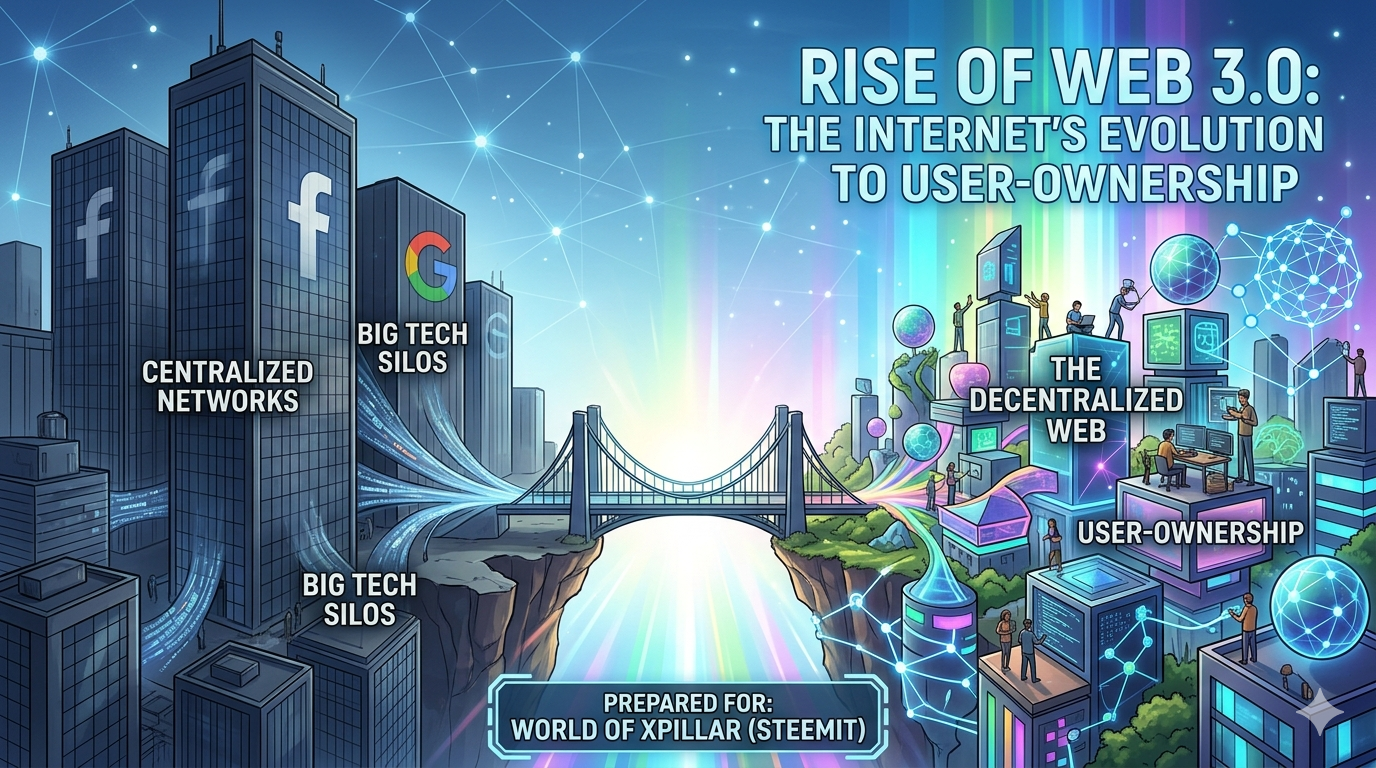
Every day, millions of us log onto the internet to create. We write insightful articles, share breathtaking digital art, curate content, and build vibrant communities. Yet, for the longest time, a quiet truth has loomed over our digital lives: we build the value, but corporations own the digital land.
If you are reading this on Steemit, you are already standing on the frontier of a massive paradigm shift. You aren't just a user of a platform; you are a stakeholder in an ecosystem. This is the core promise of the next great leap in human connectivity: Web 3.0.
But how did we get here, and why does this evolution matter so deeply for creators, artists, and thinkers? Let’s break down the digital revolution.
The Three Eras of the Digital Landscape
To understand where we are going, we have to look at the foundations of the digital world we've traveled through.
- Web 1.0: The "Read-Only" Library (The 1990s)
In the early days, the internet was essentially a massive, decentralized digital encyclopedia. Users were purely passive consumers. You opened a browser, read a static HTML webpage, and closed it. There were no comment sections, no likes, and no content creation pipelines for the average person. It was decentralized, but it was a one-way street. - Web 2.0: The "Read-Write" Social Empire (The 2000s – Present)
Web 2.0 changed everything by introducing interactivity. Suddenly, anyone could become a creator. Social media platforms, blogs, and video-sharing sites emerged, allowing us to connect and upload our lives online.
However, this era came with a heavy cost: centralization. A handful of silicon giants built massive digital monoliths. In exchange for "free" hosting, we surrendered our personal data, our privacy, and ownership of our intellectual property. On Web 2.0, if a platform decides to change its algorithm or shut down your account, years of hard work can vanish in a single click. - Web 3.0: The "Read-Write-Own" Revolution
Web 3.0 re-engineers the internet from the ground up using blockchain technology, decentralized networks, and smart contracts. The fundamental difference? True User Ownership.
In a Web 3.0 world, there is no central server or corporate gatekeeper. Data is distributed across a secure network, and value is directly distributed to the people who create it.
The Pillars of Web 3.0
What makes Web 3.0 structurally different from the internet we've grown accustomed to? It relies on three core principles:
Decentralization: Data isn't stored in a single corporate data center. Instead, it lives across thousands of nodes worldwide, making censorship incredibly difficult and ensuring the network remains open to everyone.
Trustlessness and Permissionless Access: "Trustless" doesn't mean untrustworthy—it means you don't need to blindly trust a third-party bank or corporation to execute a transaction. Smart contracts handle everything transparently. "Permissionless" means anyone, anywhere in the world, can participate without needing an approval stamp from a government or company.
Tokenization and Native Economics: By integrating cryptocurrency and tokens directly into the fabric of the web, value can flow instantly between creators and consumers without intermediaries cutting massive fees.
Why Communities Like World of Xpillar Are Leading the Charge
The World of Xpillar community has always been a space that celebrates imagination, visual storytelling, and human creativity. In a traditional Web 2.0 system, digital artists and writers often struggle to monetize their passion, frequently losing a massive percentage of their earnings to corporate platforms or relying on unpredictable ad revenue.
Web 3.0 platforms like Steemit turn that flawed model on its head:
Your Content is Asset-Backed: When you post an article or share a drawing, the engagement you receive translates into tangible cryptographic value. Your creativity is recognized directly by your peers, not dictated by an opaque, ad-driven algorithm.
Permanent Intellectual Sovereignty: Your contributions live transparently on the blockchain. You own your identity, your cryptographic keys, and your reputation.
True Community Synergy: Instead of competing against an algorithm designed to maximize outrage for ad clicks, Web 3.0 spaces foster genuine curation networks where supporting others simultaneously lifts the entire community.
Looking Forward: The Horizon of a Free Web
We are still in the early, foundational stages of Web 3.0. The user interfaces are still evolving, and the wider world is just beginning to realize that data sovereignty is a fundamental digital right.
But the bridge has been built. Every time we post, upvote, comment, and curate transparently on the blockchain, we are laying down another brick for a fairer, open-source digital society. The future of the internet belongs to those who build it.
What are your thoughts on the evolution of Web 3.0? How has shifting to decentralized platforms changed the way you view your own creative work? Let's discuss in the comments below!