Beyond Administration: Key Salesforce Roles That Deserve More Attention
While Salesforce administrators are widely recognized, several other critical roles within the Salesforce ecosystem often receive less attention despite their significant impact on business success. These roles contribute to the design, development, analysis, and strategic use of Salesforce, ensuring organizations extract maximum value from the platform.
One such role is the Salesforce Developer. Developers are responsible for building custom applications and features using programming languages like Apex and Visualforce, as well as modern tools such as Lightning Web Components. When standard Salesforce functionality cannot meet specific business needs, developers step in to create tailored solutions. Their work enables companies to automate complex processes, integrate external systems, and deliver advanced user experiences.
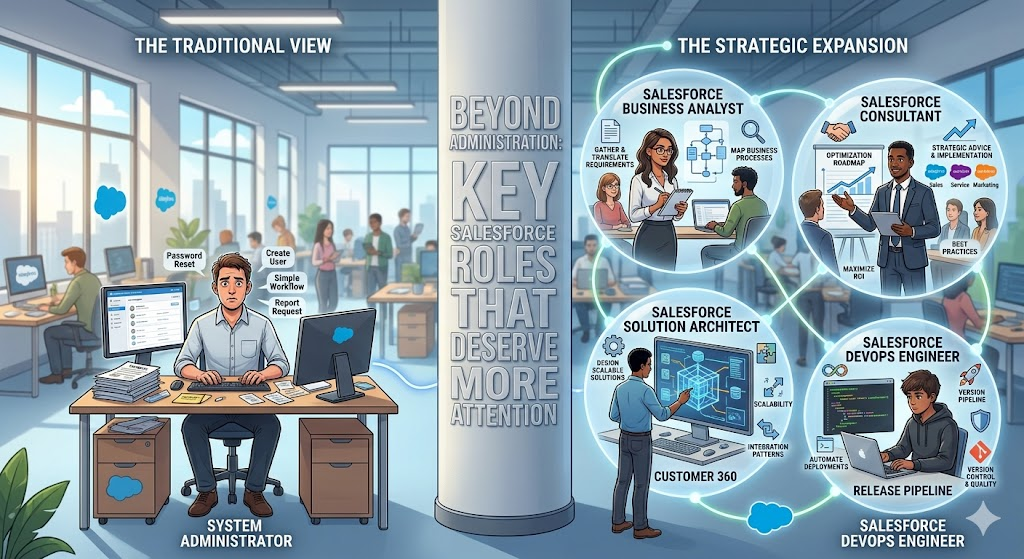
Another vital role is the Salesforce Business Analyst. Business analysts act as a bridge between technical teams and business stakeholders. They gather requirements, analyze business processes, and translate organizational needs into Salesforce solutions. This role is essential because it ensures that Salesforce implementations align with business objectives. Without clear analysis and communication, even the most technically advanced systems can fail to deliver value.
The Salesforce Consultant is also a key player, particularly in larger or more complex implementations. Consultants provide strategic guidance to organizations adopting or expanding Salesforce. They assess business requirements, design system architecture, and oversee implementation projects. Consultants often specialize in specific industries or Salesforce clouds, such as Sales Cloud, Service Cloud, or Marketing Cloud, making their expertise highly valuable.
Additionally, the role of a Salesforce Architect deserves greater recognition. Architects design the overall structure of Salesforce systems, focusing on scalability, performance, and integration. They make high-level decisions about data models, security frameworks, and system interactions. This role requires deep technical knowledge and experience, as architects ensure that systems remain efficient and adaptable as businesses grow.
Finally, Salesforce Marketing Cloud Specialists play an increasingly important role in today’s data-driven environment. They manage customer engagement strategies, including email campaigns, customer journeys, and personalized marketing automation. Their work helps organizations build stronger relationships with customers and improve conversion rates.
In conclusion, the Salesforce ecosystem is supported by a diverse range of roles beyond administration. Developers, business analysts, consultants, architects, and marketing specialists all contribute uniquely to the success of Salesforce implementations. Recognizing and investing in these roles can help organizations unlock the full potential of their CRM systems.