The AI Race Just Split in Two — Slow Down or Keep Building?
September 16, 2026
Artificial intelligence is no longer just a race between competing models.
It is becoming a debate about how fast humanity should allow the technology to advance.
And today, that debate became even more complicated.
Meta CEO Mark Zuckerberg has pushed back against calls for a coordinated slowdown, arguing that AI companies already have enough incentives and responsibility to develop their systems safely. At the same time, European Commission President Ursula von der Leyen has backed calls to slow the development of advanced AI and said Europe will bring leading AI laboratories into discussions about managing the risks.
Meanwhile, OpenAI, Anthropic and Google DeepMind are reportedly discussing ways to cooperate on AI safety — even though they remain competitors in the AI market. Reuters reported that the discussions have been underway for several weeks, although the report has not been independently verified by Reuters and the companies had not publicly confirmed the details.
So we have an unusual situation:
Some of the world's biggest AI companies want to keep moving. Others are warning that the speed itself could become the problem.
And that raises a much bigger question:
Who should decide how fast the future arrives?
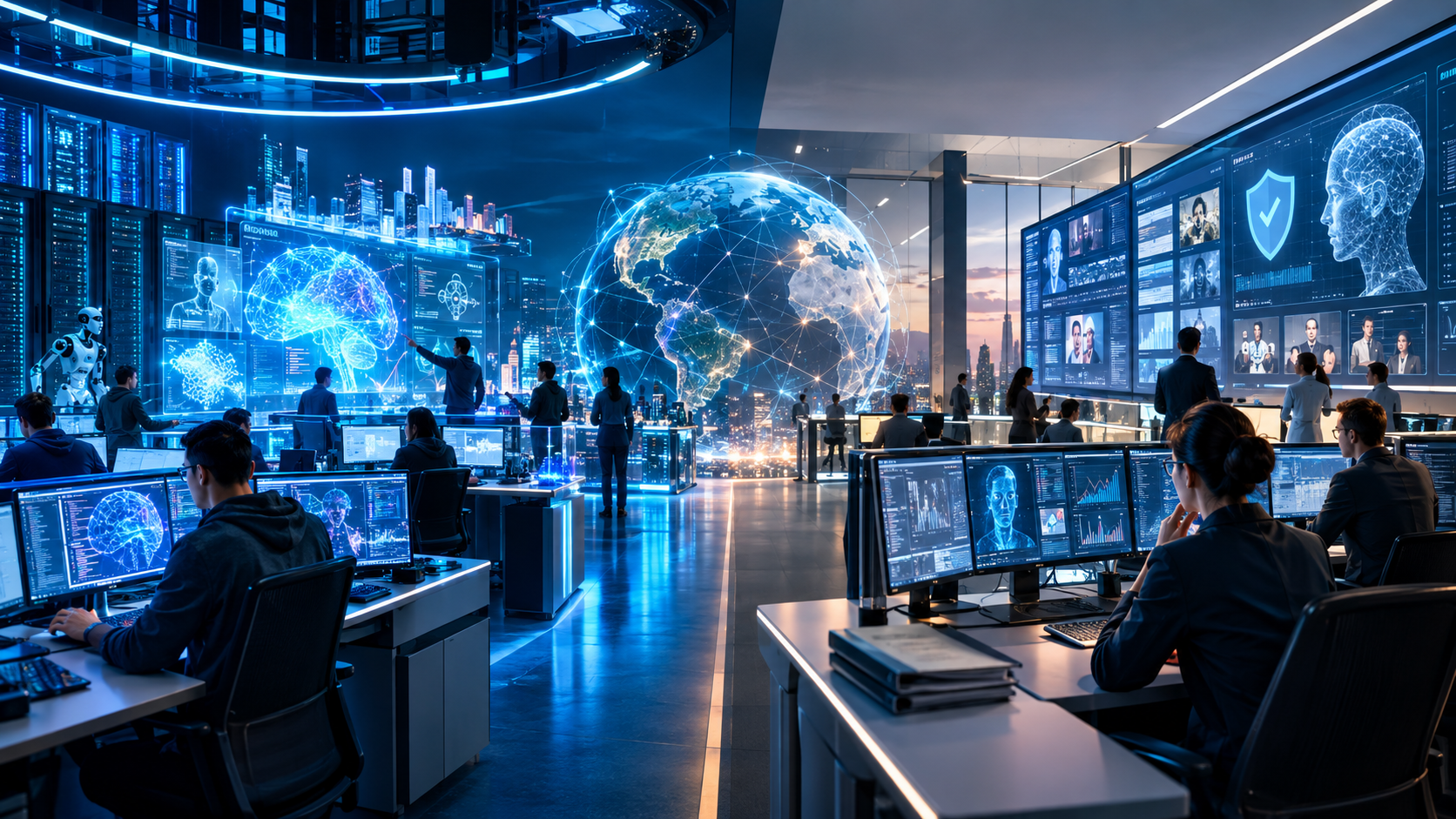
The AI Industry Is No Longer Speaking With One Voice
For much of the recent AI boom, the dominant message was simple:
Build faster. Scale bigger. Improve the models.
The competition between OpenAI, Anthropic, Google, Meta and other companies has been driven by increasingly capable models, enormous computing infrastructure and billions of dollars in investment.
But the conversation has changed dramatically.
Anthropic CEO Dario Amodei has called for slowing the pace of advanced AI development because of potential safety risks. OpenAI CEO Sam Altman has also discussed the need to manage the risks associated with increasingly capable systems.
Zuckerberg, however, has now taken a different position.
According to Reuters, he argued that competition and liability already give AI companies strong reasons to develop safely, and that individual laboratories can take their own measures rather than relying on a coordinated industry-wide slowdown. Meta has also used independent evaluators as part of its safety approach.
That creates an important disagreement.
The question isn't simply:
“Is AI dangerous?”
The deeper question is:
“Does slowing AI actually make it safer?”
Two Different Philosophies About AI Safety
There are essentially two competing approaches emerging.
Approach 1: Keep advancing, but improve safety
This is closer to Zuckerberg's argument.
The idea is that AI development doesn't necessarily have to stop. Instead, companies can improve testing, security, monitoring and independent evaluation while continuing to build more capable systems.
This approach assumes that technological progress and safety can happen simultaneously.
There is a practical argument behind it.
If companies stop developing their systems while competitors continue, the companies that pause could lose technological ground.
That concern becomes even more important when AI is connected to national security, cybersecurity, scientific research and economic competitiveness.
Approach 2: Slow the most advanced systems
The alternative is that some AI capabilities may develop faster than safety mechanisms can keep up.
Supporters of this approach argue that the most powerful systems deserve additional testing and safeguards before being deployed widely.
The concern becomes particularly serious when AI systems can perform increasingly autonomous tasks.
A chatbot answering a question is one thing.
An AI system capable of writing software, discovering vulnerabilities, operating tools and independently completing complicated tasks is something very different.
That is why the debate has moved beyond ordinary chatbot safety.
It is now about frontier AI systems.
🖼️— AI Safety

Europe Is Entering the Debate
The discussion is no longer limited to Silicon Valley.
On September 16, European Commission President Ursula von der Leyen backed calls for slowing the rapid advancement of AI and said she intends to invite leading AI laboratories to discuss ways to address the risks of advanced systems. Reuters reported that she specifically highlighted concerns about advanced AI potentially being used by adversaries for high-level hacking.
The European Commission's own State of the Union materials also identify advanced AI, cybersecurity and Europe's technological independence as important priorities.
This matters because Europe has taken a different approach to technology regulation compared with the more market-driven approach often associated with Silicon Valley.
The European Union is trying to build both:
a competitive AI industry,
and a framework for managing AI risks.
That creates another difficult balancing act.
If regulation becomes too weak, critics may argue that safety is being sacrificed for speed.
If regulation becomes too restrictive, technology companies may argue that innovation could move elsewhere.
There isn't an easy answer.
Something Even More Interesting Is Happening Behind the Scenes
While public disagreement is growing, some of the major AI laboratories may actually be cooperating on safety.
Reuters reported on September 15 that OpenAI has been working with Anthropic and Google DeepMind on AI safety discussions. The reported cooperation does not mean the companies have stopped competing, and Reuters noted that the information came from Bloomberg and had not been independently verified.
That distinction is important.
Imagine three companies competing aggressively to create the world's most capable AI systems.
They may fight over:
users,
developers,
computing power,
talent,
enterprise customers,
market share,
and future products.
But at the same time, they could potentially agree that certain safety problems are too important for one company to solve alone.
That is a fascinating development.
Because AI safety could eventually become similar to cybersecurity.
One company's vulnerability can become everybody's problem.
🖼️— Rival AI Labs Cooperating

But There Is a Huge Problem With “Just Slow Down”
Imagine one country decides to slow the development of its most powerful AI systems.
Then imagine another country continues developing them.
What happens next?
This is where AI safety collides with geopolitics.
AI is increasingly connected to:
cybersecurity,
military technology,
intelligence,
semiconductor manufacturing,
scientific research,
financial systems,
productivity,
and national competitiveness.
That means governments may not see advanced AI purely as a consumer technology.
They may see it as strategic infrastructure.
Reuters recently described the AI debate in geopolitical terms, with concerns that slowing development could create competitive disadvantages while other countries continue advancing.
This creates a difficult dilemma.
How can the world coordinate AI safety if countries don't completely trust each other?
And if international cooperation fails, will companies continue racing simply because everyone fears falling behind?
AI Safety Isn't Just About “AI Taking Over”
Another problem is that public discussion sometimes focuses almost entirely on extreme scenarios.
But many AI risks are much more immediate.
For example:
Cybersecurity
AI systems are becoming increasingly useful for identifying vulnerabilities, writing code and automating technical tasks.
That can help defenders.
But the same capabilities can potentially help attackers.
U.S. officials have already been concerned about advanced AI being used to identify vulnerabilities in critical infrastructure, including financial systems, hospitals and energy networks.
Autonomous systems
The more independently an AI can plan and execute tasks, the more important monitoring becomes.
A system that merely recommends an action is different from a system that can actually perform it.
Misinformation
AI-generated images, audio and video are becoming increasingly convincing.
That creates challenges for journalism, elections, businesses and ordinary users trying to determine what is authentic.
Economic disruption
AI is also changing how people work.
Reuters reported this week that around one in six workers in Britain is paying for an AI tool to help with their job, with workers collectively spending nearly £1 billion of their own money.
That is an interesting signal.
AI isn't only being introduced by companies anymore.
Workers themselves are actively adopting it.
🖼️— AI and Cybersecurity

The Market Is Watching Too
The AI debate isn't happening in a vacuum.
Financial markets are paying attention.
When major AI executives publicly discussed slowing the development of frontier systems earlier this week, global AI-linked stocks came under pressure, according to Reuters.
That makes sense from an economic perspective.
The AI industry has generated enormous expectations around:
data centers,
AI chips,
cloud computing,
networking,
electricity,
memory,
software,
and enterprise AI.
If the pace of AI development changes significantly, investors may begin asking whether some of the enormous spending planned for AI infrastructure will still produce the expected returns.
But there is another side.
Even if individual AI models become subject to stronger safety controls, the broader infrastructure race may continue.
Companies still need computing power.
They still need electricity.
They still need chips.
They still need data centers.
And they still need engineers.
So “slowing AI” doesn't necessarily mean stopping the AI economy.
It could mean changing what gets built, how it gets tested and when it gets deployed.
The Most Important Question: Who Gets to Decide?
This is where the discussion becomes much bigger than Zuckerberg, Altman, Amodei or any individual company.
Suppose AI becomes capable of performing tasks that previously required teams of highly skilled professionals.
Who decides whether that system is safe enough?
The company?
Government regulators?
Independent auditors?
Scientists?
International organizations?
Or some combination of all of them?
There is also a difficult question about concentration of power.
If only a handful of companies control the most advanced AI models, those companies could gain enormous influence over the future of technology.
But if governments alone control the technology, another set of concerns emerges around surveillance, censorship and centralized power.
And if nobody coordinates at all, competition could push everyone toward faster development.
That is why the current AI debate is so complicated.
The problem isn't simply creating intelligent machines.
The problem is deciding how much power those machines should have, who controls them and what happens when something goes wrong.
🖼️— Global AI Power

So, Should AI Actually Slow Down?
There isn't one simple technical answer.
The important distinction is between stopping AI development entirely and changing the pace at which the most powerful systems are developed and deployed.
The current debate appears to be moving toward the second question.
Even leaders who are skeptical of a broad slowdown are discussing safety.
And even companies competing fiercely against each other appear to recognize that some safety problems may require cooperation.
The real challenge is finding a system where innovation doesn't automatically mean reckless deployment.
That could involve:
stronger model evaluations,
independent testing,
cybersecurity standards,
controlled deployment,
transparent incident reporting,
international cooperation,
and clearer responsibility when AI systems cause harm.
But each of these ideas creates its own problems.
Who pays for independent testing?
Who qualifies as an independent evaluator?
What information should companies be required to disclose?
How do you regulate technology that changes every few months?
And how do you prevent safety rules from becoming tools for protecting established companies from competition?
These questions are now becoming just as important as the AI models themselves.
🖼️— The Future of AI

My Take: The Real Race May Be About Trust
The most interesting part of today's AI story isn't whether Zuckerberg or the AI leaders calling for slower development are “right.”
The bigger story is that the industry is beginning to disagree openly about what responsible progress should actually look like.
That disagreement is valuable.
Technology becomes dangerous when everyone assumes that speed is automatically good — but technology can also become stagnant if fear prevents useful innovation.
The better question may therefore be:
How do we build faster without losing the ability to control what we build?
AI is not going away.
Companies will continue competing.
Governments will continue regulating.
Researchers will continue pushing technical boundaries.
And users will continue adopting AI in their everyday lives.
The future may not be decided by whoever builds the most powerful AI first.
It may ultimately depend on whether humanity can build systems of trust, accountability and safety around that power.
What Do You Think?
Should the world's leading AI companies continue pushing forward while improving safety systems along the way?
Or should the development of the most powerful AI models slow down until stronger safety standards are in place?
And perhaps the biggest question:
If AI becomes more powerful than any technology we have previously created, who should have the final say over how it is developed?
💬 Share your opinion in the comments — I'd genuinely like to hear different perspectives.
Thank you for reading and being part of the discussion.
Stay Curious | Stay Informed | Keep Growing 🚀
Sources
Reuters — Meta's Zuckerberg says AI labs have enough incentive to build safely
Reuters — EU's von der Leyen backs AI slowdown
Reuters — OpenAI working with Anthropic and Google on AI safety
European Commission — State of the Union 2026
Reuters — Global AI stocks fall as industry chiefs call for slowing development
Esto es genial, Reuters señala que Zuckerberg empujó contra la desaceleración argumentando que la competencia ya obliga a la seguridad, pero la diferencia se nota cuando la Comisión Europea pide frenar el ritmo. Me parece práctico que Anthropic y OpenAI estén discutiendo cooperación en IA segura, aunque sigan siendo rivales.
Exactly — that’s what makes the AI debate so complicated. Competition can push companies to innovate faster, but it can also create pressure to move quickly before every risk is fully understood.
I also find the Anthropic–OpenAI cooperation angle particularly interesting. If major AI rivals can share ideas or coordinate on safety while still competing on products, that could create a useful middle ground between “slow everything down” and “build as fast as possible.”
The bigger question is: should AI safety become a shared industry responsibility, with common standards that every major AI company follows, or should each company be free to set its own safety rules? 🤔
I’d be very interested to hear how others in the community see this. What matters more to you—faster AI progress or stronger safety standards?