How Do Regenerative DC Electronic Loads Improve AIDC Power Supply Testing?
Introduction
Artificial intelligence is transforming the architecture of modern data centers. As AI servers, GPUs, CPUs, accelerators, and high-speed networking systems become more powerful, the electrical infrastructure supporting these systems must also evolve. AIDC (Artificial Intelligence Data Center) power supplies are being designed for higher power density, faster dynamic response, greater efficiency, and continuous operation under demanding conditions.
These changes create new challenges for power-supply manufacturers and test engineers. A power supply designed for an AI server cannot be adequately validated using only a simple resistive load or a conventional static test. Engineers need to reproduce rapidly changing current demands, evaluate transient response, perform long-duration aging tests, and verify protection functions under controlled and repeatable conditions.
This is where the regenerative DC electronic load becomes particularly valuable.
Unlike a conventional electronic load that converts the energy absorbed from a device under test primarily into heat, a regenerative DC electronic load can recover much of the test energy and feed it back to the electrical grid. At the same time, a modern programmable regenerative load can provide fast current transitions, automated test sequences, precision measurement, and high-power operation.
For AIDC power-supply testing, these capabilities can improve not only test accuracy and flexibility, but also laboratory energy efficiency and operating economics.
1. Why AIDC Power Supply Testing Is Becoming More Challenging
The power profile of an AI data center is fundamentally different from that of a conventional computing environment.
Modern servers can contain multiple high-performance GPUs, CPUs, memory subsystems, storage devices, networking hardware, and other accelerators. Their power consumption can change rapidly depending on workload. For example, a processor or accelerator may transition from a relatively low-power state to a high-power operating state within a very short period.
These changes can create steep current transients at the output of the power supply.
A power supply may perform correctly under a stable 50% or 100% load but experience excessive voltage deviation when the load changes rapidly. Therefore, testing must go beyond steady-state output measurements.
Engineers may need to evaluate:
- Output-voltage regulation
- Current response
- Transient overshoot and undershoot
- Recovery time
- Control-loop stability
- Protection functions
- Thermal performance
- Long-duration operating stability
- Response to repeated load transitions
- Performance across different operating points
A programmable DC electronic load provides the controllability necessary to reproduce these conditions. A regenerative version adds another important capability: recovering the energy consumed during testing.
2. What Is a Regenerative DC Electronic Load?
A DC electronic load is an active test instrument used to draw controlled electrical power from a DC power source. Instead of simply connecting a fixed resistor, engineers can electronically program how much current or power the load draws.
Depending on the instrument, operating modes can include constant current (CC), constant power (CP), and constant resistance (CR).
A regenerative DC electronic load goes one step further.
Rather than dissipating the absorbed electrical energy as heat, the load uses power-electronic conversion technology to transfer the energy back toward the AC grid. In effect, the test system acts as both a controllable load and an energy-recovery system.
This distinction becomes increasingly important as the power rating of AIDC power supplies increases.
Consider a high-power power-supply test that runs continuously for several hours. With a conventional energy-consuming load, a substantial amount of electrical energy is converted into heat. That heat must then be removed from the test laboratory using ventilation or air conditioning.
With regenerative loading, a large portion of the absorbed energy can instead be returned to the grid. The result is potentially lower energy consumption, reduced heat generation, and lower thermal-management requirements.
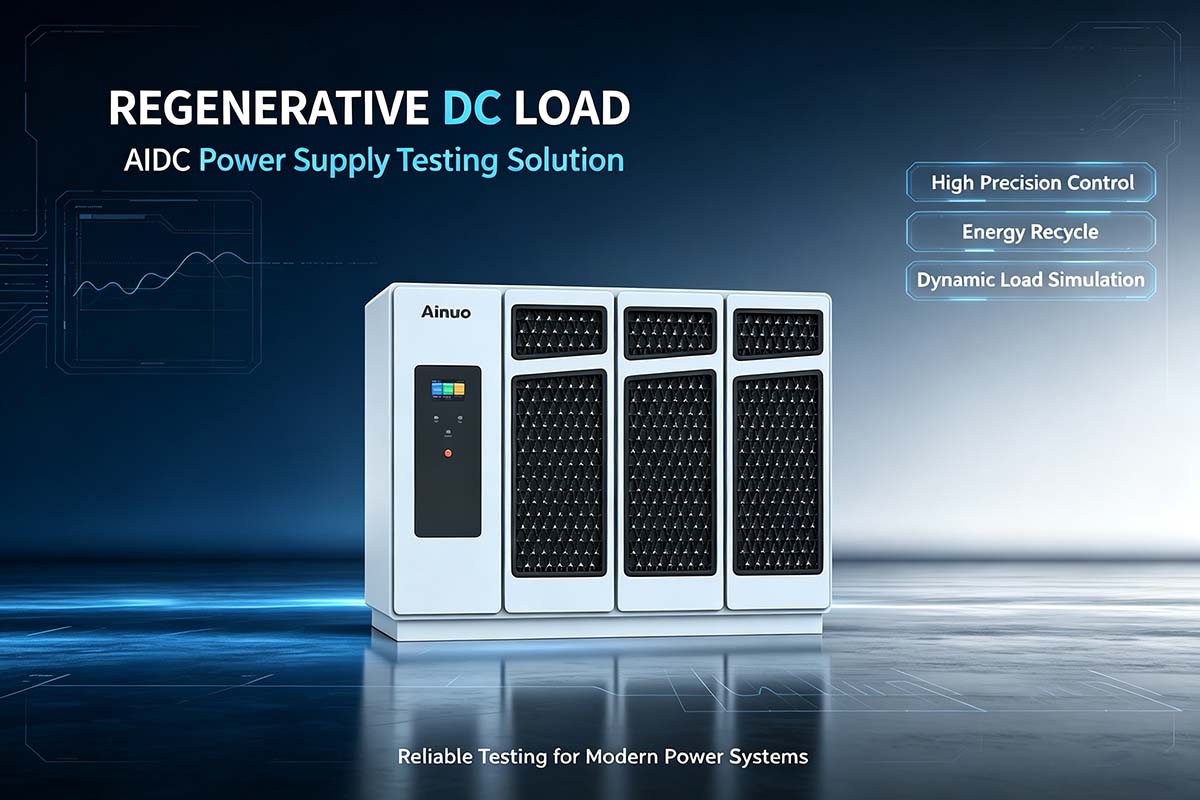
Ainuo's ANMEL(F) regenerative DC electronic load is specifically positioned for AI server power-supply R&D validation and production-line aging testing, with an emphasis on fast current transient response, long-term load stability, and automated test integration.
3. Energy Recovery Reduces the Cost of High-Power Testing
One of the biggest advantages of regenerative DC electronic loads is energy efficiency.
Traditional electronic loads essentially consume the energy supplied by the device under test. In a high-power test laboratory, this can result in substantial electricity consumption.
For example, suppose a power supply is tested at an average load of 100 kW for 10 hours.
The energy absorbed by the load would be:
100 kW × 10 hours = 1,000 kWh
With a conventional dissipative load, this energy ultimately becomes heat.
For a production environment performing this test repeatedly across multiple units, the energy requirement can become very significant.
A regenerative load can recover a substantial portion of this energy and return it to the grid. The actual recovered energy depends on the equipment's regeneration efficiency, operating conditions, and system configuration, but the principle remains the same: energy that would otherwise be converted into laboratory heat can instead be reused.
This is particularly valuable for AIDC power-supply production lines, where aging and burn-in tests may operate continuously for extended periods.
4. Regenerative Loads Reduce Thermal Stress in the Test Laboratory
Energy consumption is not the only problem associated with conventional high-power loads.
Electrical energy dissipated by a load becomes heat.
At low power levels, this may not be a major concern. At tens or hundreds of kilowatts, however, the thermal consequences can become substantial.
A conventional high-power load may require:
- Large cooling systems
- Additional ventilation
- Larger laboratory space
- Higher air-conditioning capacity
- Careful thermal management
- Greater consideration of operator comfort and equipment temperature
A regenerative DC electronic load significantly changes this equation because much of the absorbed energy can be transferred back to the grid rather than being released into the laboratory environment.
This can help reduce the cooling burden associated with high-power testing and make high-density test facilities easier to manage.
For AIDC test laboratories where multiple power supplies may be tested simultaneously, the thermal advantage can become especially important.
5. Fast Current Slew Rate Enables Realistic AI Server Load Simulation
Energy recovery alone does not make a regenerative load suitable for AIDC testing. The load must also be capable of accurately reproducing the dynamic behavior of modern computing systems.
One of the most important parameters is current slew rate.
A power supply may encounter a rapid increase in current demand when an AI server starts a high-performance workload or when an accelerator transitions into a more demanding operating state. If the electronic load changes current too slowly, it cannot reproduce the actual transient seen by the power supply.
This can lead to incomplete or misleading test results.
The ANMEL(F) series addresses this requirement with a programmable current slew rate and high current rise rate, allowing engineers to reproduce steep current transitions such as server startup transients.
This capability enables engineers to create test profiles such as:
Low Load → High Load → Low Load → High Load
The transition amplitude, timing, repetition rate, and current slew rate can be configured according to the intended test conditions.
More sophisticated profiles can also be developed to approximate realistic workload behavior rather than relying exclusively on simple static loads.
6. Dynamic Testing Reveals Power Supply Weaknesses
Static-load testing answers an important question: Can the power supply maintain its specified output under a particular steady-state load?
Dynamic testing answers a different and often more difficult question: How does the power supply respond when the load changes?
During a dynamic load test, engineers can monitor:
Voltage Overshoot and Undershoot
When the load suddenly increases or decreases, the output voltage may temporarily move outside its nominal value. Excessive deviation can indicate limitations in the power supply's control loop, output filter, compensation network, or transient energy storage.
Recovery Time
After a load transition, the output voltage should return to its regulation range within an acceptable time. Measuring recovery time provides insight into the dynamic behavior of the power supply.
Current Response
The power supply must respond rapidly enough to meet changing current demand without instability or excessive voltage deviation.
Repetitive Transient Performance
A single transient event may not reveal a problem. Repeating the same load transition thousands or millions of times can expose weaknesses that appear only after prolonged operation.
A high-performance programmable regenerative load therefore becomes a tool for both electrical characterization and reliability validation.
7. Programmability Makes Automated Testing More Efficient
AIDC power-supply testing can involve many operating points and test sequences.
Manually changing the load for every test is time-consuming and introduces opportunities for operator error. Programmable electronic loads can automate these operations.
For example, a test sequence could include:
- Set the power supply to its nominal output.
- Apply a low-load condition.
- Increase the load to a defined high-load level.
- Measure voltage deviation.
- Return to the low-load state.
- Repeat the transition at different slew rates.
- Perform a constant-power test.
- Execute a long-duration aging sequence.
- Record voltage and current waveforms.
- Generate test data for analysis.
The ANMEL(F) incorporates memory functions for storing setup parameters, communication interfaces including RS232, RS485, LAN, and USB, and real-time waveform recording. These capabilities can support integration into automated test benches and production-line systems.
Automation is particularly valuable when manufacturers need to test large numbers of power supplies consistently.
8. Precision Measurement Improves Test Confidence
An electronic load is not simply a source of electrical stress. It is also part of the measurement system.
If the load's voltage and current measurements are inaccurate, engineers may have difficulty determining whether a power supply has actually passed or failed a test requirement.
The ANMEL(F) specifications list current accuracy below 0.1% full scale, voltage accuracy of ≤0.1% full scale, and power accuracy of ≤0.2% full scale.
These specifications can help engineers obtain more reliable test data when characterizing power-supply performance across different operating points.
The system also supports real-time voltage and current waveform recording, with a stated recording interval of 0.05 ms. This can be useful when investigating fast transient behavior rather than relying solely on averaged readings.
9. High Power Density Supports the Growing Requirements of AIDC
As AI computing power increases, the required capacity of power-supply test equipment also increases.
A test platform designed for today's server power supply may not provide sufficient capacity for tomorrow's high-power AIDC architecture.
Scalability is therefore an important consideration when selecting a regenerative DC electronic load.
The ANMEL(F) series uses a modular design based on a silicon-carbide power platform, with the goal of achieving high power density and high switching frequency. The series also supports parallel operation, allowing configurations for testing megawatt-class products.
This scalability can be important for manufacturers developing increasingly powerful server and data-center power systems.
Rather than building an entirely new test platform whenever power requirements increase, a scalable architecture can provide a pathway for expanding test capacity.
10. Safety and Reliability Remain Essential
High-power AIDC testing involves significant electrical energy, so energy recovery and performance are only part of the selection criteria.
A regenerative DC electronic load should also provide appropriate protection and fault-management functions.
The ANMEL(F) includes protections for conditions such as input undervoltage, input phase loss, bus overvoltage, output overvoltage, power-module overcurrent, overtemperature, and output short-circuit current limiting. It also provides emergency-stop functionality, alarm reset, safety key lock, and fault self-diagnosis.
These functions are particularly important in automated production environments, where equipment may operate continuously with limited direct operator intervention.
A well-designed test system should combine the electronic load's internal protection functions with appropriate external safety measures, interlocks, emergency-stop circuits, wiring protection, and laboratory procedures.
11. Regenerative DC Loads Fit the Complete AIDC Testing Workflow
The greatest value of a regenerative DC electronic load is not any single specification. It is the combination of capabilities within a complete test workflow.
A typical AIDC power-supply validation process can progress from basic electrical characterization to increasingly demanding tests:
Stage 1: Static Testing
Verify output voltage, current capability, regulation, and basic operating behavior.
Stage 2: Constant-Power Testing
Evaluate power-supply performance at different operating points.
Stage 3: Dynamic Load Testing
Apply rapid load transitions to evaluate transient response.
Stage 4: Protection Testing
Verify the response of the power supply under defined abnormal conditions.
Stage 5: Automated Test Sequences
Combine multiple operating conditions into repeatable programmable procedures.
Stage 6: Aging and Reliability Testing
Operate the power supply for extended periods under controlled load conditions.
Stage 7: Production Testing
Use stored parameters, communication interfaces, and automated sequences to increase consistency and throughput.
A regenerative electronic load can contribute to each of these stages while simultaneously reducing the amount of test energy that must be dissipated as heat.
Conclusion
AIDC power supplies are becoming more powerful and more dynamic as artificial intelligence drives demand for high-performance computing infrastructure. This evolution is changing the requirements for power-supply validation.
Traditional fixed loads and conventional energy-consuming electronic loads may be sufficient for basic testing, but they become less attractive as test power, test duration, and dynamic-performance requirements increase.
A regenerative DC electronic load addresses several of these challenges simultaneously.
It can provide programmable load conditions, fast current transitions, precise measurement, automated test sequences, long-duration stability testing, and energy recovery. By feeding absorbed energy back to the grid rather than converting all of it into heat, regenerative technology can also reduce electricity consumption and the thermal burden associated with high-power test facilities.
For AIDC power-supply manufacturers, the benefits extend beyond energy efficiency. Fast current slew rates enable more realistic simulation of server transients, while programmable operation and waveform recording support repeatable characterization of voltage regulation, transient response, recovery time, and protection performance.
Ainuo's ANMEL(F) series is specifically designed for AI server power-supply R&D validation and production-line aging applications, combining regenerative operation with high current rise rates, programmable slew rate, multiple operating modes, automated-test interfaces, precision measurement, waveform recording, and parallel operation.
As AI data centers continue to increase power density and place greater demands on electrical infrastructure, the test equipment used to validate those power systems must evolve as well. Regenerative DC electronic loads provide a practical way to make AIDC power-supply testing more dynamic, more repeatable, more scalable, and more energy-efficient.