Continuous learning architectures for enterprise AI platforms
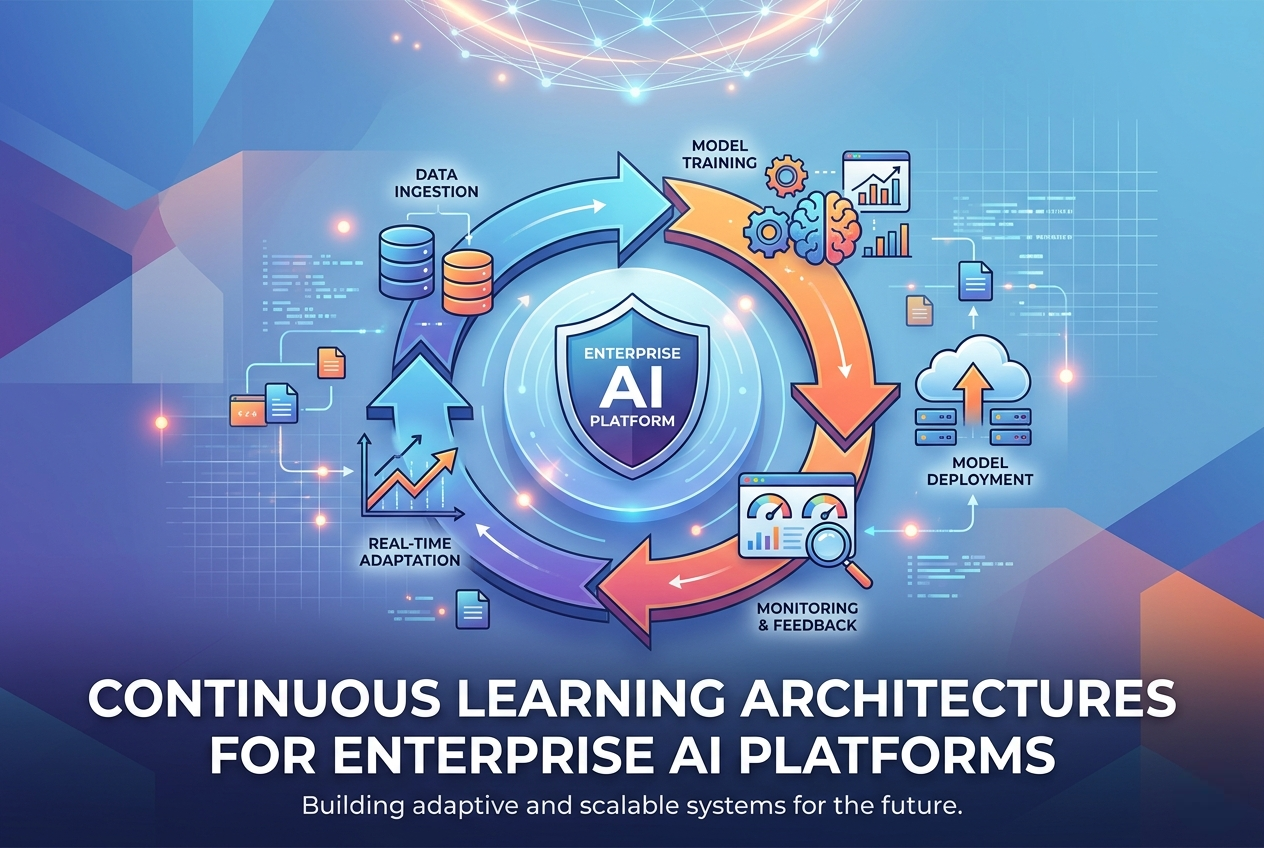
Enterprise AI is no longer defined by static models trained once and deployed indefinitely. Organizations operating at scale are moving toward systems that evolve continuously, learning from new data, user behavior, and changing market conditions. This shift is where continuous learning architectures become essential.
For decision-makers evaluating AI Development Services, understanding how these architectures work and why they matter can directly impact long-term ROI, system accuracy, and competitive advantage.
What Is a Continuous Learning Architecture?
A continuous learning architecture refers to an AI system designed to update itself over time using new data inputs without requiring full retraining cycles from scratch. Instead of periodic model refreshes, the system incrementally improves its predictions and decisions.
In enterprise environments, this often includes:
• Automated data ingestion pipelines
• Model monitoring and performance tracking
• Feedback loops from real-world usage
• Incremental or online learning models
• Governance layers to ensure compliance and accuracy
Unlike traditional AI deployments, which degrade over time due to data drift, continuous learning systems adapt dynamically.
Why Enterprises Are Adopting Continuous Learning Models
The business case is straightforward. Static AI models struggle in environments where data patterns shift frequently. Industries such as finance, healthcare, retail, and logistics deal with constantly changing variables.
A report highlights that companies leveraging adaptive AI systems see significantly higher performance improvements compared to those using static models.
Key drivers include:
1. Data Drift and Market Volatility
Customer behavior, pricing patterns, and operational signals evolve. Continuous learning ensures models remain relevant without manual intervention every few months.
2. Faster Decision Cycles
Enterprises gain the ability to act on near real-time insights. This is critical in areas like fraud detection, recommendation engines, and demand forecasting.
3. Reduced Operational Overhead
Instead of retraining and redeploying entire models, incremental updates reduce engineering effort and infrastructure costs over time.
Core Components of Continuous Learning Architectures
Building such systems requires more than just advanced models. It involves an integrated architecture that connects data, models, and feedback systems.
Data Pipelines and Streaming Infrastructure
Continuous learning depends on fresh data. Enterprises invest in real-time data pipelines using streaming technologies that feed models with updated inputs.
These pipelines must handle:
• Structured and unstructured data
• Data validation and cleansing
• Latency-sensitive processing
A strong AI Development Company will prioritize scalable data infrastructure before model design.
Model Training and Update Mechanisms
There are two common approaches:
• Online learning where models update incrementally with each new data point
• Batch incremental learning where updates happen at defined intervals
The choice depends on the use case. For example, fraud detection systems often require near real-time updates, while recommendation engines may work with periodic updates.
Feedback Loops and Human-in-the-Loop Systems
Continuous learning is not purely automated. Enterprises often integrate feedback loops from:
• User interactions
• Expert validation
• Business outcomes
Human-in-the-loop systems ensure that model updates align with business goals and compliance requirements.
Monitoring, Evaluation, and Governance
Without strong monitoring, continuous learning can introduce risk. Enterprises must track:
• Model accuracy and drift
• Bias and fairness metrics
• Performance benchmarks
Regulated industries, in particular, require audit trails and explainability. This is where Custom AI Development Services play a critical role in aligning systems with compliance standards.
Role of Full-Stack AI Development
Continuous learning architectures cannot be implemented in isolation. They require coordination across multiple layers of technology.
Full-Stack AI Development ensures that every component, from data ingestion to deployment and monitoring, works cohesively.
This includes:
• Backend infrastructure for data processing
• Model lifecycle management tools
• APIs for integration with enterprise systems
• Frontend dashboards for monitoring and control
Organizations that approach AI as a full-stack discipline tend to achieve faster deployment cycles and more reliable outcomes.
Use Cases Across Enterprise Environments
Continuous learning architectures are already driving measurable impact across industries.
Financial Services
Fraud detection models continuously adapt to new attack patterns. Static systems often fail because fraud tactics evolve rapidly.
Retail and E-commerce
Recommendation engines update based on real-time user behavior, improving conversion rates and average order value.
Healthcare
Clinical decision systems incorporate new patient data and research findings, improving diagnostic accuracy over time.
Logistics and Supply Chain
Demand forecasting models adjust to disruptions, seasonal changes, and market fluctuations.
Each of these use cases demonstrates how continuous learning directly contributes to operational efficiency and revenue growth.
Challenges Enterprises Must Address
While the benefits are clear, implementing continuous learning is not without complexity.
Data Quality and Consistency
Poor data leads to poor learning. Enterprises must invest in strong data governance frameworks.
Infrastructure Costs
Real-time systems require scalable infrastructure. However, these costs are often offset by long-term efficiency gains.
Model Stability
Frequent updates can introduce instability if not properly managed. Version control and rollback mechanisms are essential.
Compliance and Risk
Continuous updates must align with regulatory requirements, especially in industries like finance and healthcare.
Working with an experienced provider of AI Development Services helps mitigate these risks through structured implementation frameworks.
Best Practices for Building Continuous Learning Systems
Enterprises that succeed in this space follow a disciplined approach.
Start with High-Impact Use Cases
Focus on areas where continuous learning provides immediate value, such as personalization or anomaly detection.
Invest in MLOps
Model operations, or MLOps, is critical for managing the lifecycle of continuously evolving models.
Build Modular Architectures
Decouple components so updates can be made without affecting the entire system.
Prioritize Observability
Real-time monitoring ensures issues are detected early and performance remains consistent.
Partner with the Right Experts
Choosing the right AI Development Company can significantly reduce time-to-market and implementation risk.
The Future of Enterprise AI
Continuous learning is quickly becoming the standard rather than an advanced feature. As enterprises rely more on AI-driven decision-making, systems must remain accurate, adaptive, and aligned with real-world conditions.
Emerging trends include:
• Integration of reinforcement learning for dynamic decision systems
• Greater use of edge AI for localized continuous learning
• Enhanced governance frameworks for ethical AI deployment
Final Thoughts
Continuous learning architectures represent a fundamental shift in how enterprise AI systems are built and maintained. They move AI from a static asset to a dynamic capability that evolves alongside the business.
For enterprises and well-funded startups, the question is no longer whether to adopt this approach, but how quickly it can be implemented effectively.
Investing in Custom AI Development Services and Full-Stack AI Development ensures that systems are not only technically sound but also aligned with long-term business objectives. When executed correctly, continuous learning becomes a strategic advantage that compounds over time.