How A Programmable AC Power Supply Improves the Test Efficiency of Labs and Production Lines?
In modern electronics labs and high-volume production lines, testing is no longer a simple pass-fail operation. Products must perform reliably across different voltages, frequencies, load conditions, and even abnormal power scenarios. As devices become more complex and global standards more demanding, traditional fixed AC power sources are often no longer sufficient. This is where a programmable AC power supply plays a critical role, significantly improving test efficiency, accuracy, and repeatability.
What Is a Programmable AC Power Supply?
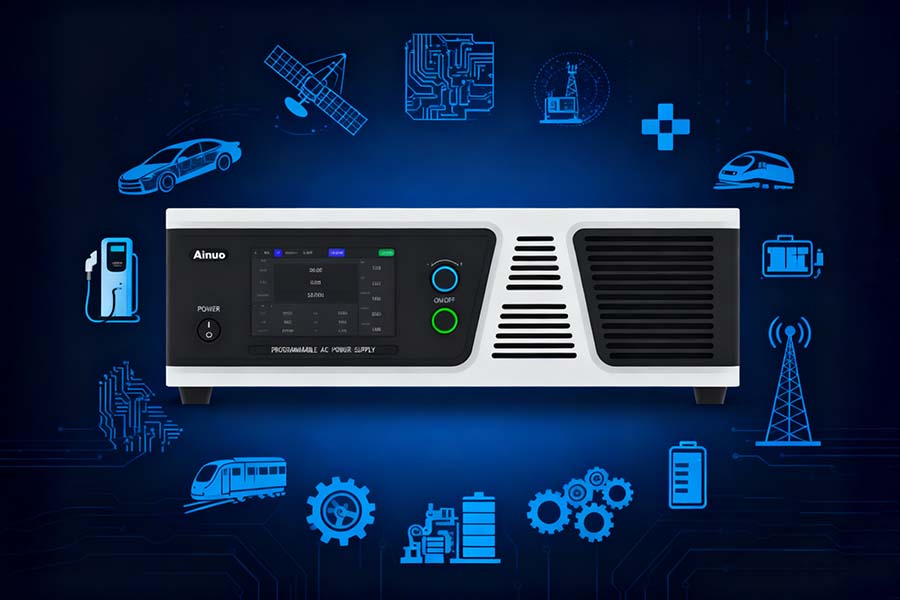
A programmable AC power supply is a power source that allows users to precisely control output parameters such as voltage, frequency, waveform, phase angle, and current limits. Unlike conventional AC sources that provide a fixed output, programmable supplies can be adjusted through front panels, software interfaces, or automated test systems. This flexibility makes them ideal for both R&D laboratories and automated production environments.
Faster Test Setup and Changeover
One of the most immediate efficiency gains comes from reduced setup time. In traditional testing, engineers may need to manually adjust transformers, switch between multiple power sources, or rewire test benches to accommodate different test conditions. A programmable AC power supply eliminates much of this manual work.
With stored test profiles and remote control capabilities, engineers can switch between voltage levels, frequencies, or test sequences in seconds. This is especially valuable in production lines where multiple product variants are tested on the same station. Faster changeover directly translates into higher throughput and lower downtime.
Improved Test Coverage and Accuracy
Test efficiency is not just about speed—it’s also about the quality and completeness of testing. Programmable AC power supplies allow labs and manufacturers to simulate real-world power conditions with high precision. This includes:
- Voltage sags and surges
- Frequency variations (e.g., 50 Hz to 60 Hz or beyond)
- Harmonic distortion
- Abnormal or worst-case power scenarios
By accurately reproducing these conditions, engineers can uncover issues that might otherwise only appear in the field. Catching failures earlier reduces costly rework, returns, and warranty claims, improving overall operational efficiency.
Seamless Integration with Automated Test Systems
Modern test environments rely heavily on automation. Programmable AC power supplies are designed to integrate seamlessly with automated test equipment (ATE) through interfaces such as USB, LAN, GPIB, or RS-232. This enables full control via test scripts and software platforms like LabVIEW or Python-based systems.
Automation reduces human error and ensures consistent test execution across shifts, operators, and locations. Once a test sequence is validated, it can be replicated indefinitely with the same parameters, dramatically improving repeatability and reliability in both lab validation and mass production.
Reduced Equipment Footprint and Cost
In many cases, a single programmable AC power supply can replace multiple fixed-output power sources. Because it can generate a wide range of voltages and frequencies, labs and production lines need fewer dedicated units. This reduces equipment clutter, simplifies maintenance, and lowers capital expenditure.
Additionally, built-in measurement functions—such as voltage, current, power, and power factor monitoring—often eliminate the need for external meters. Fewer instruments mean fewer calibration requirements and lower long-term operating costs.
Enhanced Safety and Protection
Efficiency also depends on minimizing failures, downtime, and damage. Programmable AC power supplies typically include advanced protection features such as overvoltage, overcurrent, overpower, and short-circuit protection. These safeguards protect both the device under test (DUT) and the test equipment itself.
In production environments, where mistakes can quickly scale into large losses, these protection mechanisms are especially valuable. Automated limits and controlled ramp-up sequences reduce the risk of accidental damage, improving yield and overall line efficiency.
Better Support for Global Compliance Testing
Many products today are designed for international markets, which means they must comply with multiple regional power standards. A programmable AC power supply makes it easy to test devices under different country-specific conditions without changing hardware.
Engineers can validate performance at 100 V/50 Hz, 120 V/60 Hz, 230 V/50 Hz, and other combinations using the same setup. This capability streamlines compliance testing, shortens development cycles, and accelerates time-to-market.
Scalability from R&D to Production
Another key advantage is scalability. The same programmable AC power supply used during product development can often be deployed in pilot runs and full production lines. This continuity ensures that test conditions remain consistent throughout the product lifecycle.
When test methods are aligned from R&D to manufacturing, troubleshooting becomes easier, data correlation improves, and engineering changes can be implemented more efficiently.
Conclusion
A programmable AC power supply is far more than a flexible power source—it is a productivity tool. By reducing setup time, improving test accuracy, enabling automation, and supporting global standards, it significantly enhances test efficiency in both laboratories and production lines.As products grow more sophisticated and quality expectations rise, investing in programmable AC power supplies helps organizations test smarter, faster, and more reliably. The result is higher throughput, lower costs, and greater confidence in product performance—key advantages in today’s competitive electronics landscape.