GPerya APK Android 16 Intent Security Guide: Why a Valid-Looking Intent Can Still Be Rejected
GPerya APK Android 16 Intent Security Guide: Why a Valid-Looking Intent Can Still Be Rejected
A Philippines-focused Android security guide to intent redirection hardening, Safer Intents, intent filters, exported components, IntentSanitizer, URI grants, and StrictMode diagnostics.
An Android intent can look completely ordinary in application code and still be rejected, filtered, or treated as unsafe on a newer device. Android 16 strengthens several intent-handling paths specifically to reduce the chance that one app can trick another app into launching a component or forwarding privileges it should not control.
For Filipino readers using GPerya APK as a mobile-software reference, the useful lesson is broader than one app or one APK. Intents are Android's messaging mechanism between activities, services, receivers, and other components. Because they can cross application boundaries, the platform increasingly checks not only where an intent points, but whether the requested action actually matches what the receiving component declares.
That means a failure to open a screen is not automatically proof that an app is missing or broken. On Android 16, stricter intent rules can reject behavior that older releases tolerated.
1. Intent redirection is a confused-deputy problem
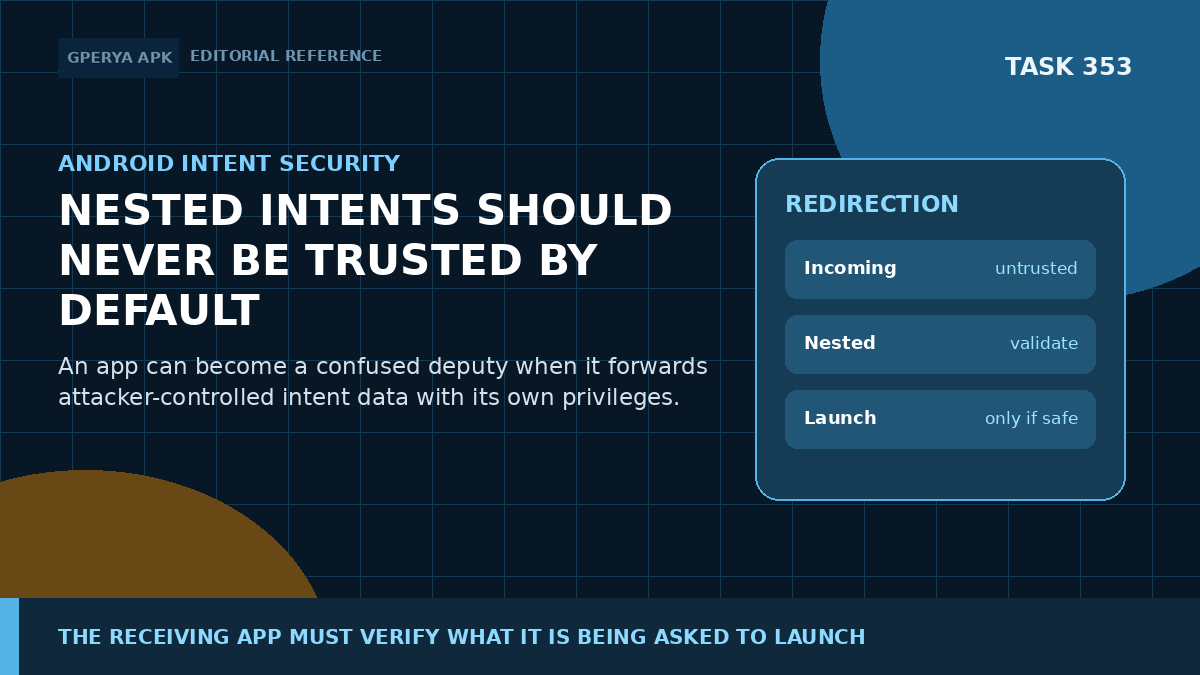
Intent redirection happens when one app receives an intent and then launches another intent whose contents are partly controlled by an untrusted sender.
The vulnerable app can accidentally become a deputy: the attacker cannot directly reach a protected component, but the vulnerable app can. If it forwards the nested intent without validation, it may expose private activities, providers, URI permissions, or privileged actions.
Android's security documentation treats this as a platform-interaction vulnerability rather than a normal navigation bug.
2. Android 16 adds default hardening against redirection
Android 16 introduces platform-level protection against general intent-redirection attacks. Google's current behavior documentation says normal intent use should continue to work in most cases, while suspicious nested-intent launch patterns receive additional protection.
This matters because the operating system can now block some unsafe launches even when the application code itself has not been rewritten yet.
Developers should not treat the new hardening as a substitute for secure code. It is an additional safety layer around a class of mistakes that should still be fixed at the source.
3. Safer Intents makes matching stricter for receiving apps
Android 16 also expands the Safer Intents initiative for apps targeting API level 36. Receiving apps can opt in to stricter intent resolution through manifest configuration.
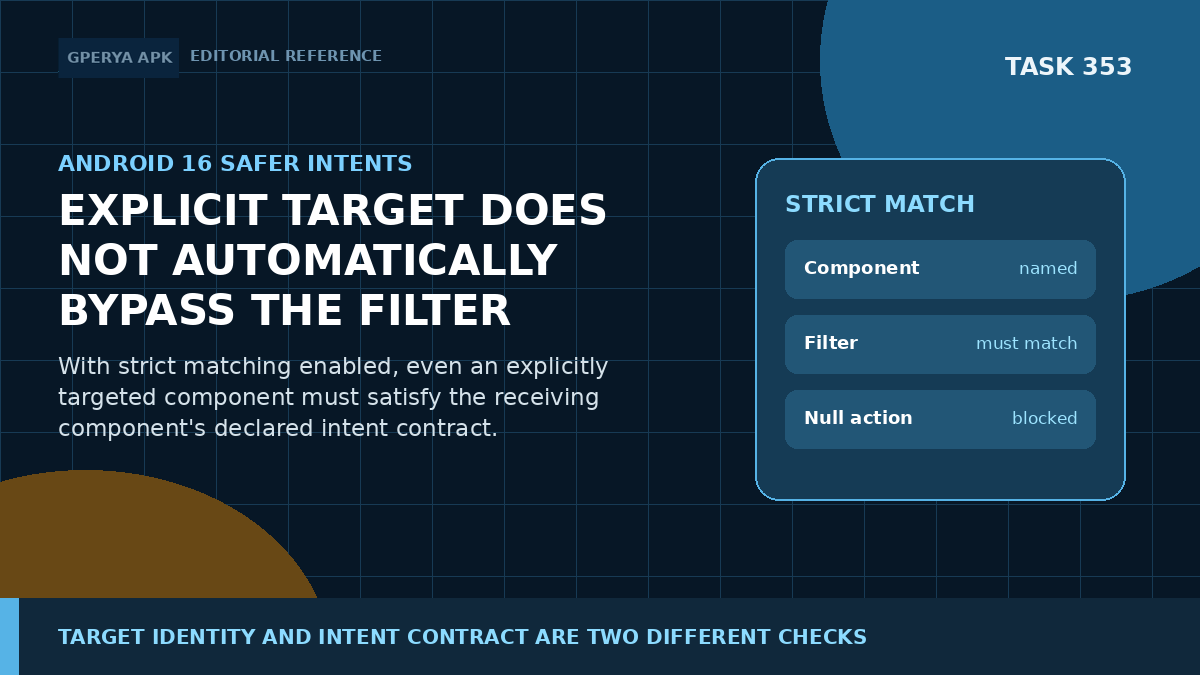
With strict matching enabled, an explicit intent that targets a component must also match that component's intent filter. Intents without an action do not match intent filters unless the app deliberately relaxes that rule.
This removes a common assumption that explicitly naming a component should always be enough. The receiving app can require the incoming request to match the contract it published.
4. Exported components deserve a separate security review
Activities, services, receivers, and providers can be exposed to other applications when they are exported. That exposure is necessary for many legitimate integrations, but it also creates an entry point that has to validate external input.
An exported component should accept only the actions, data, categories, extras, and callers that its feature actually needs. If the component should not be reachable from another app, it should not be exported merely because doing so fixes a test case.
Third-party SDKs deserve the same review because they can add components to the merged manifest without the application team noticing immediately.
5. IntentSanitizer can enforce an allowlist
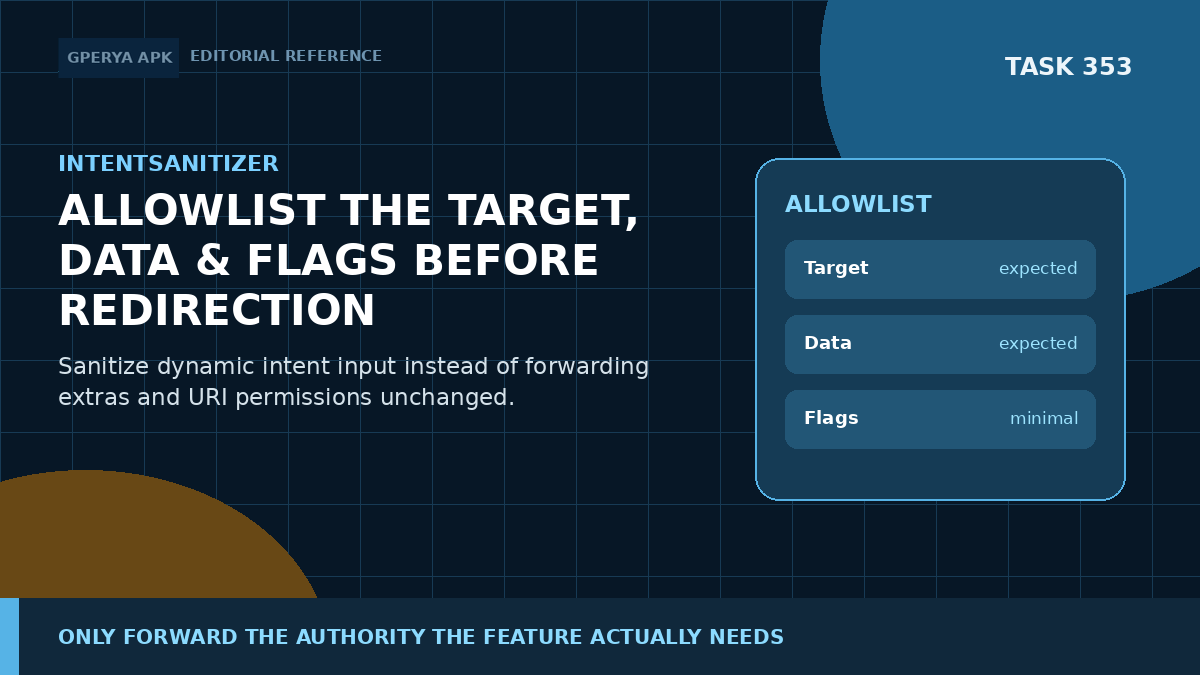
AndroidX provides IntentSanitizer for cases where an app must process dynamic or externally supplied intent data. The developer defines which components, data patterns, types, categories, flags, and extras are acceptable.
An allowlist is safer than trying to blacklist a few known-bad inputs because it starts from the narrow contract the feature actually requires.
For redirection flows, a sanitizer should be combined with target validation and careful handling of URI permission flags rather than blindly launching a nested intent after one superficial check.
6. URI grant flags can carry more authority than expected
Intents can carry flags that grant temporary or persistable access to content URIs. Those permissions are useful for legitimate document and media sharing, but forwarding them without review can widen access to data.
Android's intent-redirection guidance specifically warns developers to inspect or clear read, write, persistable, and prefix URI-grant flags when handling untrusted nested intents.
The safe rule is to preserve only the permissions the receiving flow genuinely needs. Extra authority should not survive simply because it arrived inside a nested object.
7. StrictMode can reveal unsafe launches during development
Android has provided unsafe-intent-launch detection through StrictMode since Android 12. When enabled, it can flag patterns where an app unparcels a nested intent from an incoming intent and immediately launches it.
This is useful because many intent-security problems are invisible in normal UI testing. The feature may appear to work perfectly until a malicious or malformed sender supplies different extras.
Security-oriented QA should therefore include unexpected actions, missing extras, mismatched target components, hostile URI flags, and nested intents from another application.
8. Android 16 opt-outs should be exceptional
Android 16 exposes an API that can remove launch-security protection from an intent when a legitimate compatibility case requires it.
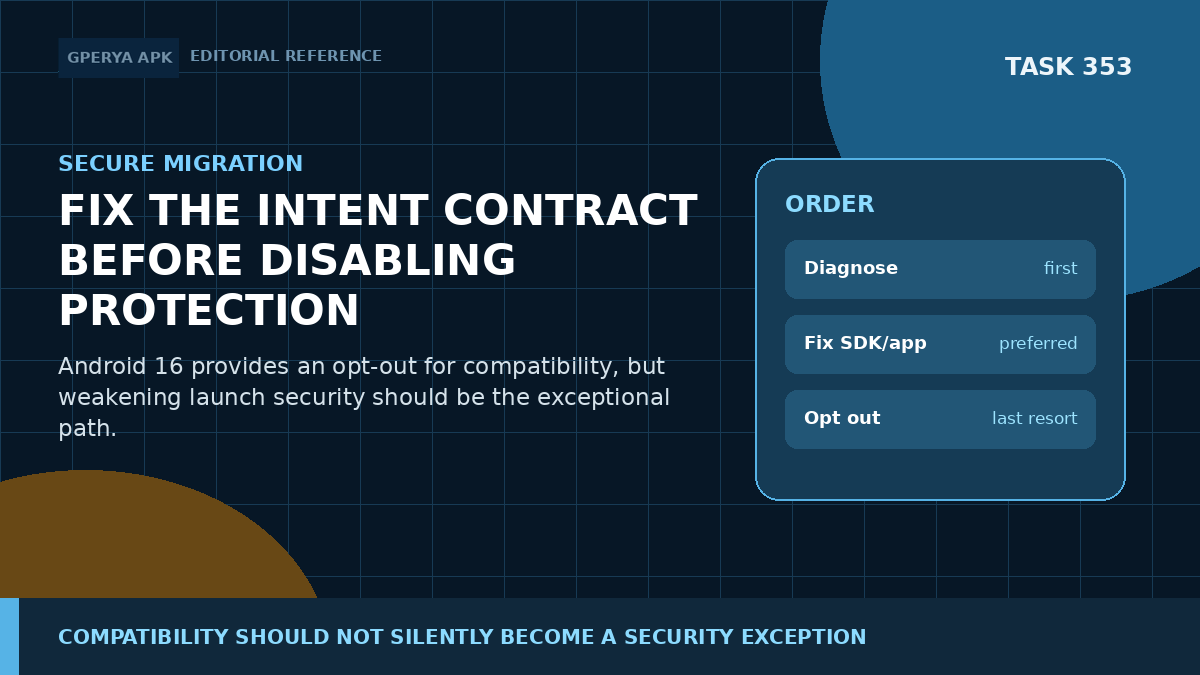
Google explicitly warns that opting out increases security risk and should be used only when necessary. A failed integration should therefore trigger a compatibility review before a developer disables the protection.
If an older SDK depends on unsafe forwarding behavior, updating or replacing that SDK is usually a stronger long-term response than permanently weakening the launch path.
9. A working deep link does not prove every intent path is safe
Deep links, app links, explicit intents, broadcasts, and nested intents all use related platform machinery, but they do not have identical trust boundaries.
One route can work because its action and filter match correctly while another route fails because the sender omitted an action, supplied incompatible data, or attempted to redirect through a private component.
The GPerya APK privacy policy can provide brand-side context about data handling on the website, but Android intent safety should be verified from the installed application's manifest, code, dependencies, and runtime behavior rather than inferred from a site policy or app name.
10. A practical Android 16 intent-security checklist
Start with the merged manifest and list every exported activity, service, receiver, and provider. Confirm that each exported component is intentionally public and protected by the narrowest correct contract.
Next, inspect every place where the app reads an intent from extras or converts a URI or string back into an intent. Validate the destination, sanitize the payload, review URI grants, and handle missing actions or extras safely.
Then enable StrictMode unsafe-intent detection during development, test the Android 16 hardening behavior, and exercise cross-app cases rather than only internal navigation. If a protection blocks a legitimate flow, understand exactly why before considering any opt-out.
Android 16 makes intent handling more defensive by default, but the core engineering rule has not changed: cross-app input is untrusted until the receiving code proves otherwise.
For GPerya APK-related Android troubleshooting, a rejected intent can be a security feature rather than a compatibility failure. Review exported components, intent filters, nested-intent redirection, URI grants, sanitization, and StrictMode evidence before weakening the platform's protections.
Sources & Benchmark References
Android Developers — Android 16 behavior changes for all apps / Intent redirection hardening — https://developer.android.com/about/versions/16/behavior-changes-all
Android Developers — Android 16 behavior changes for target 36+ / Safer Intents — https://developer.android.com/about/versions/16/behavior-changes-16
Android Developers — Intent redirection security guidance — https://developer.android.com/privacy-and-security/risks/intent-redirection
Android Developers — Intents and intent filters / unsafe intent launch detection — https://developer.android.com/guide/components/intents-filters
Google Help — Remediation for Intent Redirection Vulnerability — https://support.google.com/faqs/answer/9267555
Coverage benchmark — Microsoft Security Blog: Intent redirection vulnerability in third-party SDK — https://www.microsoft.com/en-us/security/blog/2026/04/09/intent-redirection-vulnerability-third-party-sdk-android/
Coverage benchmark — AppSecure: Securing Android Intents: Redirection, Spoofing & Interception — https://www.appsecure.security/blog/android-intent-vulnerabilities
Steemit Wallet FAQ — Posting / Markdown / images — https://steemitwallet.com/faq.html
GPerya APK — Homepage / brand-side context — https://gperya-apk.com/
GPerya APK — Privacy Policy / brand-side privacy context — https://gperya-apk.com/privacy-policy/