Why Most Dating Apps Fail in the First Year (And How to Avoid It)
Let's be honest, we’ve all been there. Swiping through endless profiles, hoping to find "the one" or at least a decent date. But for every Tinder or Bumble that dominates the market, there are hundreds, if not thousands, of dating apps that launch with a bang and fizzle out within their first year. If you're considering diving into dating app development, this isn't meant to scare you, but rather to arm you with the knowledge to succeed where so many others stumble.
The dating app market is a behemoth, projected to hit a global revenue of nearly $11 billion in 2026, according to Statista. This lucrative landscape attracts countless entrepreneurs, but the brutal truth is that many fail to capture even a sliver of that pie. Why? It's rarely about a lack of passion or a bad idea. More often, it comes down to a series of avoidable missteps in strategy, execution, and understanding the unique psychology of online dating.
The Market Reality: Why the Dating App Business Model Crumbles
One of the most critical reasons for early failure isn't technical, but commercial. Many new apps simply don't have a sustainable dating app business model. They launch with grand ambitions but a fuzzy idea of how they'll actually make money and retain users.
Consider the landscape: giants like Match Group (Tinder, Hinge, OKCupid) and Bumble have already cornered the market. They offer free basic services, drawing in millions, and then upsell premium features. A new entrant can't simply replicate this without deep pockets and a massive marketing budget. In fact, app intelligence reports from AppFigures highlight a stark reality: approximately 75% of niche dating apps launched in recent years fail to generate more than $10,000 in revenue in their first six months. This isn't due to poor dating app development alone, but a fundamental flaw in their monetization strategy. This isn't due to poor dating app development alone, but a fundamental flaw in their monetization strategy.
So, what should you consider?
Freemium with clear value: Your free tier needs to be good enough to attract users, but your premium features must offer tangible, desirable benefits that users are willing to pay for. Think beyond "see who liked you."
Niche monetization: If you target a specific niche (e.g., dog lovers, gamers, vegans), explore unique monetization strategies like partnerships with relevant brands or events, which can be more effective than a generic subscription.
Data-driven pricing: Don't guess. A/B test different pricing models and feature bundles to see what resonates best with your target demographic.
Technical Hurdles: Common Pitfalls in Dating App Development for Startups
Beyond the business model, the actual dating app development process is fraught with technical challenges that can sink a startup before it ever gains traction. Ignoring these can lead to a buggy app, frustrated users, and ultimately, uninstallations.
Performance and Scalability Issues
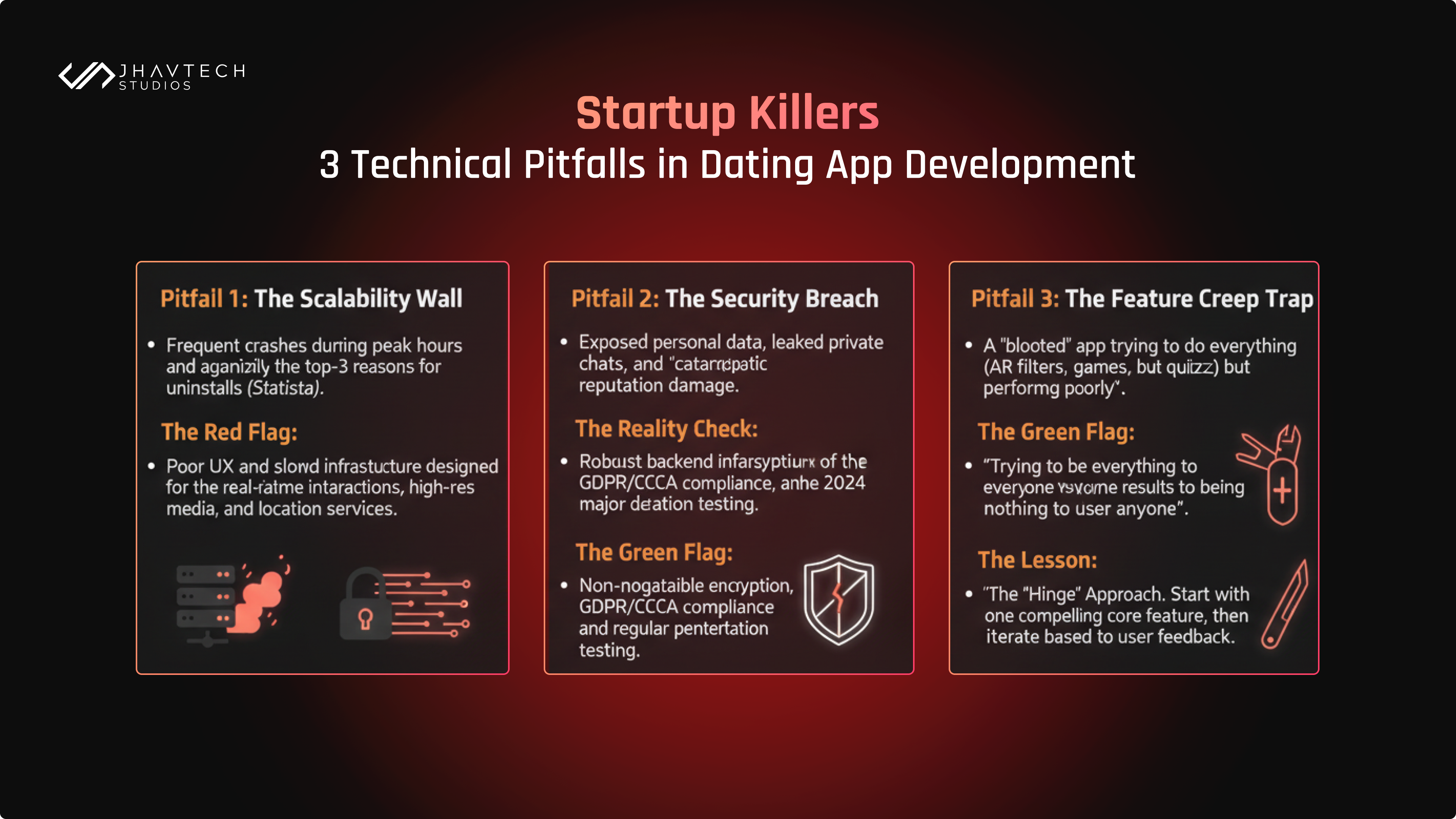
Imagine launching your app and it crashes every time more than a thousand people try to log in simultaneously. Or perhaps profiles load agonizingly slowly. These are common issues for startups that underestimate the complexity of building a scalable platform. Dating apps deal with real-time interactions, high-resolution images, and often, location-based services. This demands robust backend infrastructure.
According to research data from Statista, technical hurdles and poor user experience are leading drivers of the "dating app disconnect." Specifically, studies have shown that slow loading times and frequent crashes are among the top three reasons users pull the plug and uninstall. A fantastic idea with poor execution is still a poor product. This is where meticulous planning and a strong development team become indispensable. They understand the intricacies of building an app that handles millions of concurrent users without breaking a sweat.
Security and Privacy Concerns
Dating apps deal with highly sensitive personal data: names, photos, locations, preferences, and even intimate conversations. A single security breach can be catastrophic, destroying user trust and leading to significant legal repercussions. Remember the data breach incident with a popular dating app in early 2024, exposing millions of user profiles? It took them months to recover their reputation.
Robust encryption, secure data storage, and adherence to global privacy regulations (like GDPR and CCPA) are non-negotiable. Regular code review and penetration testing are essential to identify and fix vulnerabilities before they are exploited. Prioritizing user safety isn't just good ethics; it's smart business.
Feature Creep and Lack of Focus
It's tempting to try and include every conceivable feature in your dating app: video calls, augmented reality filters, in-app games, elaborate personality quizzes. However, this often leads to a bloated, confusing app that performs poorly and takes forever to launch. This "feature creep" is a common pitfall in dating app development for startups.
The most successful apps start with a core, compelling feature and then iterate based on user feedback. Hinge, for instance, initially focused on "relationships, not hookups" and built features around thoughtful prompts and limited matches. This focused approach allowed them to refine their core offering before expanding. Trying to be everything to everyone often results in being nothing to anyone.
The Solution: How to Prevent Dating App Failure in the First Year
So, how do you navigate these treacherous waters and launch a successful dating app? It starts with a strategic approach, meticulous planning, and partnering with experienced professionals.
Define Your Niche and Unique Value Proposition (UVP): Don't try to out-Tinder Tinder. Identify a specific underserved demographic or a particular problem in the dating world that your app can solve better than anyone else. Perhaps it's an app for remote workers seeking others who understand their lifestyle, or an app focused purely on platonic friendships. Your UVP should be crystal clear and inform every aspect of your dating app development.
Start Lean and Iterate: Build a Minimum Viable Product (MVP) with only the essential features that deliver your core UVP. Launch, gather feedback, and then iterate. This approach saves time and money and ensures you're building something users actually want. Tools like A/B testing and user surveys are your best friends here.
Prioritize User Experience (UX) and User Interface (UI): A beautiful, intuitive, and seamless user experience is paramount. If your app is clunky, confusing, or visually unappealing, users will abandon it quickly, regardless of how good your concept is. Invest in professional UI/UX design.
Focus on Security and Privacy from Day One: Integrate security protocols into the very fabric of your app's architecture, not as an afterthought. Be transparent with users about their data and give them control over their privacy settings.
Build for Scalability: Even if you start small, design your architecture with growth in mind. This means choosing flexible technologies and frameworks that can handle an increasing user base without requiring a complete overhaul. Sometimes, projects that go off track technically may even require a software project rescue to get them back on course, highlighting the importance of solid foundations.
Partner with Experienced Developers: This is arguably the most crucial step. Navigating the complexities of backend architecture, secure data handling, real-time communication, and scalable infrastructure requires specialized expertise. Professional dating app development teams can provide the comprehensive oversight needed from concept validation to post-launch support. Their experience in building reliable and user-friendly platforms can be the difference between an app that thrives and one that languishes.
The journey of dating app development is challenging but immensely rewarding if approached strategically. By understanding the common pitfalls, focusing on a sustainable business model, and leveraging expert technical guidance, you can significantly increase your chances of building an app that not only survives its first year but flourishes into a long-term success story. Don't just build an app; build a community and a thriving platform.