Is Your App Secure? Run This Free Code Review to Find Out
If you are a founder, a developer, or a product manager, you likely spend your nights worrying about user growth, feature releases, and market fit. But there is a silent killer that can wipe out all that progress in a single afternoon: a security breach.
With cyberattacks on the rise, the question is no longer "if" your application has a vulnerability, but "where." This is why a professional code review is no longer a luxury but a fundamental necessity for digital survival.
In 2024, vulnerability-based attacks surged by a staggering 124% compared to the previous year. Even more alarming is the fact that nearly 1 in 6 attacks are now launched through vulnerable public-facing applications or APIs. When you consider that the global average cost of a data breach has climbed to $4.44 million, the "wait and see" approach is effectively a gamble with your company's future.
Why a Vulnerability Assessment is Your Best Defense
When we talk about app security, we often think of firewalls and encryption. While those are important, they are often just the outer shell. A deep vulnerability assessment looks at the logic of your application itself. It identifies where your code might be leaking data, where your APIs are exposed, and where a clever hacker could bypass your login screens.
Take the recent example of the 2024 AT&T breach that impacted over 110 million customers, or the Snowflake data breach that targeted over 100 companies. These incidents highlight that even tech giants can fall victim to misconfigurations and unpatched flaws.
A thorough code review acts as a preventative strike. By identifying these gaps before a hacker does, you are not just fixing bugs; you are protecting your brand’s reputation. If you are unsure where to start, you can access a free code review to get a professional baseline of your current security posture.
The Hidden Power of Static Application Security Testing (SAST)
In the world of modern software, we use something called Static Application Security Testing (SAST). This is a method where your source code is examined without even running the program. The Open Web Application Security Project (OWASP) defines this as "white-box" testing. It is like a structural engineer looking at the blueprints of a skyscraper to find a weak beam before the building is ever constructed.
The beauty of SAST is its efficiency. It can scan thousands of lines of code in minutes, flagging "code smells," hardcoded credentials, and insecure library dependencies. However, while automated tools are fast, they are not perfect. They can sometimes miss complex business logic errors. This is why the most effective code review strategies involve a combination of automated scanning and manual expert oversight.
If your current development cycle is struggling under the weight of old, messy code, you might be in need of a software project rescue. This process involves bringing in experts to stabilize a failing project, paying down technical debt, and implementing the rigorous testing standards that were missed during the initial rush to launch.
How to Perform a Security Code Review: A Practical Checklist
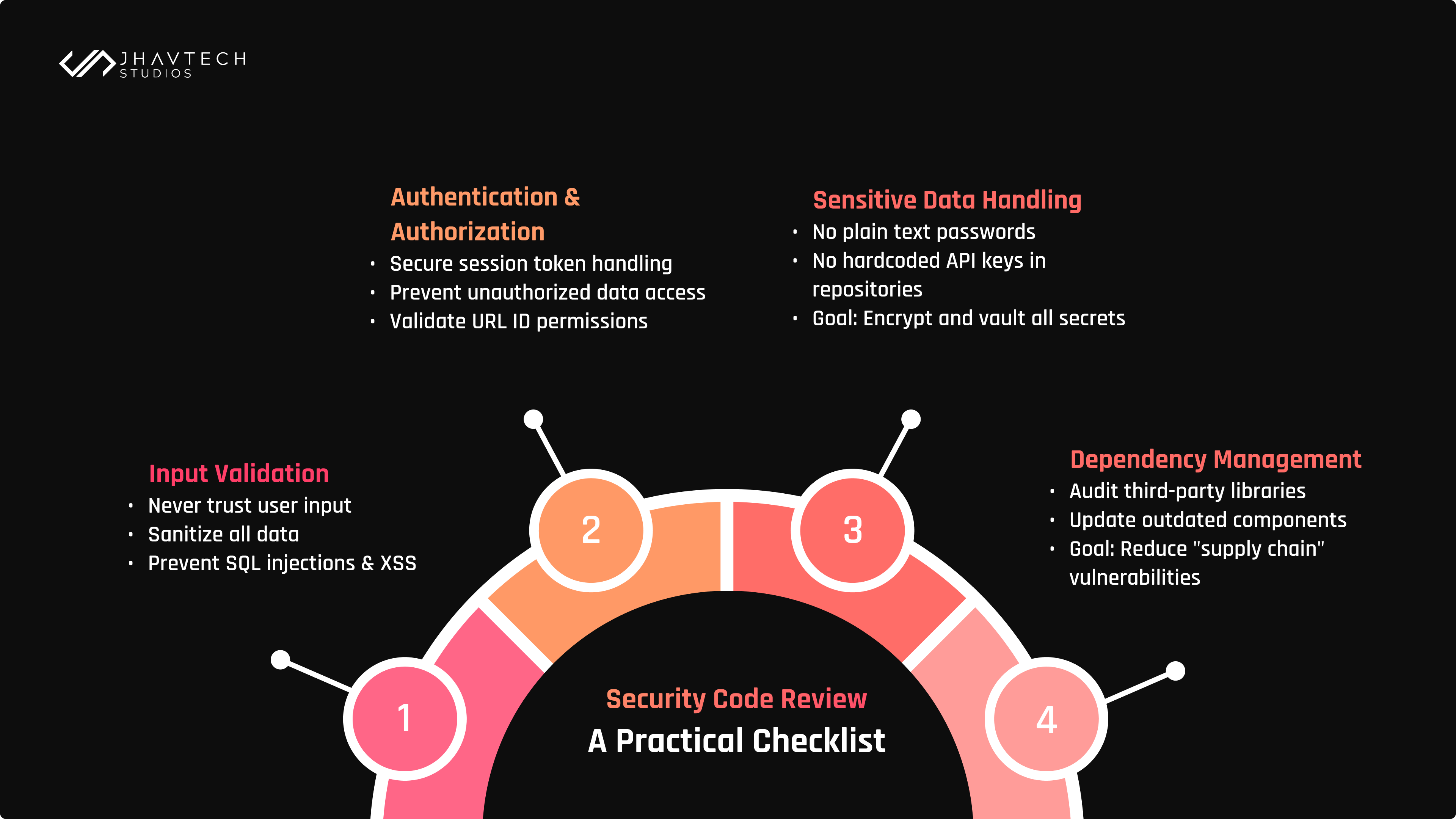
If you are wondering how to perform a security code review, you don't have to be a cybersecurity wizard to start. From our years of working in the trenches of various dev cycles, we have realized that most leaks happen in the most obvious places. Here is a simplified framework that can be used to ensure no stone is left unturned:
Input Validation: Are you trusting user input? Never do that. Ensure every piece of data coming from a user is sanitized to prevent SQL injections and Cross-Site Scripting (XSS).
Authentication & Authorization: Check if your session tokens are handled securely. Can a user access data that doesn't belong to them by simply changing a URL ID?
Sensitive Data Handling: Are you storing passwords in plain text? Are API keys hardcoded in your GitHub repository? (Hint: They shouldn't be).
Dependency Management: Modern apps are built on a mountain of third-party libraries. If one of those libraries is outdated, your whole app is at risk.
By following these steps, a code review becomes a roadmap for improvement rather than just a list of complaints.
Lessons from the Field: Our Personal Take on "Spaghetti Security"
We have seen many teams treat security like a "final coat of paint" that you apply right before the house goes on the market. This is a dangerous mindset. We remember a specific project where the client had built a brilliant platform. On the surface, it was beautiful. But underneath? It was a mess of "Spaghetti Security."
They had bypassed standard encryption protocols to "speed up" the API response time. When we performed their initial code review, we found that an attacker could have drained user accounts using a simple script. They were three days away from launch. That experience cemented our belief that you cannot trade security for speed.
One of the most cited studies in software engineering, popularized by IBM and NIST, shows that the cost of fixing a bug increases exponentially the later it is found. Fixing a vulnerability during the design phase might cost you $100. If that same bug makes it into production, it could cost you $10,000 or more in patches, downtime, and lost customer trust.
In the world of mobile app development, this is even more critical. Once an app is in the hands of thousands of users on their personal devices, a security flaw is much harder to "recall" than a web-based update.
Best Practices for Secure Code Review in 2026
As we look toward the near future, the landscape is shifting. AI is now being used by hackers to find vulnerabilities faster than ever before. To keep up, you need to adapt. Here are the best practices for secure code review in 2026:
Shift Left: Integrate security checks at the very beginning of your development cycle, not as a "final check" before release.
Continuous Reviews: Don't treat a code review as a one-time event. It should be a part of every pull request.
Human Context: While AI tools are getting better, they still lack the "context" of your business logic. Always have a senior developer or a third-party expert review the most critical parts of your architecture.
Zero Trust Architecture: Assume that a breach will happen and write your code in a way that limits the damage.
The Culture of Code: Why Your Team Might Be Resisting
In our experience, the biggest hurdle to a successful audit is not technical; it is cultural. Developers often feel like their work is being "attacked" during a review. This leads to a defensive atmosphere where bugs are hidden rather than solved.
To fix this, technical leaders should emphasize a "blameless" culture. The goal is not to find who wrote the bad code, but to find how the code can be better. When a team views security as a shared responsibility rather than a finger-pointing exercise, the quality of the software skyrockets.
Understanding the Technical Nuance of "Taint Analysis"
For those who want to dive deeper into how modern tools actually work, we often look at "Taint Analysis." This is a feature of many SAST tools that tracks the flow of data from an untrusted source (the "taint") to a sensitive sink (like a database query).
If the data reaches the sink without being "sanitized," the tool flags it. Understanding this flow is vital for developers who want to write cleaner, safer code from day one. It helps move the conversation from "the tool says this is wrong" to "I understand why this data path is dangerous."
The Escalating Cost of Neglect
If your app feels sluggish, or if you have that nagging feeling that your data might not be as safe as it should be, don't wait for a "Notification of Indicator of Compromise" to land on your desk. Statistics from the Australian Cyber Security Centre show a massive 83% increase in these notifications recently. The threats are real, and they are active.
By performing a regular code review, you are investing in the longevity of your product and the trust of your users. It is the single most effective way to ensure that your innovation isn't undermined by an avoidable mistake.
Take Action for Your App's Health
Your code is the heart of your business. If it is broken or exposed, your business is at risk. Whether you are looking for a high-level check or a deep-dive audit, taking that first step today can save you months of headaches and millions in potential losses later.
If you are ready to evaluate your system, you can explore professional assistance through a free code review to identify immediate risks.
Have you ever discovered a major vulnerability in your project after launch? What did you learn from that experience? Let's discuss in the comments below!