I Thought Voice Cloning Was Private. Shared Voice Libraries Changed That.
I used to think voice cloning followed one obvious path:
record your voice → clone it → use it in your own content
That still makes sense when the voice is part of a person's identity or a brand. But while looking through AI voice tools recently, I came across another approach: browse voices that people have already shared before creating a new one.
It sounds like a small change. In practice, it changes where the whole process begins.
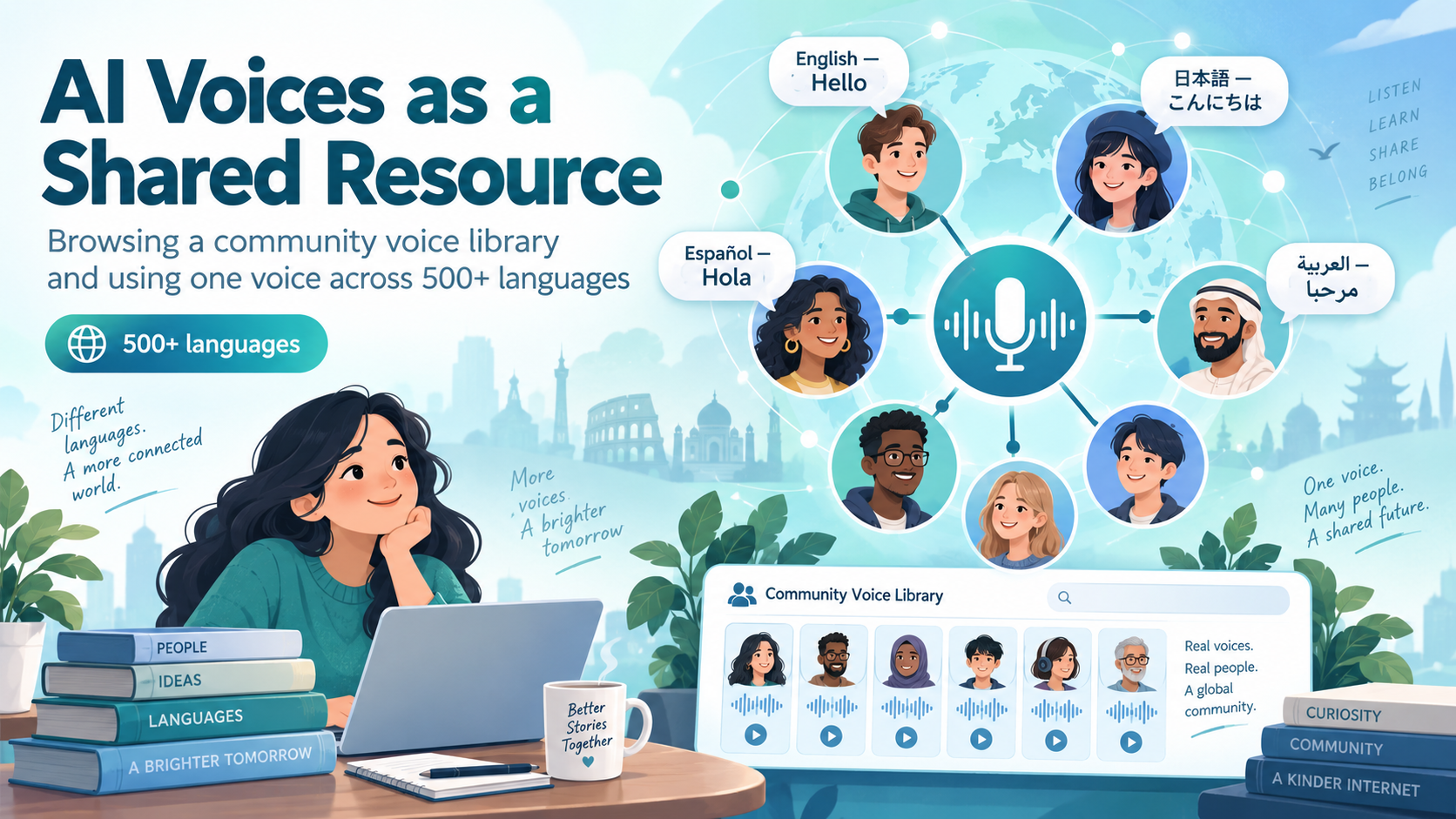
Starting with a voice that already exists
If I need narration for a quick tutorial or prototype, recording a new sample may be unnecessary.
I can browse a community voice library first and see whether an existing voice fits the project. That feels closer to choosing stock audio or a preset than to setting up a personal voice clone.
The workflow becomes:
need a voice → browse → choose → generate
rather than:
need a voice → record → clone → generate
For a one-off video or a quick experiment, browsing first removes a setup step that may not add much to the result.
When a voice becomes a shared resource
The other direction is more interesting to me. A voice someone creates can be added to a community library, where another person may find and use it.
Instead of only:
my voice → my content
there can also be:
shared voice → someone else's content
That makes a cloned voice reusable, but the comparison with ordinary creative assets only goes so far. A human voice is not a font or an icon. It may be closely connected to someone's identity.
Permission and intended use still matter. If I were creating a voice, I would want to know whether it would remain private or become public before uploading anything. If I were using a shared voice, I would want to understand how its owner intended it to be used.
Convenience does not make a voice unrestricted.
Language changes what the voice can be used for
The multilingual side also caught my attention.
When I hear someone speaking Japanese, I tend to think of it as a Japanese voice. I make the same association with English, Spanish, or Arabic. A cloned voice, however, does not necessarily stay tied to the language in the original sample.
The same cloned voice can be used across 500+ languages.
That opens up a practical workflow for multilingual content:
one voice → English
same voice → Japanese
same voice → Spanish
same voice → Arabic
The scripts change while the voice remains more consistent. For several versions of the same tutorial or video, that continuity may matter more than having hundreds of unrelated voices available.
"500+ languages" is not the end of the edit
Generating speech is only part of the process.
Languages have different rhythms and sentence lengths. A line that takes five seconds in English may run noticeably longer in Japanese or Spanish. Names, abbreviations, and technical terms can also need extra attention.
Even when the voice sounds fine, I would still check:
- pronunciation
- speaking speed and pauses
- names and technical terms
- whether the translated sentence sounds natural aloud
Sometimes the best fix is to rewrite the sentence rather than adjust the voice. AI can produce the audio, but someone still has to listen and decide whether it works in the finished content.
Where shared voices seem useful
I can see this approach fitting:
- short tutorial videos
- prototypes and internal demos
- temporary narration
- multilingual content tests
- comparisons between voice styles
For a long-term brand or a project built around a particular personality, I would probably choose a dedicated private voice. The extra control makes sense there.
When narration is only one small part of a larger project, checking an existing library first feels more practical.
What changed for me
The cloning technology itself was not the part that stayed with me. It was the idea that a cloned voice could be deliberately shared, discovered, and reused.
That makes voice cloning feel less like a private tool and more like a library model. It also makes the questions around consent, ownership, and appropriate use harder to ignore, especially when a voice may represent a real person.
I started with the assumption that voice cloning was mainly about copying your own voice. Now I am more interested in what happens when people choose to share those voices, and what rules need to follow them when they do.