What Developers Mean When They Say “This Code Feels Wrong”

Ever been in a situation where you’re looking at a piece of software, maybe even your own, and a shiver runs down your spine? Not because it’s haunted, but because something just feels off? You can’t quite put your finger on it, but you know deep down, this code isn’t as clean, efficient, or maintainable as it should be. Welcome to the world of code smells... a term seasoned developers use to describe those subtle indicators that something might be amiss in your codebase.
Expert developers encounter these "gut feelings" daily, and they have learned to translate them into actionable strategies for building robust, scalable software solutions. It's more than just aesthetics; ignoring these early warnings can lead to significant problems down the line, affecting everything from performance to long-term costs.
The Intuition Behind the "Wrong" Feeling
That "wrong" feeling isn't some mystical developer sixth sense. It's born from experience, best practices, and a deep understanding of software design principles. When a developer says, "This code feels wrong," what they're often articulating is an intuitive recognition of one or more code smells. These aren't necessarily bugs, the software might even function perfectly, but they are symptoms of deeper design problems that could lead to bugs, make future development difficult, or introduce performance bottlenecks.
Think of it like a strange noise in your car. It still drives, but that persistent squeak or rattle is telling you something needs attention before it becomes a major breakdown. In software, these "noises" manifest as patterns that hint at deeper structural or design issues.
Why Do We Care About Code Smells?
Ignoring code smells is akin to accumulating technical debt. Each small "wrong" decision, each piece of clunky code, adds to a growing burden that slows down development, increases maintenance costs, and makes the system more fragile.
A study by Stripe found that developers spend an average of 17 hours per week dealing with maintenance and "bad code," equating to over $85 billion annually in lost productivity for the US economy alone. That's a staggering figure that highlights the very real, financial impact of letting code smells fester. For businesses seeking efficient app development and long-term sustainability, addressing these issues proactively is paramount.
Common Code Smells and What They Really Mean
Let's break down some of the most frequent "wrong feelings" and connect them to their technical counterparts:
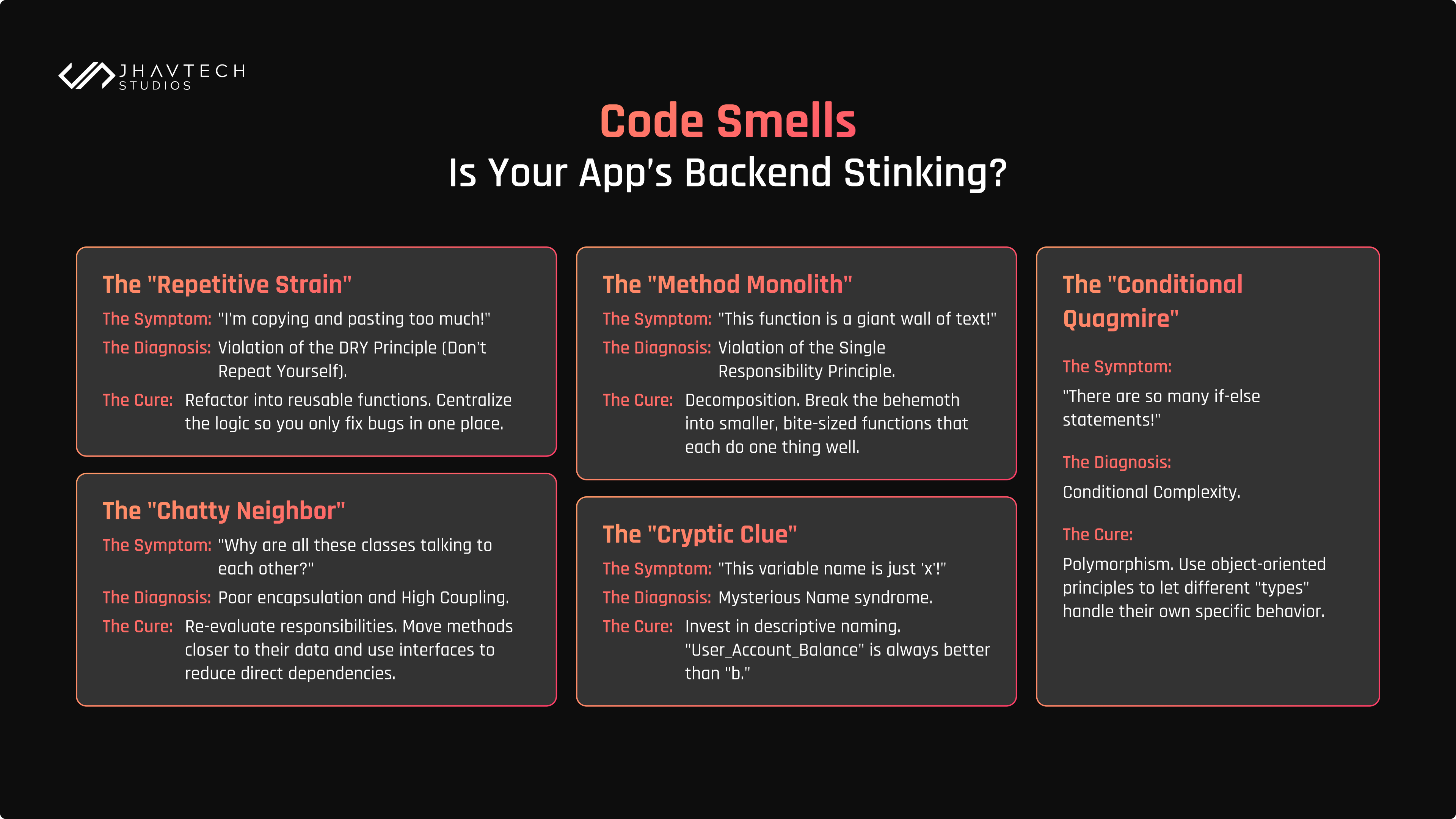
"I'm copying and pasting too much!" – The Repetitive Strain Injury of Code
The Smell: You find yourself writing the same block of code over and over again in different parts of your application, perhaps with minor variations.
The Problem: This is a classic violation of the DRY Principle (Don't Repeat Yourself). Duplicate code is a maintenance nightmare. If you find a bug in one instance, you have to fix it everywhere. If a requirement changes, you have to update every copy.
The Fix: Refactor this into a reusable function, method, or class. Abstraction is your friend here, allowing you to centralize logic and make your codebase more robust.
"This function is a giant wall of text!" – The Monolith of Methods
The Smell: You scroll and scroll through a single function or method, and it seems to do everything from fetching data to processing it and then displaying it.
The Problem: This often points to a Large Class or Long Method code smell. Such methods violate the Single Responsibility Principle, making them difficult to understand, test, and maintain. A single change might accidentally break unrelated functionality within that same behemoth method.
The Fix: Break down the large method into smaller, more focused functions, each responsible for one specific task. This improves readability and makes testing much easier.
"Why are all these classes talking to each other?" – The Chatty Neighbor Syndrome
The Smell: You have a web of dependencies where many classes seem to know too much about the internal workings of other classes, passing data back and forth excessively.
The Problem: This can be a sign of Feature Envy or Data Clumps. It indicates poor encapsulation and high coupling, meaning changes in one part of the system have ripple effects across many others.
The Fix: Re-evaluate class responsibilities. Can some methods be moved closer to the data they operate on? Can interfaces be used to reduce direct dependencies?
"This variable name is just 'x'!" – The Cryptic Clue
The Smell: Variable names, function names, or class names are generic, abbreviated, or just plain confusing, making it hard to understand their purpose without diving deep into the implementation.
The Problem: This is a clear indicator of Mysterious Name. Poor naming conventions significantly hinder code readability and understanding, especially for new team members or when revisiting old code.
The Fix: Invest time in meaningful, descriptive names. While it might seem trivial, clear naming is one of the quickest ways to improve code comprehension.
"There are so many 'if-else' statements!" – The Conditional Quagmire
The Smell: You encounter a nested labyrinth of if-else or switch statements, especially when dealing with different types or behaviors.
The Problem: Often a Switch Statement or Conditional Complexity code smell. This can make code hard to extend; adding a new type often means modifying every switch statement in the codebase.
The Fix: Consider using polymorphism. Object-oriented principles can often replace complex conditionals with more elegant, extensible solutions where each type handles its own specific behavior.
How to Identify Code Smells in Your Project
Recognizing code smells is the first step towards writing truly high-quality software. For beginners, it might feel like an abstract concept, but with practice, you’ll start to develop that intuitive "feel."
Here’s how you can actively look for them:
Read Your Own Code (and others’): Actively review code with a critical eye. Does it make sense? Is it easy to follow the logic?
Pair Programming: Working with another developer often brings fresh perspectives and helps spot issues more quickly.
Automated Tools: Linters and static analysis tools (like SonarQube, ESLint, or Checkstyle) can automatically flag many common code smells and adherence to clean code principles. These tools are invaluable for maintaining quality at scale.
Unit Tests: Well-written unit tests can indirectly reveal code smells. If a function is difficult to test, it often indicates it's doing too much or has too many dependencies which are classic signs of an underlying issue.
Look for Change Resistance: If modifying one part of the code constantly breaks another, it's a strong indicator of high coupling and underlying structural problems. This is often the prime symptom of accumulated technical debt.
Jhavtech Studios' Approach to Pristine Code
At Jhavtech Studios, our philosophy revolves around building not just functional software, but maintainable software. We believe that preventing and refactoring code smells is a core part of delivering lasting value to our clients. Our developers are trained to meticulously review code, adhere to robust design patterns, and continuously improve the codebase.
We don't just fix bugs; we look for the systemic issues that cause them. This proactive approach ensures that the solutions we build for our clients are resilient, adaptable, and cost-effective in the long run. Whether it's a new app development project or maintaining an existing system, our focus is always on delivering excellence that stands the test of time.
Final Thoughts...
That "wrong" feeling about code isn't a sign of weakness; it's a sign of a developing expertise. Learning how to identify code smells is a crucial skill for any developer looking to move beyond just making things work, towards making them work well and sustainably. By understanding these subtle indicators and actively refactoring your codebase, you contribute to a healthier, more manageable project.
As Uncle Bob Martin famously said, "The only way to go fast, is to go well." Adopting a mindset of constantly seeking out and eliminating code smells will not only make your life as a developer easier but will also dramatically improve the quality, longevity, and efficiency of the software you build.