The Martian moon Phobos
Phobos: The Persistent Question of an Artificial Moon
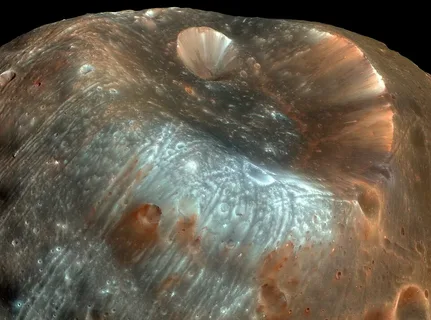
Phobos, 2008 HIRISE color image. Theoretically, moons are supposed to be made of dirt and green cheese; they are not supposed to reflect light all over creation like mirrors...
Among the many unresolved anomalies in the Mars system, none has lingered as long—or been as quietly uncomfortable—as the question of Mars’ inner moon, Phobos. Claims that Phobos might be artificial did not originate with internet forums or modern social media, but with serious scientific work conducted during the Soviet era.
Early Soviet AnalysisIn the late 1950s and early 1960s, Soviet astrophysicist Iosif Shklovsky examined the orbital behavior of Phobos and concluded that its observed rate of orbital decay did not match expectations for a solid natural body. Based on the density estimates available at the time, Shklovsky proposed that Phobos might be hollow or possess large internal voids.
This conclusion was controversial even within the USSR, and it was later officially walked back in favor of a more politically and scientifically palatable explanation: that Phobos was a highly porous “rubble pile” asteroid captured by Mars.
Density and Orbital ProblemsPhobos has an unusually low density, significantly lower than that of solid rock. While rubble-pile models are now commonly invoked, such models introduce their own difficulties. A loosely bound aggregate should not survive long on Phobos’ extremely low, decaying orbit without dispersing.
Phobos orbits Mars at an altitude so low that it is gradually spiraling inward and will eventually be torn apart. For a captured asteroid, this orbit is dynamically awkward and difficult to reconcile with long-term stability.
Surface Features and GroovesThe surface of Phobos is marked by long, parallel grooves that extend for many kilometers. These grooves cross craters rather than conforming to them, and their orientations do not cleanly match simple impact-ejecta models. Over the decades, explanations for these grooves have shifted repeatedly, without any consensus solution.
Radar and Internal Structure ClaimsThere have also been reports—primarily from Russian sources—of radar experiments suggesting internal discontinuities within Phobos, including claims of large rectangular or cavernous spaces. These reports are difficult to verify independently and have never been fully explored in Western literature, but they persist as part of the historical record.
Whether these radar interpretations were correct, overstated, or misunderstood remains an open question. What matters is that they were taken seriously enough at the time to warrant discussion by professional scientists.
Reflectivity and AppearanceUnlike what one might expect from a body composed of loose dirt and rock, Phobos reflects light in unusual ways. High-resolution color images show linear streaking and surface patterns that some observers describe as metallic in appearance. While visual appearance alone is not proof of composition, it adds to the sense that Phobos does not behave like a typical small natural moon.
An Unsettled QuestionTo be clear, none of this proves that Phobos is artificial. But it does establish something important: the question has never been conclusively settled. Over more than sixty years, the explanation for Phobos has shifted from hollow object, to porous rubble pile, to fractured asteroid—each model introduced to resolve problems left by the previous one.
Phobos remains an object whose density, orbit, internal structure, and surface features resist a simple, stable explanation. That alone is enough to justify continued curiosity.
Final ThoughtIf Phobos were unquestionably natural, the idea of artificiality would have died long ago. Instead, it continues to resurface—not because of sensationalism, but because the data never quite closes the door.