Predicting the Past
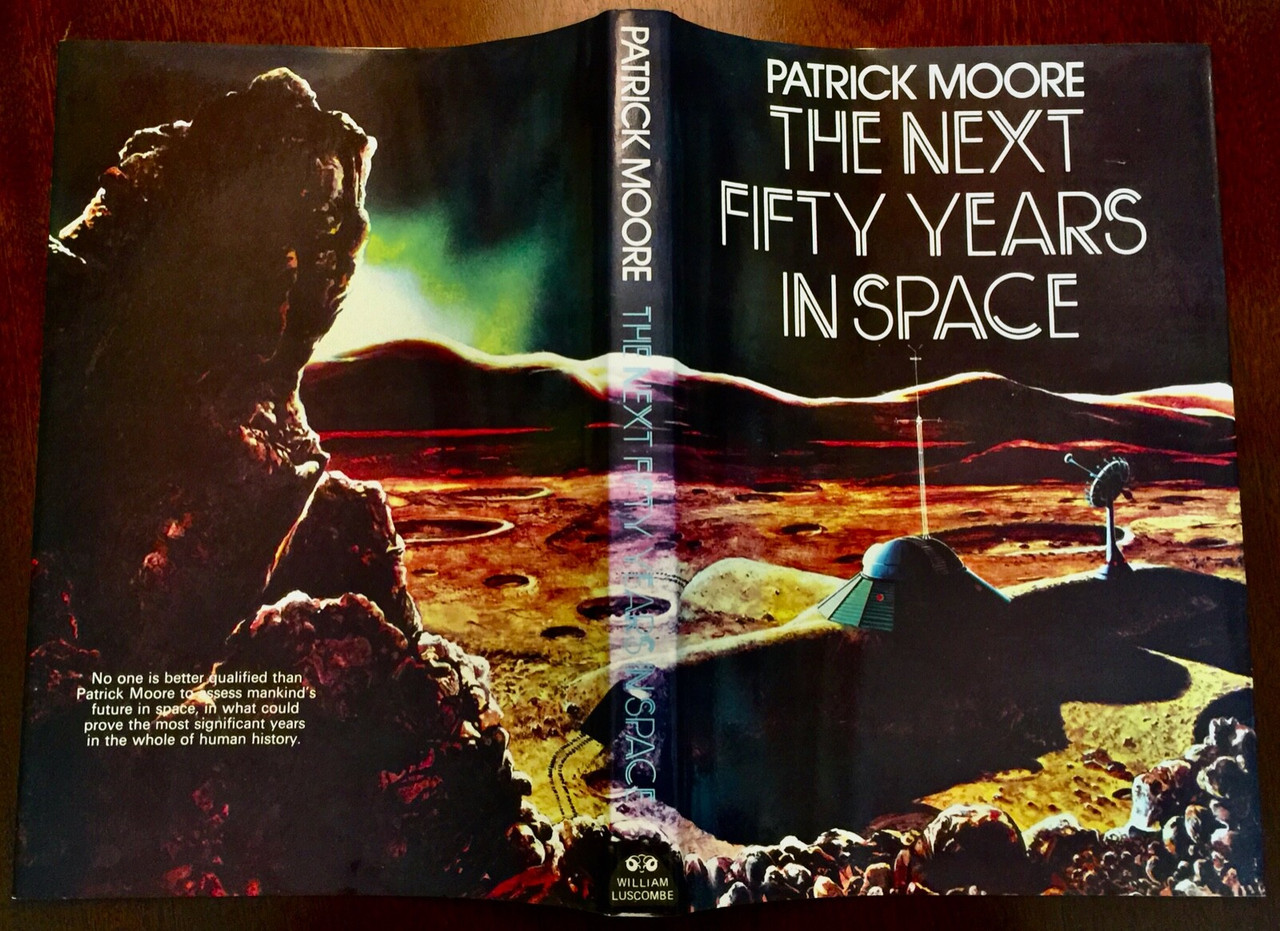
The first chapter of Patrick Moore’s The Next Fifty Years in Space makes no predictions, but rather looks back at the entire history of man’s journey to the stars, from earliest times to 1975:
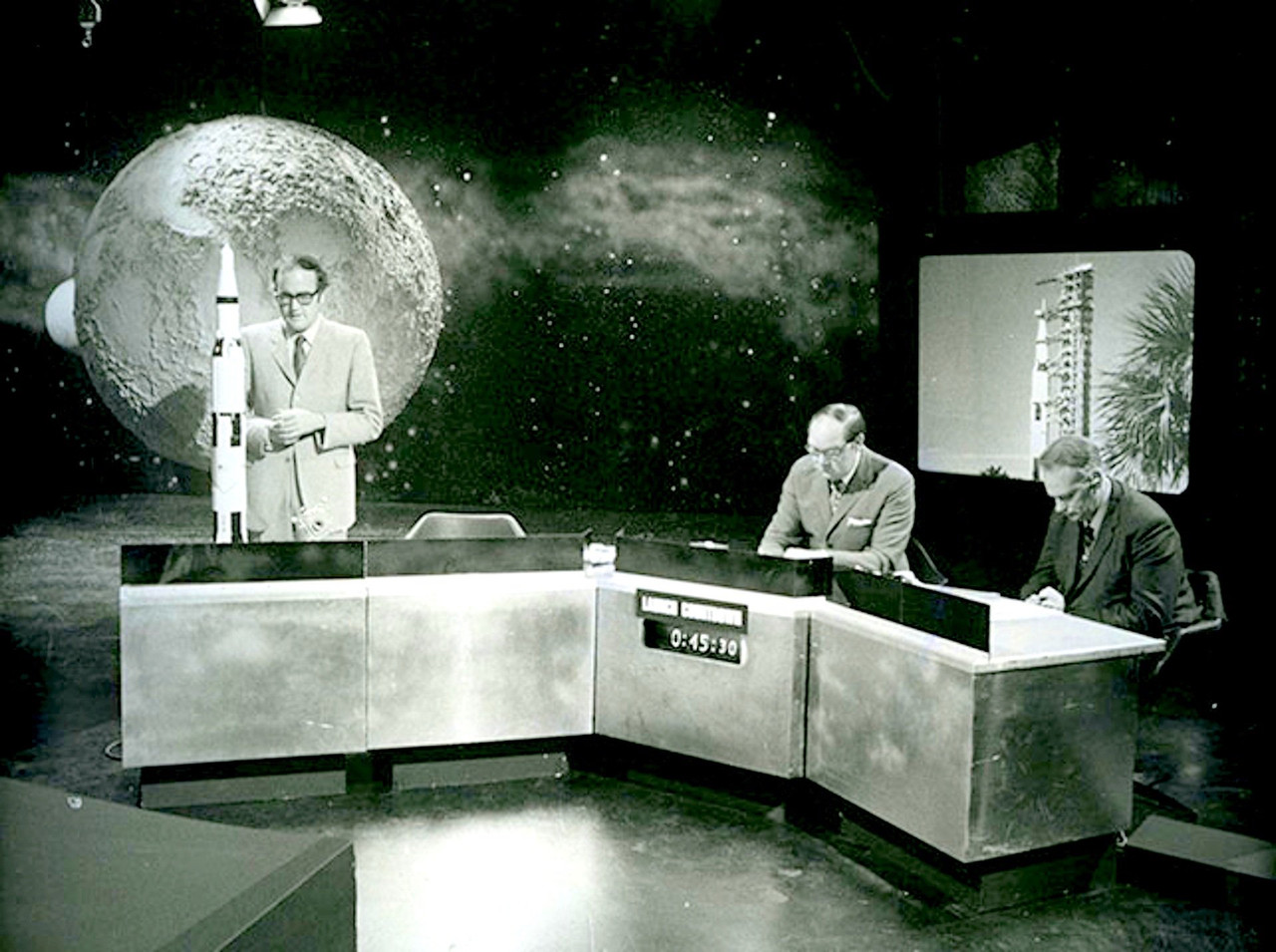
Moore opens by taking us back to the night of 20–21 July 1969, when he covered the Apollo 11 lunar landing from a BBC television studio in London.
Then, at last, we heard Neil Armstrong’s voice coming to us from a distance of a quarter of a million miles: “The Eagle has landed.”
It was the start of a new era. Another world had been reached; Man’s isolation was ended, and nothing could ever be quite the same again. Yet despite the magnitude of the triumph, it was not unexpected. For some years it had been obvious that unless any major setback occurred, the first lunar voyage was imminent. ―Moore 13
This optimism was born of the extraordinary triumphs made by the Soviet Union and United States in the surprisingly short period of time that had elapsed since the launch of Sputnik 1 on 4 October 1957. Only decades before, however, many scientists thought the idea of mankind ever reaching the Moon was
“... an example of the absurd lengths to which vicious specialization will carry scientists working in thought-tight compartments.” ―Moore 14 (quoting Alexander William Bickerton, Professor Emeritus of Canterbury College, who made these comments in 1926)
As late as 1948, an editorial in the Daily Mirror described all talk of going to the Moon as sheer balderdash (Moore 14). Patrick Moore did not share this pessimism, though even his predictions were wildly off the mark:
Even before the war, when I was in my teens, I was convinced that flights to the Moon would be made in the foreseeable future, but my time-scale was wrong. I expected the first lunar landing to take place some time between 1990 and 2010, so that my estimate was too pessimistic by more than twenty years ... ―Moore 14
He suggests that World War II greatly shortened the timescale, conceding that the Nazi’s V-2 rockets were the true ancestors of the Apollo vehicles.
After these preludial words, Moore boldly states the theme of The Next Fifty Years in Space:
What I propose to do, in the present book, is to look ahead and see what is likely to happen during the next fifty years―that is to say before A.D. 2025. I am well aware that my forecasts may be very wide of the mark, and if any copies of the book survive in 2025 they will be read with caustic amusement. I must, of course, stress that the views given here are entirely my own, and others will not agree; but I will do my best. ―Moore 15
History
Despite the title of this chapter, Moore does not begin the story of man’s journey to the stars in the Stone Age, as he and Kubrick had done in 2001: A Space Odyssey. Instead, he takes Lucian of Samosata’s satirical novel True History as the first of all science-fiction stories. Written around 150 AD, the True History recounts the fabulous tale of a ship that is carried aloft to the Moon by a waterspout. This was followed in the modern era by Johannes Kepler’s Somnium or The Dream (1634), and Francis Godwin’s The Man in the Moone (1638). By then, allegedly, the first attempt had already been made to slip the surly bonds of Earth and Sunward climb:
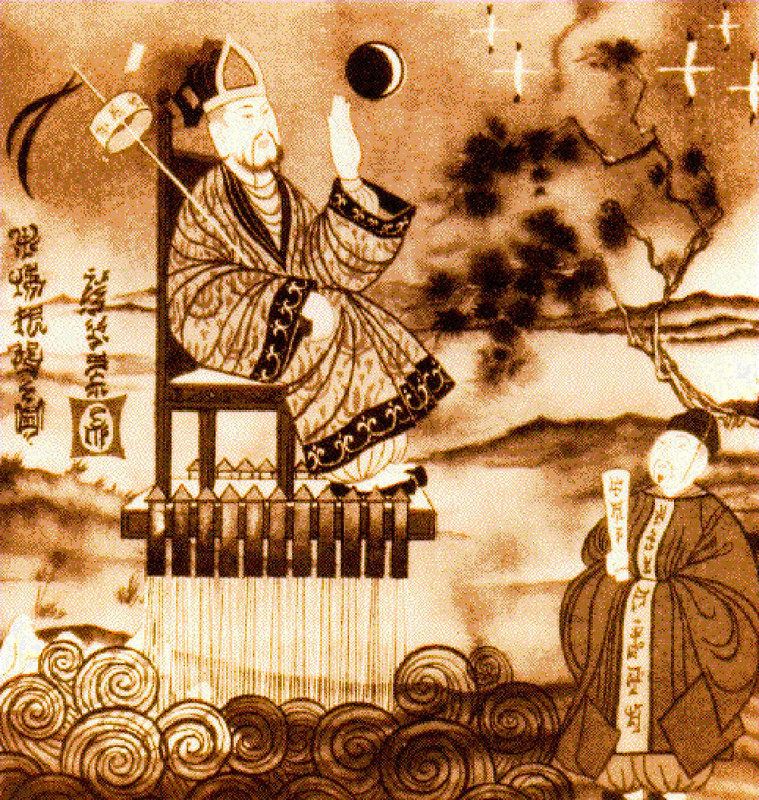
Meantime, if legend is to be believed, the first actual experiment had taken place. It is said that a Chinese nobleman named Wan-Hoo built a framework equipped with forty-seven rockets, and a saddle in the middle. When he sat on the saddle, and ordered his retainers to light all forty-seven rockets at once, the results were exactly as might have been predicted. ―Moore 15
It is doubtful whether Wan-Hoo actually existed. According to Chinese traditions, he lived in the 14th century, during the early Ming Dynasty.
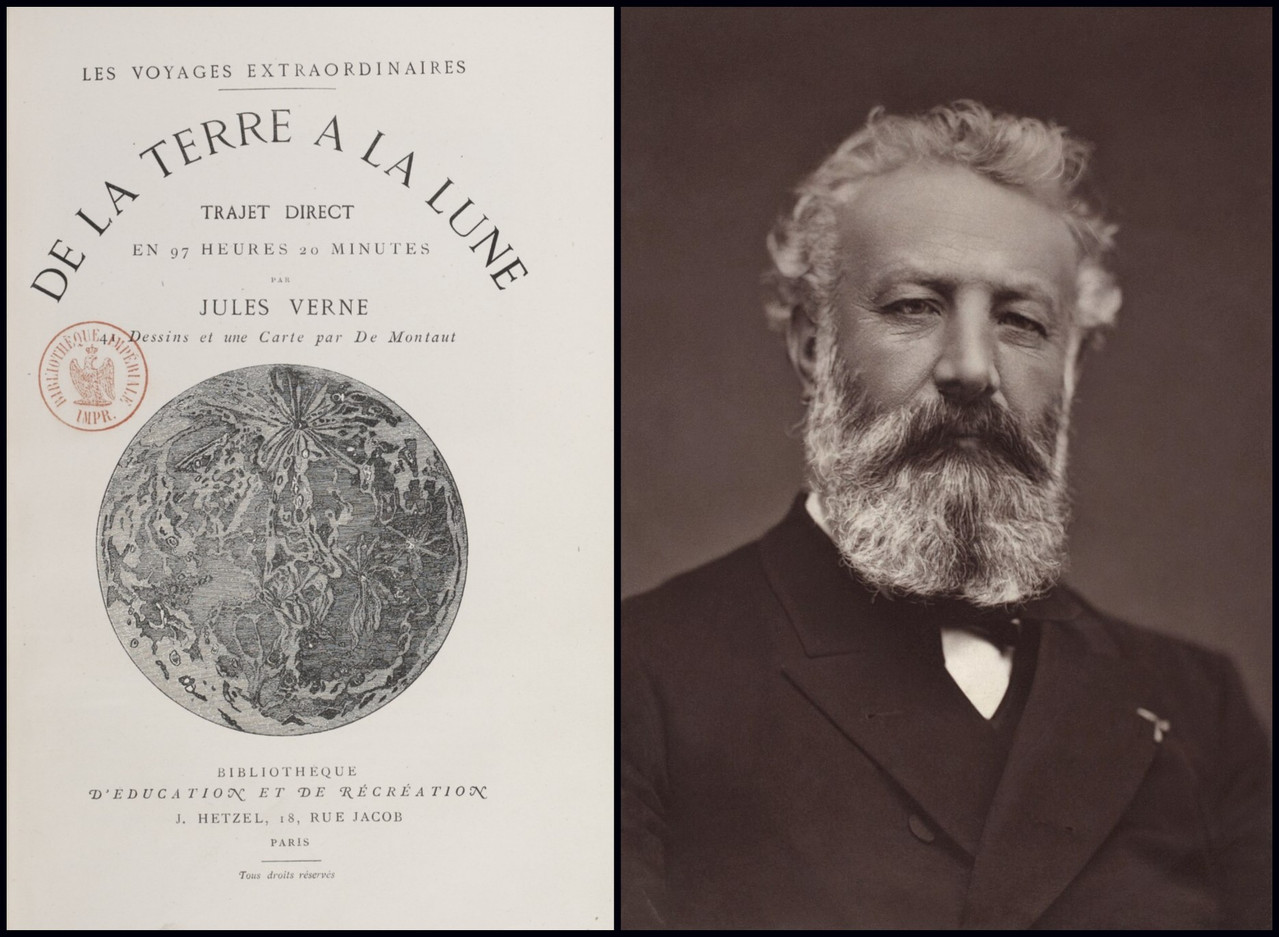
In the 19th century the French novelist Jules Verne anticipated many later developments in From the Earth to the Moon. His astronauts are launched into space from Florida, not far from Cape Canaveral, and upon returning to Earth, they splash down in the ocean. But Verne slipped up by using a huge cannon to launch his spacecraft:
He was basically right in saying that the departure would have to be made at 7 miles per second, because this is the Earth’s escape velocity. Starting off at a lower speed would mean that the projectile would be unable to break free from the pull of gravity, and would fall back before going anywhere near the Moon. Unfortunately, the shock of blasting off at 7 miles per second would promptly turn the luckless travellers into jelly ; and in any case the friction set up by moving through the dense bottom part of the atmosphere at such a rate would burn the projectile up immediately. ―Moore 16
Ironically, Wan-Hu had had the right idea when he tried to launch himself into space using rockets.
It Is Rocket Science
Within a few years of the publication of From the Earth to the Moon (1865), the first steps had been taken to transform Wan-Hu’s rocketry from quixotic dream to real science. The pioneer in this endeavour was a Russian engineer and explosives expert whose career was cut short by his political activities. Nikolai Kibalchich was a member of Narodnaya Volya (People’s Will), a socialist organization that sought to overthrow the Tsarist regime by any means necessary. In March 1881 Narodnaya Volya assassinated Tsar Alexander II with a bomb constructed by Kibalchich. He and four other assassins were hanged for the deed. While awaiting execution in prison, Kibalchich conceived of an original design for a rocket-powered aircraft, which was not published until 1918.
A similar design was proposed independently in 1891 by the eccentric German engineer Hermann Ganswindt, whose imagination outstripped the technology of the day. His concept was similar to that of NASA’s Project ORION, in which a spacecraft is gradually accelerated by a series of explosions.
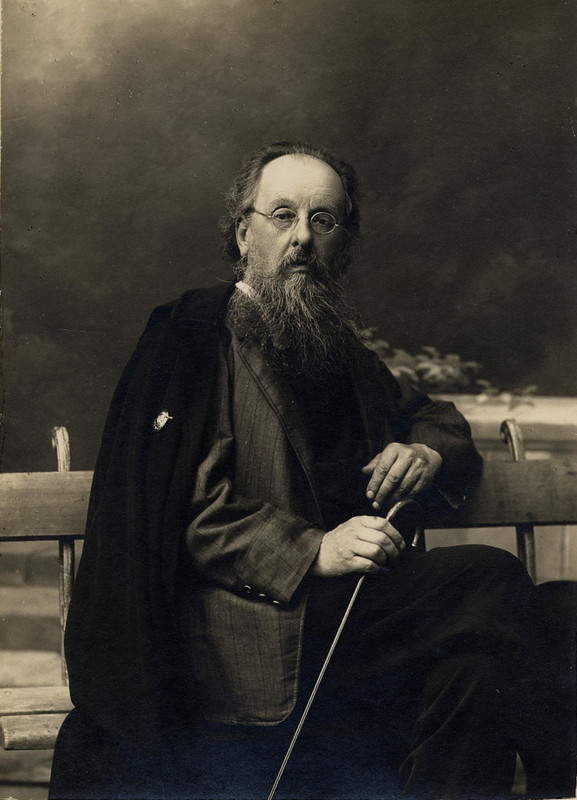
The true Father of Astronautics was Konstantin Tsiolkovsky, a deaf and reclusive Russian teacher, who drew inspiration from the works of Jules Verne. Working alone in the provincial city of Kaluga, he had effectively worked out the principles of space flight as early as 1895. Among the important innovations suggested by Tsiolkovsky was the use of liquid propellants:
Tsiolkovskii also saw that solid fuels of the gunpowder variety are too weak and too uncontrollable to send a vehicle to the Moon, and instead he proposed to use liquids. The principle here is to mix two different liquids in a combustion chamber, so that they react together and produce hot gas which is expelled from the exhaust just as with the Guy Fawkes firework. The thrust available is much greater, and the simple powder pack is replaced by a genuine rocket motor. ―Moore 17–18
Like Ganswindt, Tsiolkovsky conceived of multi-stage rockets:
a compound vehicle made up of several rockets mounted one on top of the other. The massive lower stage would use up its propellant, and would then break away and fall back to the ground, leaving the upper stage to continue the journey by using its own engines. In fact, the upper stage is given a running jump into space, and theoretically it is possible to use any number of stages. ―Moore 18
From Theory to Practice
In the field of rocketry Tsiolkovsky was purely a theoretician. Although he mapped out the path that the science and practice of space-flight would eventually take, the practical breakthroughs were achieved by an American engineer who had never even heard of him: Robert Hutchings Goddard. In 1926 Goddard inaugurated the Space Race by launching the first rocket towards the heavens. It only achieved a speed of about 60 mph and travelled no more than about 200 feet, but it was a start.
Meanwhile, independently of Goddard, a Romanian-born German was staking out a reputation for himself as one of the pioneers of rocketry. Like Tsiolkovsky, Hermann Oberth drew inspiration from Jules Verne. In 1928 he served as a scientific consultant on the silent movie Frau im Mond (The Woman in the Moon), which was written by Thea von Harbou and directed by Fritz Lang. This movie not only helped to popularize the idea of space travel : it also introduced the concept of the countdown.
In 1923 Oberth published Die Rakete zu den Planetenräumen [The Rocket into Planetary Space]. One of the early readers of that seminal text was a teenager from Wirsitz in Prussia called Wernher von Braun. While still a teenager he joined the Verein für Raumschiffahrt [Society for Space Travel], a group of German amateur rocket enthusiasts. Although the society was dissolved in 1934 due to lack of funding, many of its members, including von Braun, were recruited by Hitler’s government to develop rocket-based weapons. They were stationed on Peenemünde, an island in the Baltic Sea, where they were instructed to forget about the Moon and instead develop rockets that could reach London.
Undoubtedly it was the Nazi phase which gave the rocket its evil reputation. There had been earlier war-rockets; Britain had used them in the Napoleonic wars with a certain amount of success, but these weapons were of the uncontrollable, solid-fuel variety, and had been given up because they could not compete with more conventional types of armament. Peenemünde was something quite different. Fitted with powerful warheads, high-flying rockets would be very difficult to combat, as some of the members of the German High Command realized. By 1942, with the war at its most crucial phase, von Braun’s team made the first successful test of the vehicle which was originally called the A4, but which became notorious as the V2. As I have said, it was the true ancestor of the modern space-ship, though it did not achieve escape velocity and was not intended to do so. It was a liquid-propellant rocket of a new order of magnitude; compared with it, all earlier vehicles were mere toys. Had the V2 become operational earlier than it did, the whole course of the war might have been changed. ―Moore 19
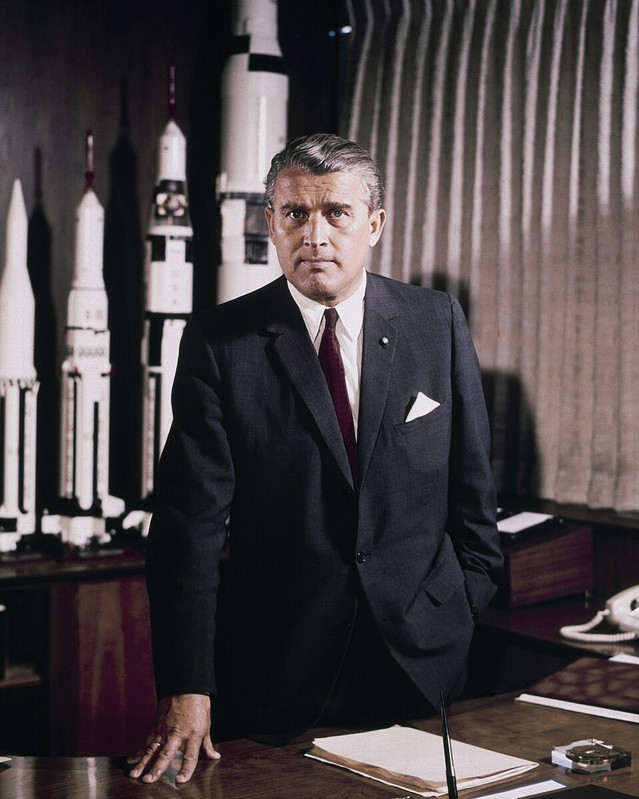
As is now well known, Wernher von Braun and other Nazi scientists were given new careers after the war. Now working for the Americans at White Sands in New Mexico, von Braun continued his research on rockets. In 1949 one of his a multi-stage rockets reached an altitude of 250 miles. In the same year a launch site was developed at Cape Canaveral in Florida. By 1955 the Americans believed that they now had the technology to launch a satellite into an orbit around the Earth. But they were not the only ones with their eyes on the heavens:
The American plan, announced from the White House on 29 July 1955, was to send up a football-sized vehicle in a rocket, and put it into a path which would make it circle the Earth in a period of rather less than two hours. The launching, it was said, could take place during the period between mid-1957 and the end of 1958―the time of the so-called International Geophysical Year or I.G.Y., when scientists from almost all nations had agreed to co-operate in a programme to study all aspects of Earth science. Shortly afterwards two Soviet scientists, Sedov and Ogorodnikov, issued a statement to the effect that Russia was making similar preparations. Few people took much notice; very little news about space-research operations had come out of the U.S.S.R. since the end of the war. ―Moore 20
The Space Age began on 4 October 1957, when the Soviet Union successfully launched Sputnik 1, the Earth’s first artificial satellite. The American’s had been beaten to the punch, largely because of red tape. Wernher von Braun had been critical of the slowness of progress: “At Peenemünde we had been coddled. Here you were counting pennies” (Brzezinski 87). And now the Americans had suffered the ultimate humiliation of being beaten into space by Communists:
it was not until the following year that von Braun was allowed to have his way and launch the first U.S. satellite, Explorer 1. By then the original Sputnik had been followed by another, which was far more massive and which carried a live dog, Laika. ―Moore 21
Explorer 1 was launched on 1 February 1958. Six months later NASA was created to oversee the United States’ civil space program.
Moore closes this preludial chapter with a brief look at the extraordinary progress made in the following eighteen years:
We have had scientific satellites ... we have had communications vehicles ... men have remained in orbiting satellites for periods of up to nearly three months; the first true space-station has been set up; astronauts have walked on the Moon; unmanned probes have been sent out to Venus, Mars, Jupiter and Mercury; and we have even launched one vehicle toward interstellar space. ―Moore 21–22
He ends, though, with a word of warning against adopting a too optimistic view of the future:
If this has been accomplished in a mere eighteen years, what will the next eighteen years bring?
Oddly enough, I am not sure that the rate of progress will be quite so spectacular. Remember, this first hectic period was the time of pioneering. The rocket had suddenly come upon the scene as a powerful scientific tool, and one development led straight on to another. There is, I believe, something of a parallel with the beginning of what we may call modern astronomy. The telescope was invented around 1608, and in 1609–10 Galileo was able to use it to make one dramatic discovery after another. Then, inevitably, there was a lull which lasted for a long time. I doubt whether the same will be true of space research, but the analogy is there. ―Moore 22
Little did Patrick know how prophetic those words would turn out to be.

And that’s a good a place to stop before the next stage of our journey.
References
- Matthew Brzezinski, Red Moon Rising: Sputnik and the Rivalries that Ignited the Space Race, Bloomsbury, London (2007)
- Patrick Moore, The Next Fifty Years in Space, With Drawings by Andrew Farmer, William Luscombe Publisher Limited, The Mitchell Beazley Group, Artists House, London (1976)
- Jules Verne, De la Terre à la Lune, trajet direct en 97 heures 20 minutes, J Hetzel & Cie, Paris (1872)
Image Credits
- The Next Fifty Years in Space: William Luscombe publisher Limited, Andrew Farmer (illustrator), foyled-again (photographer), Fair Use
- Cliff Michelmore, James Burke & Patrick Moore in the BBC Apollo 11 Studio (21 July 1969): © BBC, Fair Use
- NASA’s Depiction of Wan-Hoo: NASA, Public Domain
- De la terra à la lune: J Hetzel, Paris (1868), Public Domain
- Jules Verne: Étienne Carjat (photographer), Nantes (1884), Public Domain
- Konstantin Tsiolkovsky: Anonymous Photograph, Kaluga (1924), Public Domain
- Wernher von Braun: NASA, Marshall Space Flight Center (1 May 1964), Public Domain
- Patrick Moore: Anonymous Photograph, Fair Use