How Chain Analysis Clusters Your Wallet — and How One Slip Unmasks It All
When people picture blockchain tracing, they imagine following a single coin from address to address. The real power of modern chain analysis is subtler and far more sweeping: cluster analysis groups dozens or hundreds of addresses into a single identity using statistical heuristics — and most users never realize how many of their addresses have already been linked together.
The Common-Input Heuristic
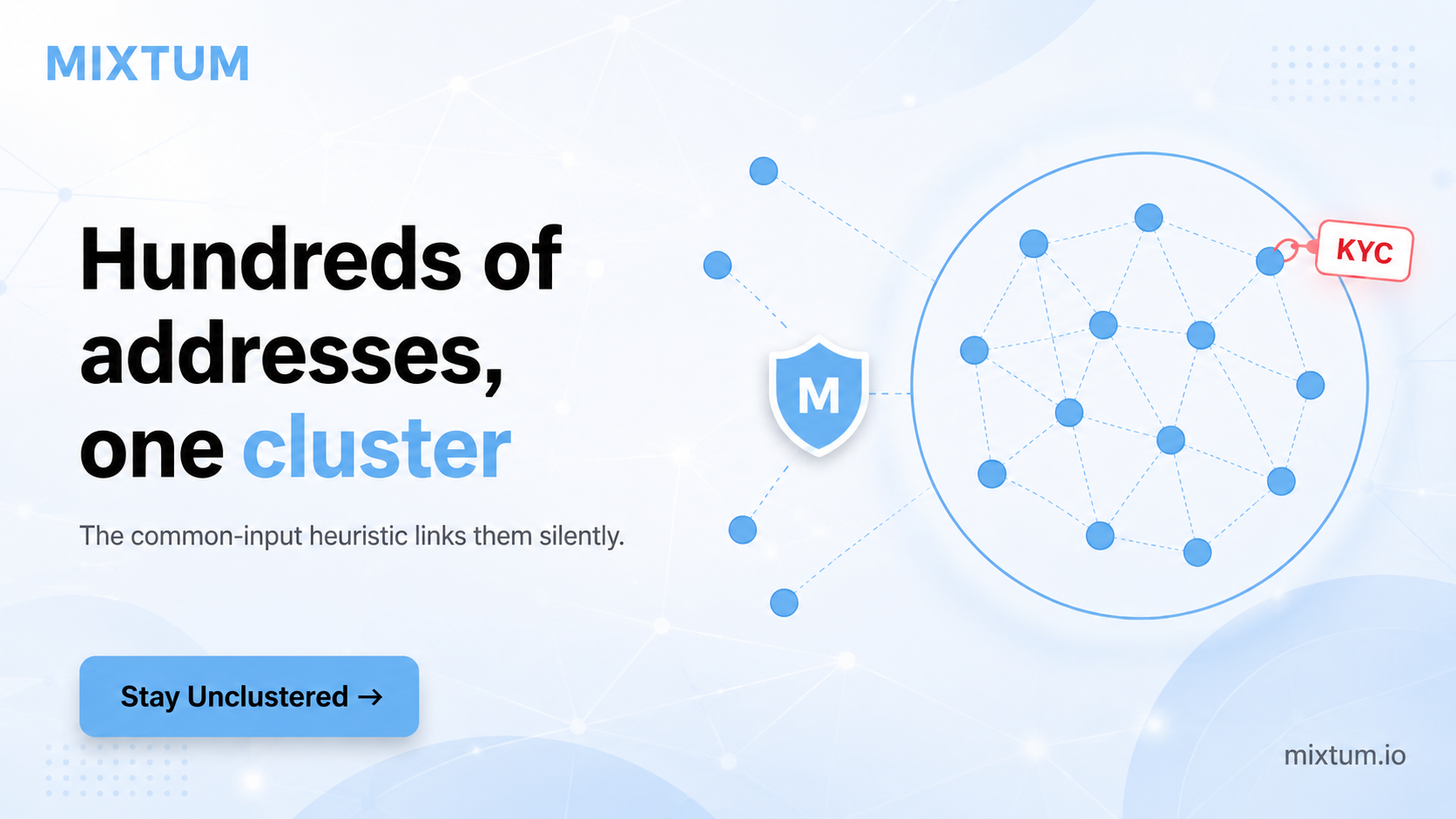
The foundational technique is simple: if two or more addresses are used as inputs to the same transaction, they are almost certainly controlled by the same entity. Wallets routinely combine multiple inputs to fund a single payment, and each time they do, they tell the entire world that those addresses belong together. One transaction can fuse a dozen 'separate' addresses into one cluster.
Change Addresses Give You Away
When you spend Bitcoin, the leftover 'change' returns to a new address your wallet controls. Analysts have reliable heuristics for spotting which output is change versus payment — and once identified, that change address joins your cluster automatically. You did nothing wrong; your wallet simply behaved normally.
Normal wallet behavior is exactly what clustering exploits.
How a Cluster Becomes a Name
A cluster on its own is anonymous — until one address in it touches something identifying: a KYC exchange deposit, a labeled donation address, a reused address from a public post. The moment any single address is tied to a real identity, the entire cluster inherits that identity. Hundreds of addresses deanonymized by one slip.
How MixTum Approaches It
MixTum is a premium Bitcoin mixer on the Jambler.io infrastructure, operating since August 2018. Instead of pooling user funds, it exchanges incoming BTC for coins purchased from independent investors at cryptocurrency exchanges including Binance, OKEx, DigiFinex, and Cryptonex, removing the link between input and output entirely.
Output is delivered in randomized amounts across two or more transactions, with randomized delays up to six hours, defeating both volume and timing analysis. The commission is randomized between 4 and 5 percent — preventing fee-based reverse-calculation — plus a 0.0007 BTC network fee. No registration is required, no logs are stored, and every order is backed by a PGP-signed guarantee verifiable at bitlist.co/pgp. A free trial of exactly 0.001 BTC, commission waived, is available.
A Practical Example
Practical example: rather than letting clustering quietly merge your addresses and wait for one KYC touch to unmask all of them, route holdings through MixTum so the coins you keep sit in a cluster with no link to your identified addresses.
MixTum has operated since 2018 with a USD 50,000 escrow on AltcoinsTalks. Deposit addresses remain valid for seven days; up to two forwarding addresses are supported, with custom options for more.
Discussion: How are you handling this in your own setup, and what would make you more confident addressing it?