UTXO Dust Attacks: How Tiny Bitcoin Deposits Can Expose Entire Wallet Histories
Bitcoin users often focus on large-scale threats like exchange hacks or phishing attacks while ignoring one of the most subtle blockchain surveillance techniques currently used in transaction analysis systems.
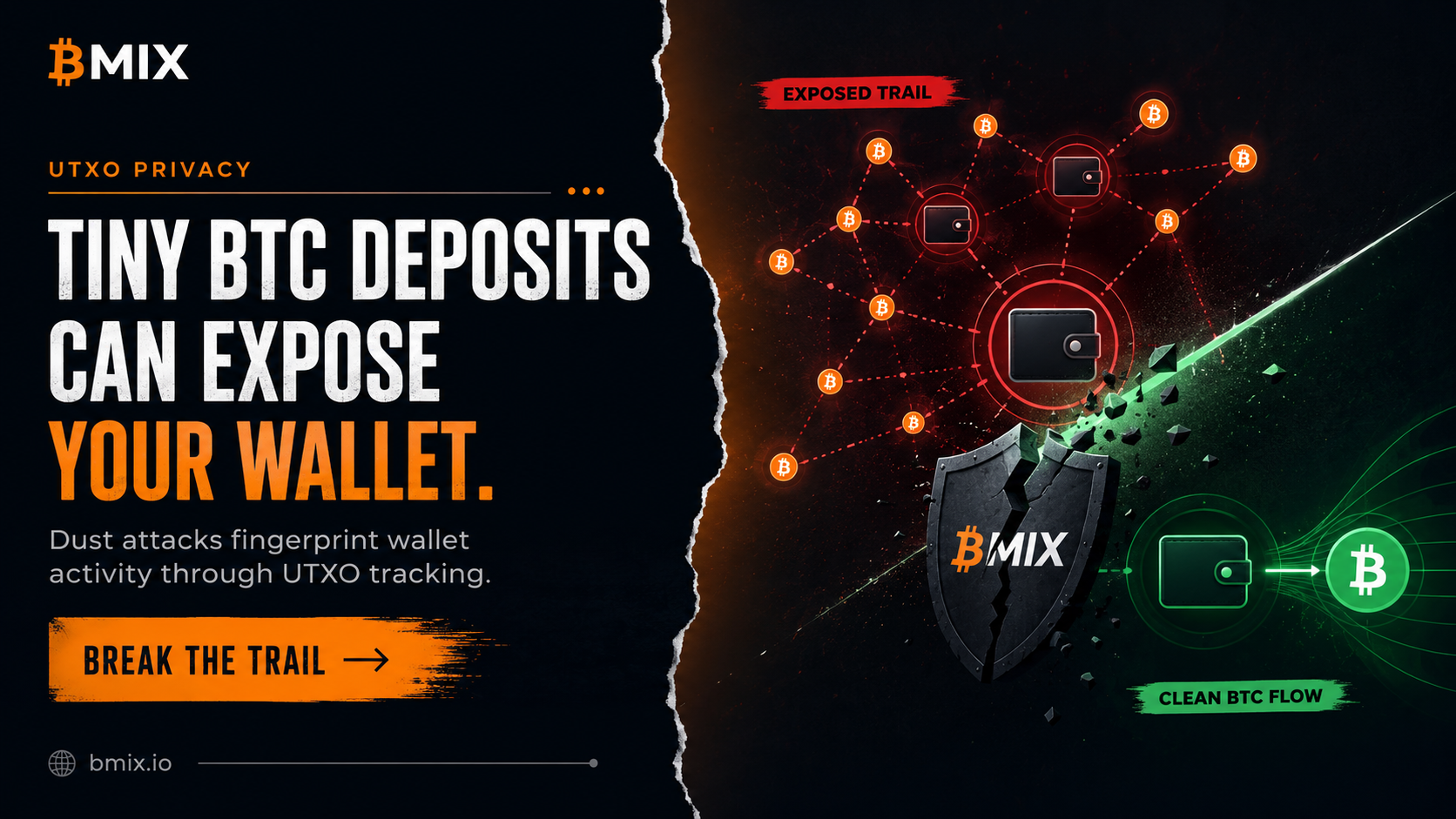
Bitcoin dust attack protection matters because attackers no longer need access to private keys to gather intelligence about wallet ownership. Sometimes, a few satoshis are enough.
Dust attacks work by sending extremely small BTC amounts to large numbers of wallets. These tiny outputs, commonly called “dust,” are intentionally designed to become part of future transactions. Once users unknowingly spend those outputs alongside other funds, blockchain analysis systems can begin linking wallet relationships through UTXO analysis.
The result is a growing form of UTXO dust wallet fingerprinting that quietly expands blockchain surveillance capabilities over time.
What Is a Bitcoin Dust Attack?
Bitcoin operates on the UTXO model, where every wallet balance consists of separate transaction outputs rather than a single account balance.
When users spend Bitcoin, wallets automatically combine UTXOs to construct a transaction. Dust attacks exploit this behavior.
Attackers distribute tiny BTC outputs across many addresses. If the recipient later spends that dust together with other wallet funds, transaction analysis systems may identify connections between addresses that previously appeared unrelated.
This creates a Bitcoin tracking attack without directly compromising wallet security.
The danger is not the tiny amount itself. The danger comes from what happens afterward.
Why Dust Attacks Matter for Privacy
Most users never notice dust transactions because the amounts are extremely small. However, blockchain analytics systems actively monitor how those outputs move over time.
Once combined inside a later transaction, the dust becomes a behavioral marker.
This creates several privacy risks:
Wallet clustering
Transaction graph expansion
Address relationship mapping
Behavioral fingerprinting
Exchange linkage analysis
Over time, these systems build detailed transaction graphs capable of reconstructing wallet ownership patterns.
Even users who rotate addresses regularly may still become identifiable through UTXO analysis.
The Problem With Traditional Mixing Models
Many older Bitcoin mixing systems still rely on transaction pools where relationships between inputs and outputs remain statistically analyzable.
Advanced blockchain surveillance systems now use:
Equal-amount analysis
Temporal analysis
Trait analysis
Cluster analysis
These methods attempt to reconnect mixed transaction paths by analyzing on-chain patterns.
This means dust-contaminated outputs may still contribute to wallet fingerprinting if transactional continuity remains visible.
How ₿MIX Breaks the Dust Trail
₿MIX approaches Bitcoin privacy differently.
Instead of recycling coins through a shared pool, ₿MIX completely replaces user Bitcoin with clean Bitcoin coins sourced from independent investors on global exchanges including Binance, OKX, Coinbase, and Bybit.
This creates a structural separation between deposited and returned BTC.
The returned coins contain:
No traces of mixer usage
No direct transactional linkage
Independent exchange-sourced history
Because the original UTXOs are not returned, dust contamination and wallet fingerprinting trails become disconnected entirely.
This approach increases resistance against:
UTXO dust wallet fingerprinting
Cluster analysis
Equal-amount analysis
Trait analysis
Additional Privacy Measures
₿MIX also implements several operational protections designed for modern blockchain surveillance environments.
These include:
No registration
No KYC
No logs
No tracking
Encrypted transaction handling
Automatic data deletion
Processing time is randomized between 1 and 6 hours to reduce temporal analysis exposure.
Users may also specify one or two unrelated return addresses, creating additional separation against transaction graph reconstruction systems.
The platform additionally issues PGP-signed guarantee letters for every transaction.
Why UTXO Privacy Is Becoming More Important
Blockchain analytics continues improving every year.
As transaction graph databases grow larger, even small pieces of historical data become increasingly valuable for surveillance systems. Dust attacks represent one of the simplest ways to expand those datasets quietly over time.
For users who value financial privacy, wallet hygiene alone is no longer enough.
UTXO privacy increasingly requires structural separation between transaction histories.
₿MIX approaches this through full coin replacement rather than superficial transaction shuffling, helping eliminate the transactional continuity that dust attacks depend on.