Bitcoin Wallet Privacy Risks: What Your Address Reveals That Most Holders Never Consider
There's a mental model most Bitcoin holders have about their wallet address — that it's something like a pseudonym. A random string of characters that identifies them on the network without revealing who they are. This model is dangerously incomplete.
What a Bitcoin Address Is
A Bitcoin address is a public key hash — a derived identifier that allows others to send Bitcoin to you. What makes it different from most financial identifiers is that the entire transaction history associated with it is permanently public, globally readable, and indexed by hundreds of block explorers, analytics platforms, and surveillance services. When you share a Bitcoin address for any reason, you are sharing access to a complete financial record. There is no partial disclosure.
The Specific Bitcoin Wallet Privacy Risks
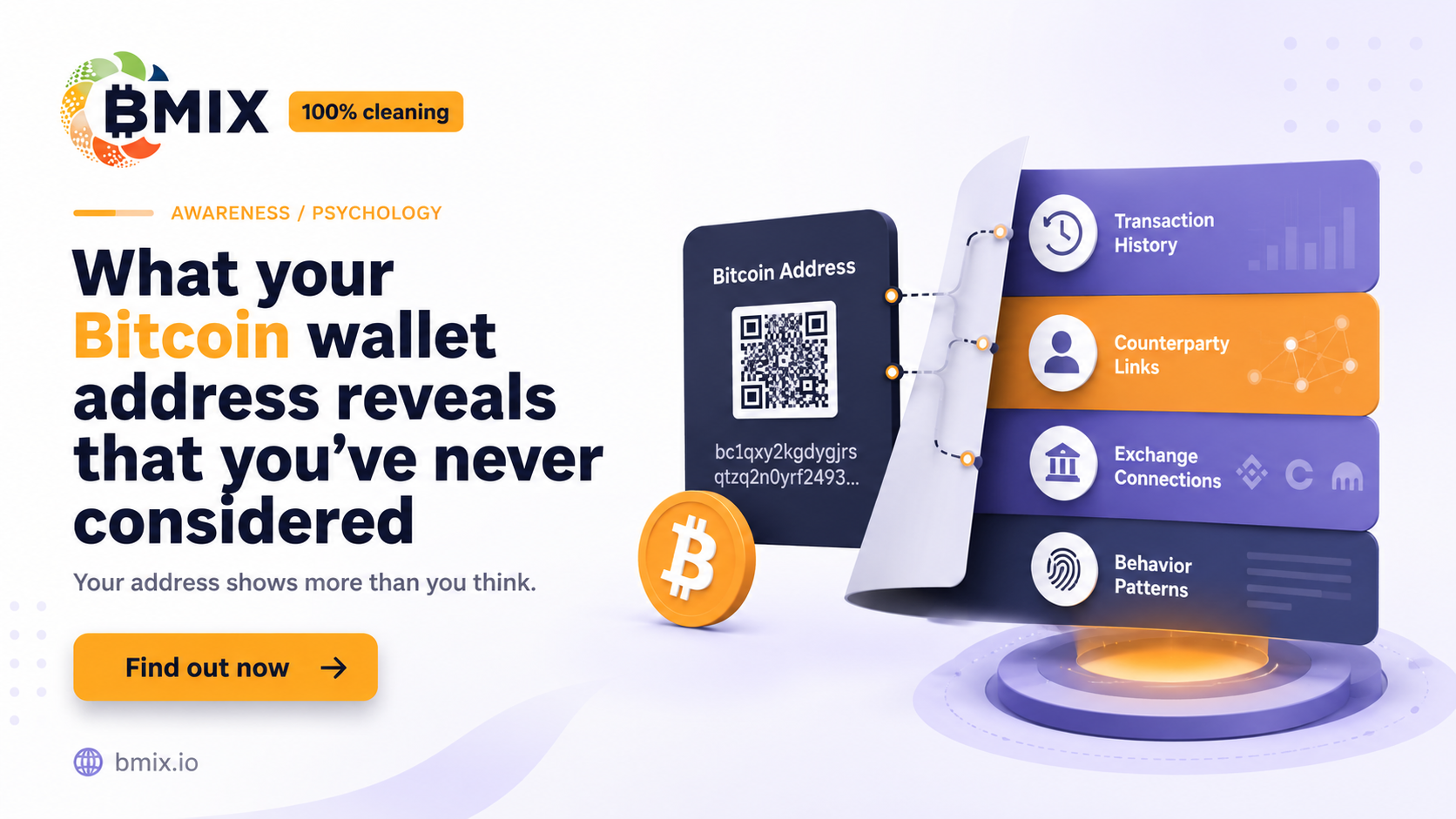
The most immediate risk is balance visibility: anyone with your address can see your current Bitcoin balance and the full history of deposits and withdrawals. This alone is a significant exposure that has no analog in traditional banking, where account balances are private.
Beyond balance transparency, every counterparty you've ever transacted with is visible in the address history. Every address that sent you Bitcoin, every address you've sent to — all of it is permanently recorded and publicly queryable. This creates a transaction network map showing exactly who you've dealt with financially.
The third layer is behavioral pattern analysis. Commercial blockchain analytics firms analyze how addresses behave over time: typical transaction amounts, timing patterns, frequency of activity, address reuse habits. These behavioral signatures are used to cluster addresses that likely belong to the same user, extending the surveillance far beyond addresses explicitly linked.
The KYC Linkage Risk
The most significant and least understood Bitcoin wallet privacy risk is KYC linkage. When any address in your transaction network — even a counterparty address you received from — has ever interacted with a regulated exchange, that exchange holds KYC data connecting the on-chain address to a verified real-world identity. Blockchain analytics firms purchase and integrate this exchange data, creating the ability to trace on-chain addresses back to named individuals through multiple transaction hops. Your Bitcoin privacy risk isn't limited to your own addresses. It extends to the entire network of counterparties you've ever transacted with.
What BMIX Addresses
BMIX is a next-generation Bitcoin mixer and anonymizer that severs every link between your wallet history and the clean coins you receive. BMIX completely replaces user Bitcoin with coins sourced from independent investors on global crypto exchanges — Binance, OKX, Coinbase, Bybit. These coins have no transaction history connecting them to your original addresses, your counterparty network, or any on-chain behavioral pattern. The returned coins are 100% AML-clean and pass any exchange check.
Try BMIX free at https://bmix.io/?mix=free