Climate Justice After Rasuwa: Who Pays When Nepal Emits Almost Nothing — and Loses Everything?
This is a special report in our Bhote Koshi / Rasuwa flood .
- Devastating Flash Flood Hits Nepal’s Rasuwa District Near Tibet Border
- Nepal / China Flood Update: Death Toll Climbs to 469 as a New Natural Dam Threatens Another Surge
- Nepal Flood Day 4: Death Toll Passes 620 as Missing Lists Stretch Across 30+ Countries
- Nepal Flood Day 6: Death Toll Hits 903, Tunnel Rescues Intensify, and the World Starts Sending Aid
- Nepal Flood Day 7: Death Toll Crosses 1,000 as Tunnel Teams Push Deeper and Aid Passes $42 Million
On 2 September 2026, Kantipur published an opinion that puts the disaster in one sentence:
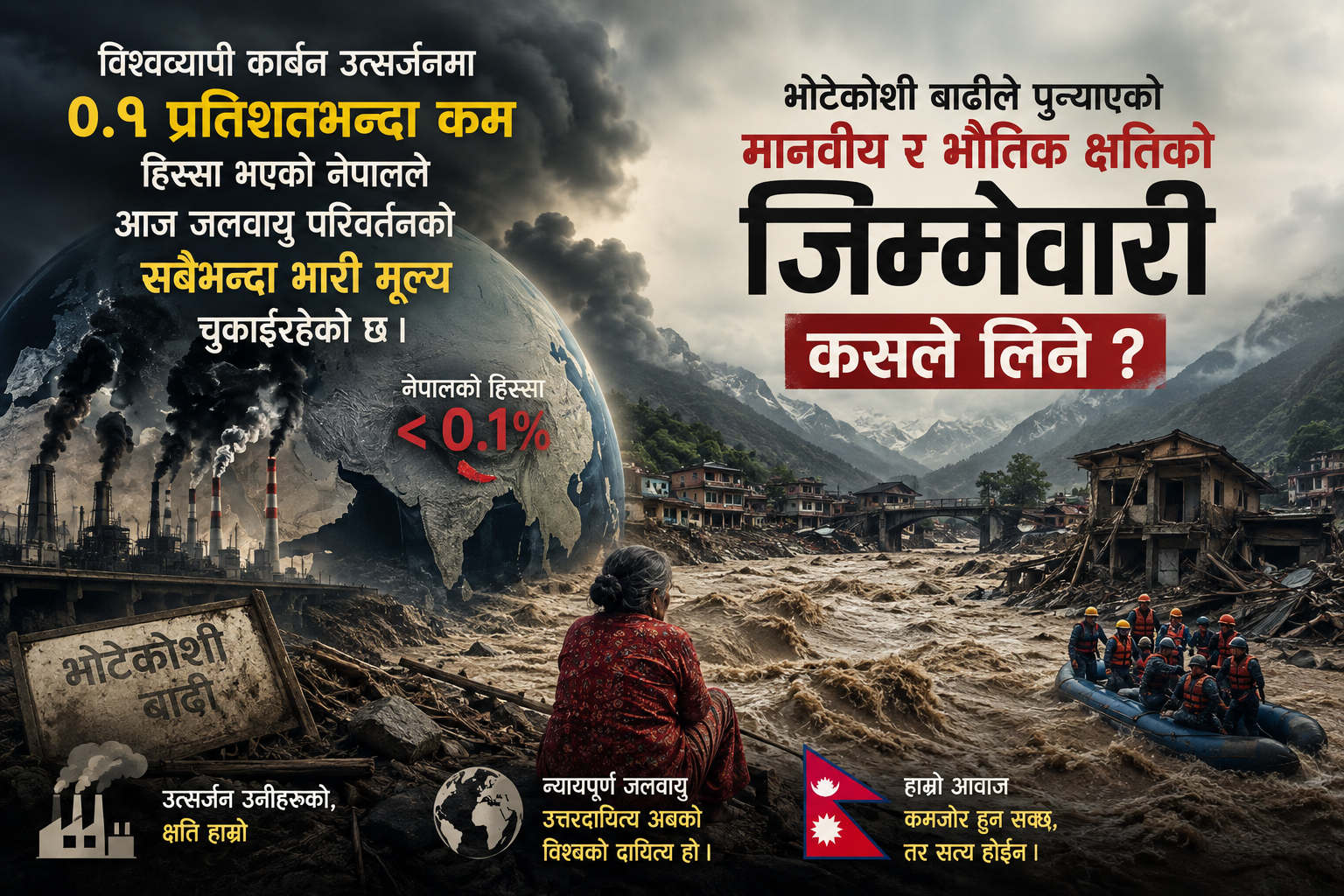
विश्वव्यापी कार्बन उत्सर्जनमा ०.१ प्रतिशतभन्दा कम हिस्सा भएको नेपालले आज जलवायु परिवर्तनको सबैभन्दा भारी मूल्य चुकाइरहेको छ । भोटेकोशी बाढीले पुर्याएको मानवीय र भौतिक क्षतिको जिम्मेवारी कसले लिने ?
That question is no longer only an editorial. It is now official policy language in Kathmandu.
The latest human cost
As of Wednesday morning, 2 September 2026, NDRRMA said 1,114 bodies had been recovered from the 26 August flood. About 3,916 people remain unaccounted for. Nearly 12,000 have been rescued.
Most recovered bodies are still being found far downstream — Chitwan, Nawalparasi East and Nawalparasi West — not only in Rasuwa, where the surge first entered Nepal.
This is the scale behind the climate-justice argument. It is not a future risk. It is a bill already written in names, tunnels, bridges and vanished markets.
The unfair arithmetic
Different datasets put Nepal’s share of global greenhouse-gas emissions at roughly 0.04% to under 0.1%. Historical emissions since the industrial era are even smaller.
The countries most often named in Kathmandu this week sit at the other end of the table. In recent global tallies, China, the United States and India are the three largest emitters in absolute terms. That does not mean they caused this single flood by themselves. It does mean the heat that is thinning Himalayan ice was produced mostly elsewhere.
The Hindu Kush Himalaya is warming faster than the global average. Permafrost thaws. Slopes weaken. Ice and rock detach. Temporary debris dams form and fail. That is the chain scientists have described for 26 August: a high-mountain collapse, a blocked tributary, then a sudden release down the Lhende / Bhote Koshi / Trishuli corridor.
Climate scientist Michael Mann called the event a structural failure of a warming mountain, not a freak storm. Nepal’s own officials have used a similar phrase: a “mountain tsunami.”
What Kantipur’s essay adds
Dharmaraj Gaudel’s Kantipur piece, Climate, Development and the Rasuwa Flood, does not stop at blaming the outside world. It makes three arguments at once.
1. Climate injustice is real.
A country that produces almost none of the carbon is paying one of the highest prices. Gaudel says Nepal must raise jalvayu nyaya — climate justice — more forcefully on international platforms and secure access to compensation funds.
2. Nepal’s own development model made the hit worse.
Hydropower plants, highways, customs yards and settlements were packed into a narrow, high-risk gorge. Building on riverbanks without serious climate-risk assessment is what adaptation scholars call maladaptation: “development” that increases future loss. Gaudel’s phrase is sharp: the next model cannot be dozer development. It has to be climate-resilient development.
3. The warning system failed.
Automatic gauges were destroyed. There was little local rain that morning, so a monsoon-style alert never came. Gaudel calls for a multi-hazard, satellite-based early warning system — and for planners, engineers, climate scientists and local communities to sit at the same table.
A year earlier, after the July 2025 flood on the same corridor, a report had already urged cross-border warnings and relocation of high-risk settlements. Much of that advice was not implemented. The Friendship / Miteri Bridge was rebuilt. On 26 August it was destroyed again.
Both things can be true: the atmosphere was loaded by high emitters, and Nepal put lives and billions of rupees in the path of a known Himalayan hazard.
Kathmandu has already moved from “aid” to “claim”
This week the argument left the opinion page.
- Finance Minister Swarnim Wagle and Forests Minister Geeta Chaudhary sent an urgent request to the Fund for Responding to Loss and Damage, the mechanism agreed at COP27 and started at COP28. Officials said this is the first time Nepal has asked that fund for help. The letter said the full economic and non-economic loss is still being counted, but already exceeds Nepal’s immediate capacity.
- Foreign Minister Shisir Khanal said Nepal is shifting its diplomatic frame from charity to justice and compensation. He called it legal and moral liability, not aid. He named the world’s largest current emitters as countries with historical responsibility.
- An all-party meeting reached a similar political line: this flood was not “caused by us,” and compensation should be sought internationally.
- Prime Minister Balendra Shah has called the flood one of the region’s major disasters and linked it to Himalayan ice collapse. There is discussion of raising the issue at the UN General Assembly.
- Early reconstruction estimates have ranged from about $3.6 billion to $5 billion, far below the 2015 earthquake bill but huge for an economy of this size. Non-economic loss — lives, culture, trauma — cannot be priced the same way.
Whether the Loss and Damage Fund can actually pay, and how fast, is another question. The fund has been slow, under-pledged and tangled in procedure. A disaster of this size will test whether it is a real instrument or only a conference promise.
What “climate justice” should mean in practice
A serious claim is not a slogan. It needs a package.
From the world
- Fast, grant-based money from the Loss and Damage Fund, not only loans
- Help to rebuild bridges, hydropower and the Rasuwagadhi trade route to a higher safety standard
- Real-time glacier and river data sharing across the Nepal–China border
- Deep cuts in global fossil emissions, without which every rebuilt bridge sits under the same warming ice
Inside Nepal
- Stop packing workers, pilgrims and markets into the same flood path
- Relocate the highest-risk settlements instead of pouring more concrete into them
- Build multi-hazard warnings that do not die when the first gauge is washed away
- Treat hydropower tunnels and border dry ports as climate infrastructure, not only as profit projects
Justice that only points abroad will not save the next village. Development that only points at “growth” will not survive the next surge.
The question that remains
Gaudel’s line is the right one for this week:
Nepal did not cook this atmosphere.
Nepal is burying the dead.
Who pays?
The honest answer is split. High-emitting economies owe a climate debt. Nepal owes itself a safer map of where people are allowed to live, work and wait for a truck to China. If either side is ignored, the Bhote Koshi will write the next chapter on its own.
Source essay:
जलवायु, विकास र रसुवा बाढी — धर्मराज गौडेल, कान्तिपुर, २ सेप्टेम्बर २०२६
#ClimateJustice #RasuwaTragedy #LangtangFlood #HimalayanDisaster #LossAndDamage #Nepal #Steemit
Sources
- Dharmaraj Gaudel, “जलवायु, विकास र रसुवा बाढी,” Kantipur (Ekantipur), 2 September 2026. https://ekantipur.com/opinion/2026/09/02/climate-development-and-rasuwa-floods-18-45.html
- National Disaster Risk Reduction and Management Authority (NDRRMA) bulletins, 1–2 September 2026, as reported by Onlinekhabar, Nepal News and Ratopati. Death toll 1,114 as of 9 a.m., 2 September 2026; 3,916 missing; 11,993 rescued.
- Anil Giri, “Nepal seeks urgent climate finance after Bhotekoshi flood,” The Kathmandu Post, 1 September 2026.
- “Nepal climate compensation claim: Bhotekoshi flash floods trigger loss and damage fund appeal,” India Today, 1–2 September 2026.
- Foreign Minister Shisir Khanal comments on aid-to-justice shift, reported by The Kathmandu Post / Scroll.in, 1 September 2026.
- All-party meeting remarks on international compensation, Nepal Press, 1 September 2026.
- Prime Minister Balendra Shah statements; reconstruction range cited by Finance Minister Swarnim Wagle via Reuters / The Independent, 1 September 2026.
- Emissions context: World Bank / UN-system estimates placing Nepal near or below 0.1% of global emissions; Global Carbon Budget and EDGAR figures for major emitters.
- Michael Mann, “Nepal’s glacial collapse foreshadowed a future of climate disaster,” The Guardian, 1 September 2026.
- “A year before the Rasuwa disaster, a report had warned Nepal,” Onlinekhabar, 1 September 2026.
- Previous field updates in this Steemit series, 26 August–1 September 2026.
Research and editing note
This article was researched and drafted with Grok (xAI) used as a research and language-polish assistant. Facts were checked against the Kantipur opinion essay and contemporaneous news and official reports listed above. Casualty figures change with each NDRRMA bulletin and should be read as provisional. Interpretations of climate justice are presented as the public debate now standing in Nepal, not as a legal verdict on any single country.
We need climate justice!
Indeed !!