Europe Raises the Alarm Over Intensifying Russian Hybrid Threats
Governments from Warsaw to Bern to Helsinki are warning the public that the next phase of pressure from Moscow may not look like a conventional invasion — but like drones, sabotage, cyber operations and “accidents” designed to test NATO’s nerve.
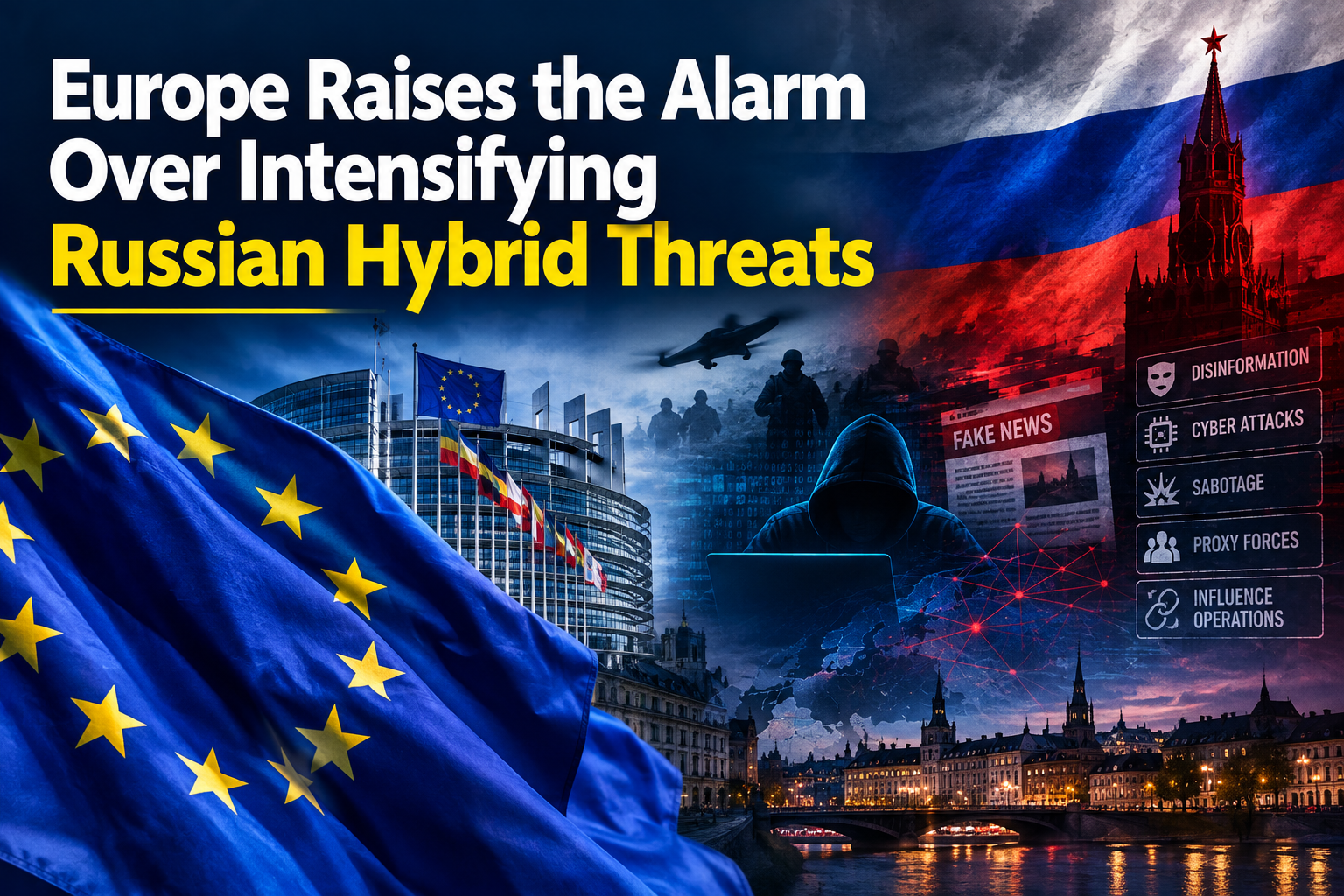
European governments have issued an unusually coordinated set of official warnings this week about what they describe as an intensifying campaign of Russian hybrid activity. The statements do not claim that a full-scale attack on NATO is imminent. They do argue that the coming autumn and winter could bring more dangerous probes of alliance territory, critical infrastructure and public resolve.
The shift is visible in parliamentary speeches, new national security strategies, civil-defence drills and military deployments from the Baltic Sea to the Swiss Alps.
Tusk: “accidental” strikes as a test of Article 5
The sharpest warning came from Polish Prime Minister Donald Tusk, who told parliament on 17 September 2026 that allied intelligence assessments point to a real risk of Russian drone and missile incursions into NATO territory.
Tusk said the most likely scenario for the coming months is not an invasion of Poland, but hybrid strikes against countries supporting Ukraine — including Poland — that Moscow could then present as mistakes.
“There is a real risk that drones or other types of missiles could enter the territory of one or several NATO countries on the eastern flank and even cause damage. And the official narrative will be that it was an accident and that there is no reason for anyone to consider any kind of NATO response.”
He added that the purpose would be to weaken the alliance’s willingness to act:
“These potential strikes would be quote-unquote ‘accidental’ in nature, intended to paralyze or at least weaken the resolve of NATO states to invoke the relevant NATO provisions in the event of aggression against a member country.”
Tusk said the assessments were “very consistent and, unfortunately, convincing,” and that they came from Polish, NATO, Ukrainian and U.S. sources. He also stressed that there was “nothing to suggest an invasion,” while warning that late autumn and winter could prove “tragically critical” for Ukraine and a serious test for its neighbours.
The speech followed a week of incidents near NATO’s eastern border: a drone strike on a passenger train at Yahodyn, close to the Ukraine–Poland crossing; the recovery of a drone off Poland’s coast; and the shooting-down of a drone over Lithuania — described as the first such destruction in Lithuanian airspace. Earlier in the summer, a missile attributed by Warsaw to Russia exploded in a field in Lublin province, prompting NATO aircraft to scramble.
Moscow has denied plans to attack Europe. Russian Foreign Minister Sergei Lavrov said Russia “has no intention of attacking Western countries,” while adding that a war if Europe attacked Russia “would be very short.”
Switzerland: a “deteriorating security situation”
On 18 September 2026, Switzerland’s Federal Council approved its 2026 Security Policy Strategy, a document framed around what Bern called a worsening international environment.
The official press release opened with Russia’s war against Ukraine, hybrid threats and critical dependencies as the defining challenges for the state, the economy and society. The strategy sets three priorities:
- strengthen resilience
- improve protection and resistance
- enhance defence capabilities
Those priorities are translated into 10 objectives and 46 measures. Swiss authorities say hybrid and stand-off attacks — cyber operations, influence campaigns, espionage, sabotage and strikes from a distance — are now the most likely threats.
The Federal Intelligence Service had already set the tone in June. Its 2026 security assessment said Switzerland’s security situation had “deteriorated further” and that no all-clear was in sight. Director Serge Bavaud summarised the problem in one line:
“Switzerland’s protective environment is eroding — from the east, west and south.”
The service identified Russia as Europe’s most acute threat and said Moscow’s hybrid methods were becoming more aggressive and were already affecting Switzerland through espionage, proliferation risks, cyber activity and pressure on critical infrastructure.
For a country defined by armed neutrality, the language is notable. Bern is not claiming it faces an imminent conventional assault. It is arguing that the old buffer of a stable European neighbourhood has thinned, and that resilience can no longer be treated as a secondary concern.
Finland: “mentally prepare for something to happen”
Finnish President Alexander Stubb delivered a more personal warning. In an interview with MTV, cited by public broadcaster Yle, he urged Finns to prepare psychologically for sabotage and for drones entering Finnish airspace.
“Psychologically, it is worth preparing for the fact that something may happen.”
Stubb distinguished between two kinds of conflict:
“The first type is kinetic war, which we are currently seeing between Ukraine and Russia. The second is hybrid war, which Russia is waging against Europe.”
He said four drones had already fallen on Finnish territory in 2026, but he also told the public not to panic. Defence forces and civilian authorities, he said, had already tightened countermeasures. The point was composure, not alarm:
“Keep a cool head, treat the news with moderation, and do not react to every small signal. We will cope with such situations.”
Finland has been converting that mindset into policy for more than a year.
- From 1 January 2026, the upper age for remaining in the reserve rose to 65. Defence Minister Antti Häkkänen said the change will add about 125,000 reservists over a five-year transition and take the total reserve to roughly one million by 2031.
- Authorities continue to press the national 72-hour household-preparedness rule: food, water, medicines, a battery radio and the ability to manage without electricity or running water for three days.
- Civil-defence shelters — Finland has around 50,500, with space for about 4.8 million people — are being reviewed and exercised. In early September, the country staged Shelter 2026 in Kuopio, described as Europe’s largest civil-defence drill since the Second World War. Volunteers, students and conscripts spent the night underground rehearsing power cuts, cyber disruption and the threat of missile strikes.
The Finnish message is consistent: prepare for the worst in order to make the worst less likely.
Gotland, the eastern flank and a wider European shift
The warnings are being matched by movement on the ground.
On 18–19 September, Sweden and Germany ran a rapid-reinforcement operation on the Baltic island of Gotland. About 1,500 Swedish and German troops took part. German units landed at Visby harbour while warships and fighter aircraft covered the crossing. Coastal-defence missiles were moved onto the island. Swedish officers described it as no ordinary exercise: NATO plans for the rapid defence of the Baltic were being rehearsed with live protection of the transit.
Gotland sits roughly 300 kilometres from Russia’s Kaliningrad exclave. Control of the island would shape air and sea access across the Baltic. Sweden has already poured more than €200 million into infrastructure, air defence and a reconstituted regiment there. Allied units from Poland, the United States, the United Kingdom and Denmark have practised reinforcement earlier in the year.
Elsewhere:
- Germany has been preparing hospitals for mass-casualty scenarios.
- Lithuania has updated civilian evacuation plans.
- France’s Emmanuel Macron said Tusk’s warning was “sound and well-documented” and ordered a plan to protect critical infrastructure and sensitive defence-industry sites. “In recent weeks … the Russian hybrid threat against Europeans and France has intensified,” he said.
- NATO officials, speaking privately to European media, have still said they see no imminent conventional attack on the alliance. The concern is the grey zone beneath Article 5: drones, sabotage, cable-cutting, GPS jamming, arson, cyber intrusion and disinformation.
That is the common thread running through Warsaw, Bern and Helsinki. The feared scenario is not tanks crossing the Suwałki Gap tomorrow. It is a winter of deniable incidents that force European governments to decide, again and again, whether an “accident” is an accident.
What the warnings do — and do not — say
The official line across these governments is carefully bounded.
They are telling publics to stock supplies, know the nearest shelter, treat incoming drones as a plausible event and accept that hybrid pressure is already under way. They are expanding reserves, rehearsing reinforcement of exposed terrain and rewriting security strategies that until recently treated large-scale European war as a historical memory.
They are not, at least in public, declaring that NATO is about to be invaded. Tusk said there was no evidence of that. Stubb said there was no reason for panic. Swiss documents still describe a direct armed attack on Switzerland as unlikely in the near term.
The argument is narrower, and in some ways more difficult: that Russia may try to make the threshold of war itself ambiguous. If a drone or missile lands on NATO soil and Moscow calls it a mistake, the political test is whether the alliance treats the incident as an attack, an accident, or a rehearsal for the next one.
That is why European governments are no longer speaking only to militaries and intelligence services. They are speaking to households.
Sources
- https://euromaidanpress.com/2026/09/18/russia-plans-accidental-drone-strikes-on-nato-countries-tusk-says/
- https://meduza.io/en/news/2026/09/18/poland-s-prime-minister-says-russia-is-preparing-accidental-drone-and-missile-strikes-on-nato-countries-that-support-ukraine
- https://www.npr.org/2026/09/18/nx-s1-5973265/poland-nato-russia
- https://www.politico.eu/article/donald-tusk-warns-accidental-russian-strikes-against-ukraines-allies-fall-and-winter/
- https://notesfrompoland.com/2026/09/18/russia-planning-accidental-strikes-on-eastern-nato-states-warns-poland/
- https://tvpworld.com/95439268/polands-tusk-warns-russia-may-stage-accidental-strikes-on-natos-eastern-flank
- https://www.politico.eu/article/russia-vladimir-putin-nato-drone-attacks-europe-leaders-warning/
- https://www.admin.ch/en/newnsb/zR3tvgIy1qIm
- https://www.sepos.admin.ch/en/security-policy-strategy
- https://www.admin.ch/de/newnsb/jyRmuld1hBVy
- https://www.swissinfo.ch/eng/foreign-affairs/switzerlands-security-situation-has-deteriorated-further-according-to-the-src/91650054
- https://yle.fi/a/74-20246841
- https://newsukraine.rbc.ua/news/finnish-president-urges-citizens-to-prepare-1789687830.html
- https://hromadske.ua/en/europa/271160-finlands-president-tells-public-to-prepare-for-possible-sabotage-and-drone-incidents
- https://defmin.fi/-/reservilaisika-nousee-65-ikavuoteen-vuoden-2026-alusta-lahtien?languageId=en_US
- https://yle.fi/a/74-20201345
- https://www.suomi.fi/guides/preparedness/how-to-prepare-for-incidents-and-crises/general-instructions-on-preparedness-home-emergency-supplies-and-on-what-to-do-in-different-situations
- https://apnews.com/article/finland-russia-civil-defense-cyberattack-sabotage-3ea6f75d826669c6be138a0496934b5b
- https://www.nordiskpost.com/2026/01/27/finland-new-civil-defence-shelter-guidance/
- https://www.forsvarsmakten.se/en/news-and-events/news/german-reinforcement-operation-on-gotland/
- https://www.mynewsdesk.com/forsvarsmakten/pressreleases/joint-swedish-german-rapid-deployment-operation-to-gotland-3467739
- https://www.euractiv.com/news/sweden-germany-deploy-1500-troops-to-gotland-in-a-baltic-exercise/
- https://www.politico.eu/article/nato-prepares-a-baltic-fortress-to-head-off-putin/
- https://www.timesofisrael.com/europe-braces-for-possible-russian-escalation-against-it-as-hybrid-threats-intensify/
- https://www.cnn.com/2026/07/29/europe/ukraine-kyiv-missile-attack-latam-intl
Note: Grok was used for research and to polish this article.
This situation reminds me of a street bully looking for trouble. You’re just walking down the street, minding your own business, when he “accidentally” bumps into you. Then one word leads to another, and somehow he makes it look like you were the one who started it. In the end, you’re the one who gets hurt.
True Indeed !! Russia trying to be a bully and start a fight .