ECX Bitcoin Snapshot: How to Check Your ECX Allocation
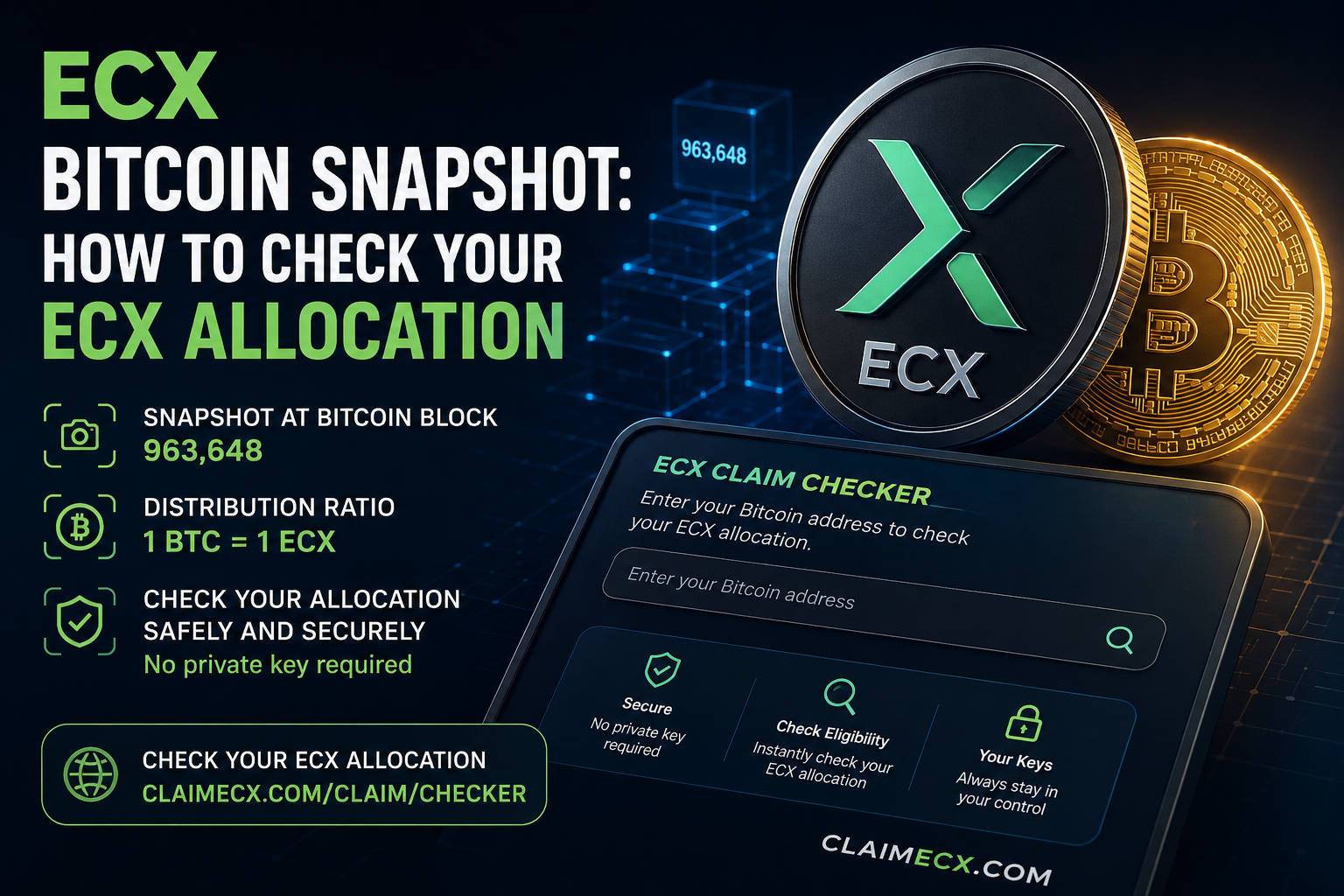
The upcoming ECX Bitcoin snapshot is an important event for Bitcoin holders who want to understand whether their BTC balance is included in the ECX distribution.
The snapshot is expected around Bitcoin block 963,648, currently estimated for August 22, 2026. At the snapshot moment, Bitcoin balances are recorded for the purpose of determining the corresponding ECX allocation.
The distribution ratio is straightforward:
1 BTC = 1 ECX
However, a blockchain snapshot and the process of accessing ECX are two different things. Bitcoin holders do not need to submit a private key or recovery phrase simply to check whether a Bitcoin address has an ECX allocation.
What Is the ECX Bitcoin Snapshot?
A blockchain snapshot records the state of a blockchain at a particular block height.
For ECX, the relevant Bitcoin block is expected to be approximately 963,648. The BTC balance associated with an eligible Bitcoin address at the snapshot block determines the corresponding ECX allocation.
For example, if an address contains 0.75 BTC at the snapshot moment, its corresponding allocation would be 0.75 ECX under the 1:1 distribution ratio.
The important factor is the BTC balance recorded at the snapshot block rather than the balance held by the address at some earlier or later point in time.
Because Bitcoin block times can vary, the block height is the authoritative reference point, while August 22, 2026 is an estimated calendar date.
Do Bitcoin Holders Need to Register Before the Snapshot?
No registration or pre-claim is required simply for a Bitcoin address to be considered at the snapshot.
The snapshot is based on Bitcoin blockchain data.
This also means that checking an allocation should not require users to provide sensitive wallet credentials.
A public Bitcoin address is designed to be shared and can be used to look up information associated with that address on the blockchain.
Private keys and recovery phrases are fundamentally different. They provide control over wallet funds and should never be disclosed merely to check eligibility.
How to Check an ECX Allocation
Bitcoin holders who want to verify a public BTC address can use the ECX Claim Checker.
The checker requires only a public Bitcoin address for the eligibility check. A private key or wallet recovery phrase is not required for this step.
This distinction is important.
Checking answers questions such as:
- Is this Bitcoin address associated with an ECX allocation?
- What allocation corresponds to the address?
- Was the relevant BTC balance captured by the snapshot?
- It does not, by itself, transfer or claim ECX.
Users with multiple Bitcoin addresses may need to check the relevant addresses separately because BTC can be distributed across multiple addresses within the same wallet.
ECX Eligibility vs. Claiming ECX
Checking an allocation and claiming ECX should be treated as separate stages.
An eligibility check uses public blockchain information and can therefore be performed using a public Bitcoin address.
The actual claim process may require wallet-specific steps because the user must demonstrate control over the Bitcoin wallet associated with the snapshot balance.
Keeping these two stages separate allows Bitcoin holders to verify their expected allocation before proceeding with any operation involving sensitive wallet information.
For a detailed explanation of the process, users can refer to the ECX claim guide.
What If Bitcoin Is Stored in a Wallet With Multiple Addresses?
This is an important consideration because many Bitcoin wallets generate multiple addresses.
A wallet balance displayed in an application does not necessarily represent BTC stored at a single Bitcoin address. The wallet may control a number of addresses, each with its own balance at the snapshot block.
As a result, checking only one address may not represent the entire wallet.
Users should identify the Bitcoin addresses relevant to their BTC holdings when checking their ECX allocation.
What If BTC Moves After the Snapshot?
Once the snapshot block has been reached, subsequent Bitcoin transactions do not change the historical BTC balance recorded at that block.
For example, moving BTC after the snapshot does not rewrite the blockchain state that existed at block 963,648.
This is one of the key concepts behind blockchain snapshots: they provide a fixed reference point that can later be independently verified using blockchain data.
Security Matters When Checking or Claiming ECX
Bitcoin holders should distinguish carefully between information that is safe to share and information that controls their funds.
A public Bitcoin address can be used for blockchain lookups.
A private key or recovery phrase, on the other hand, can provide control over wallet assets and must be treated as sensitive information.
An eligibility checker should not require a private key or recovery phrase simply to determine whether a public Bitcoin address has an allocation.
Users should also verify that they are visiting the intended website before entering any wallet-related information.
What Happens After the Snapshot?
After the snapshot block is confirmed, the recorded Bitcoin balances provide the reference data for ECX allocations.
Bitcoin holders can then verify the allocation associated with their relevant BTC addresses and follow the appropriate claiming process when it becomes available.
There is no need to rush solely because the snapshot has occurred. The snapshot establishes the historical balance used for the allocation; it does not require Bitcoin holders to complete every subsequent step at the exact snapshot moment.
Final Thoughts
The ECX Bitcoin snapshot provides a clear blockchain reference for determining ECX allocations.
The key points for Bitcoin holders are simple:
- The snapshot is expected around Bitcoin block 963,648.
- The estimated snapshot date is August 22, 2026.
- The distribution ratio is 1 BTC to 1 ECX.
- Allocation is based on the BTC balance recorded at the snapshot.
- A public Bitcoin address can be used to check an allocation.
- A private key or recovery phrase is not needed for an eligibility check.
- Checking an allocation and claiming ECX are separate processes.
Understanding these distinctions makes it easier to verify an ECX allocation while keeping sensitive Bitcoin wallet credentials protected.