Copyleft Explained
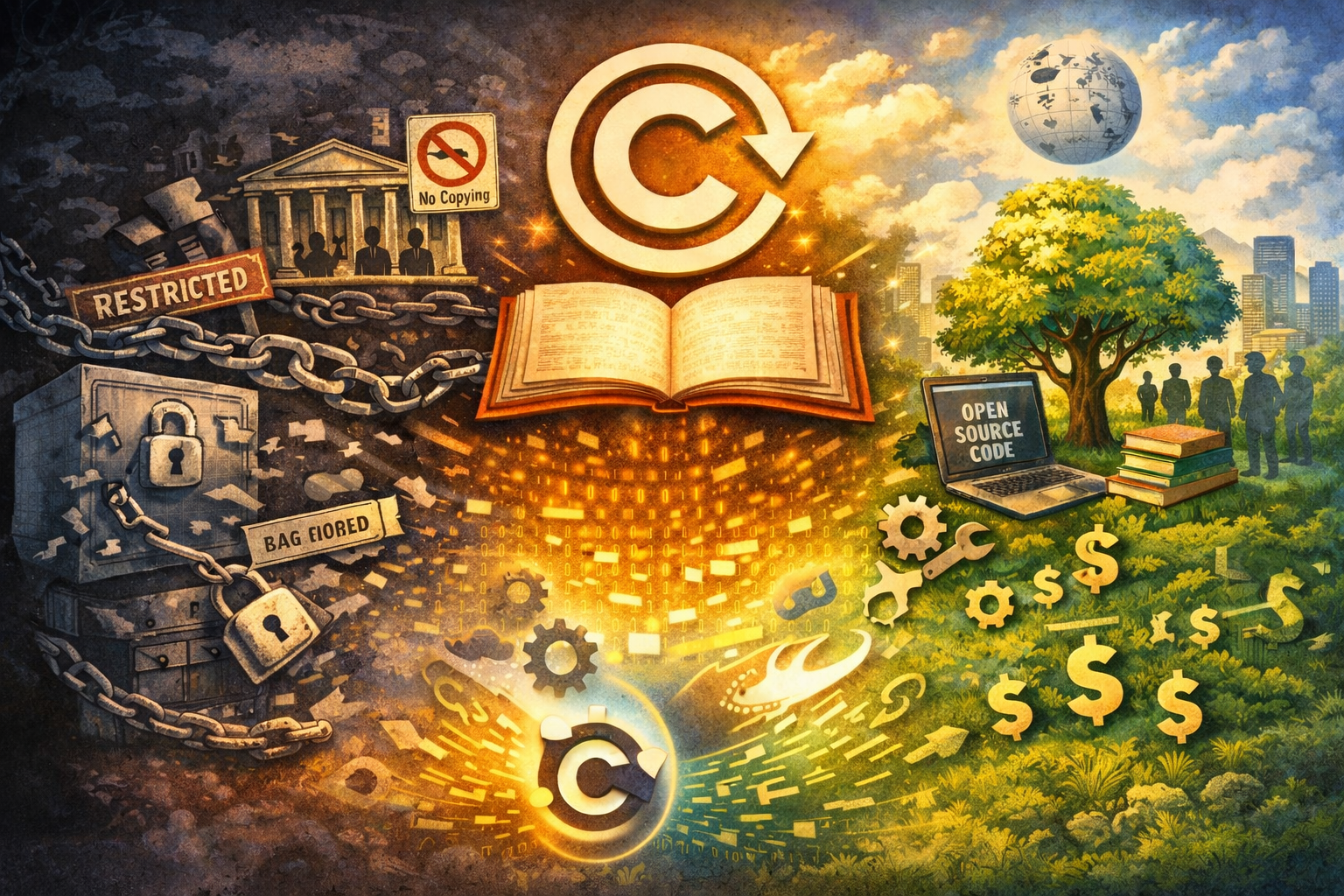
A legal trick that turns regular copyright inside out. If standard copyright basically forbids you from touchinfg anything without permission, copyleft does the opposite: it allows you to copy, modify,and distribute the work however you want. But there is one key condition: evreything you create based on that code or text must stay just as free. You can’t take someone else’s open work, tweak it a bit, and then claim it as your own intellectual property that you keep locked away.
This idea was created as a response to the dominance of closed software, so that knowledge would remain shared and could not be privatized. The most well-known example is the GPL license. If you include GPL-licensed code in your program, that’s it—you’re trapped: your project also becomes open, and you are required to provide the source code. That doesn’t mean you can’t make money from it. You can sell the software itself or offer support services, charge for setup or customization, but you simply have no right to restrict the freedom of those who use the product after you. It’s like a relay race where you’re not allowed to drop the baton of freedom.
Copyleft isn’t limited to programming, by the way. Wikipedia works under similar rules: you can take and modify the content, but only if the result remains just as accessible to evreyone else. Because of this feature, the license is often called “viral.” Once a single piece of such code gets into a large project, it sort of infects everything else with its freedom.
That’s exactly why big business gets so nervous when it hears “GPL.” Companies are afraid of losing their “secret formula.” If they accidentally use a copyleft library, lawyers can force them to open all their internal developments,which for a business often means death or a loss of uniqueness . Competitors can then legally take that code and use it themselves. On top of that the legal side is full of gray areas. It’s not always clear whether a small addition counts as a “derivative work” or not, and nobody wants to end up in court.
Investors aren’t thrilled by this either. When a startup is preparing for sale, checking for GPL code is usually at the top of the list. If it turns out that a core technology depends on copyleft, the company’s valuation drops or the deal falls apart entirely. That’s why corporations usually choose more permissive licenses like MIT or Apache. They let you use the results of someone else’s work without demanding anything in return except attribution. Compnies like control and predictability, and copyleft imposes its own rules of the game, which break the usual logic of ownership.