Best Alternative to 16 Personalities Test: Why 64 Archetypes Feel More Personal
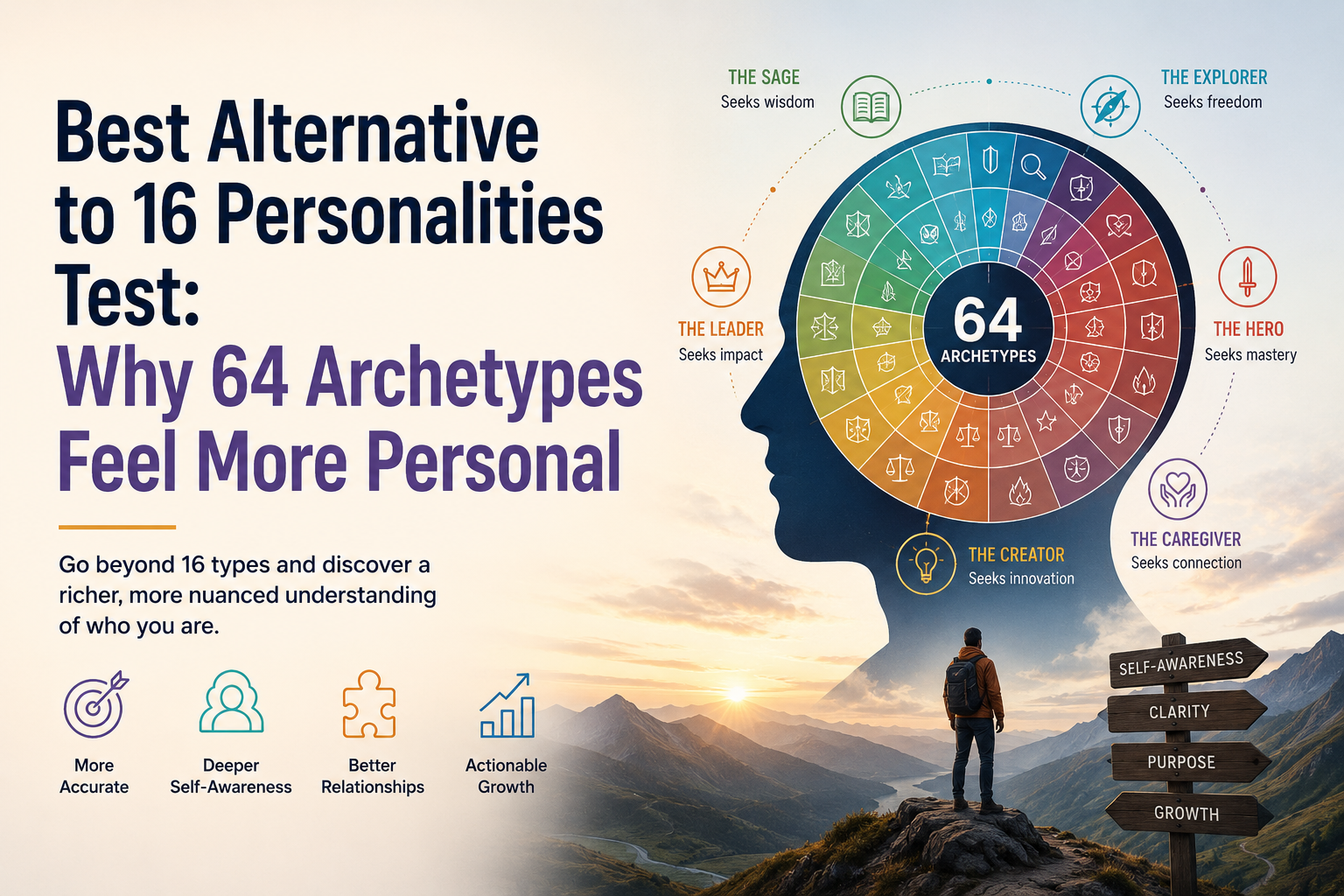
For decades, the Myers-Briggs Type Indicator (MBTI) and its popular derivative, the 16 personalities test, have dominated the conversation around personality frameworks. Millions have used them to find a four-letter label, seeking clarity on their work style, communication preferences, and personal identity. While these models provide a valuable starting point, a growing number of individuals and coaches are finding their broad categories limiting. The search for a more nuanced alternative to 16 personalities test has led to the emergence of models with greater granularity, most notably systems built around 64 archetypes.
The core appeal of a 64-archetype framework lies in its capacity for specificity. Where a 16-type model might group millions of people under a single banner like "INFJ" or "ESTP," a system with four times the number of categories can account for significant internal variation. It moves beyond binary preferences (Introvert vs. Extrovert, Thinking vs. Feeling) to explore the interplay of multiple core drivers, resulting in a portrait that feels less like a demographic box and more like a recognizable individual. This depth is what makes the exploration feel genuinely personal.
This article will examine the inherent limitations of the 16-type model, explain the psychological principles that make higher-granularity systems more robust, and detail the practical benefits of engaging with a 64-archetype assessment. We'll also guide you on how to approach these richer models to gain actionable insights for personal and professional growth.
The Limitations of the 16-Personality Framework
The 16 personalities model, based on Carl Jung's theory of psychological types, operates on four dichotomies: Extraversion/Introversion, Sensing/Intuition, Thinking/Feeling, and Judging/Perceiving. The strength of this model is its simplicity and memorability, which has fueled its viral spread. However, this simplicity is also its primary weakness when used as a definitive tool for deep self-analysis.
A major critique is the forced-choice nature of the dichotomies. Human personality rarely exists at pure poles; most people are ambiverts, blend logical and empathetic decision-making, or use both concrete and abstract information depending on the context. Being categorized as one or the other can feel reductive. Furthermore, the model does not account for intensity or development. Two people who test as the same type can have vastly different levels of emotional maturity, confidence, or skill development, leading to dramatically different expressions of that type in the real world.
Finally, the 16-type system offers limited guidance on growth. Knowing you are an "INTP" tells you little about which specific cognitive functions need development or how to healthily integrate your shadow aspects. The model describes a static category more than it outlines a dynamic path. For those seeking more than a label, this creates a need for a framework with greater descriptive and prescriptive power.
Why 64 Archetypes Offer Deeper Resolution
Archetypal systems draw from a deeper well of narrative psychology, suggesting that human behavior patterns are woven from universal, mythic motifs like the Hero, the Caregiver, the Sage, or the Rebel. A model that combines multiple archetypes into a composite profile can capture the complexity of an individual's psyche far better than a single type identifier. Moving from 16 types to 64 archetypes isn't just about adding more boxes; it's about creating a multidimensional map.
The Power of Combinatorial Diversity
Think of it like colors. The 16-type model offers 16 primary colors. A 64-archetype model, by blending and layering these foundational elements, creates hundreds of subtle hues and shades. It might combine a core "Strategist" archetype with a secondary "Innovator" and a tertiary "Diplomat," painting a picture of someone who plans meticulously (Strategist) for novel solutions (Innovator) while maintaining team harmony (Diplomat). This combinatorial approach mirrors how we actually experience our personalities: as a fluid mix of competing and cooperating inner roles.
This increased resolution directly addresses the "within-type" variance problem of simpler models. It can explain why two people who share a basic temperament can have completely different passions, communication styles, and blind spots. The result is a description that often elicits a reaction of "Yes, that's exactly me," rather than "Well, that's mostly right." For a truly tailored exploration, many are turning to a comprehensive alternative to 16 personalities test that leverages this archetypal depth.
Practical Benefits of a More Granular Personality Model
Engaging with a detailed archetypal profile delivers tangible advantages over broader typologies, particularly in applied settings like career development, relationship building, and personal coaching.
Improved Self-Awareness and Reduced Stereotyping: A nuanced profile helps you move beyond generic type-based stereotypes. Instead of trying to fit the mold of an "ENTJ," you understand your unique blend of leadership archetypes, which may include a "Visionary," a "Commander," and an "Architect." This specificity prevents the self-limiting thinking that can come from overly broad labels and allows for a more authentic self-concept.
Enhanced Team Dynamics and Communication: In professional environments, understanding the precise archetypal mix of colleagues can transform collaboration. Knowing someone operates with a "Researcher" primary and a "Mediator" secondary is more actionable than knowing they are an "INTJ." It suggests they need ample data (Researcher) presented in a low-conflict manner (Mediator) to buy into a plan. This granularity facilitates better role alignment, reduces friction, and leverages complementary strengths.
Targeted Personal Development: A key benefit is the creation of a clearer growth roadmap. A 64-archetype assessment often identifies not only your dominant patterns but also your underused or "dormant" archetypes. Your profile might indicate an over-reliance on a "Perfectionist" archetype and an underdeveloped "Explorer." This insight directs you toward specific, actionable development goals—like consciously seeking new experiences to cultivate flexibility—rather than vague advice to "be more spontaneous."
How to Engage with a 64-Archetype Assessment
If you're intrigued by the potential of a higher-resolution model, your first step is to find a reputable assessment. Look for platforms that base their system on established psychological or narrative theory, not just arbitrary categorization. A quality assessment will take 15-20 minutes and should ask nuanced questions that probe your motivations, fears, and values, not just your surface-level preferences.
When you receive your results, approach them as a narrative to explore, not a verdict to accept. Read the full description of your primary archetypal blend. Pay attention to the descriptions of your potential strengths in different contexts (e.g., under stress, in leadership, in creativity) and your likely challenges. The most value comes from reflecting on which parts resonate deeply and which feel off—this discrepancy itself is insightful. Many platforms offer a free 64 archetypes quiz as a low-commitment starting point to experience this depth of analysis firsthand.
Finally, use your profile proactively. Discuss it with a trusted friend, coach, or therapist to gain external perspective. Experiment with consciously embodying a suggested underused archetype in a low-stakes situation. The goal is not to be confined by a new, more complex label, but to use the rich vocabulary of archetypes as a tool for conscious self-evolution and more effective interaction with the world.
Frequently Asked Questions
What's the main difference between 16 personalities and 64 archetypes?
The 16 personalities model categorizes you into one type based on four dichotomous preferences (e.g., Introverted/Extraverted). The 64-archetype model typically identifies a blend of several core archetypes that form your unique psychological makeup. It's the difference between being assigned a single primary color and being given a personalized palette of several blended colors that represent your complex nature.
Is a 64-archetype test more accurate?
"Accuracy" in personality assessment is complex. A 64-archetype model is often more descriptively precise for many people because it captures more nuance and internal variation. It can feel more accurate because its detailed narrative is easier to personally identify with, moving beyond broad strokes to describe the specific textures of your motivations and behaviors.
Can my archetype blend change over time?
Yes, and this is a significant advantage of archetypal thinking. While your core tendencies may be stable, the prominence of different archetypes can shift with life experience, conscious effort, and personal development. You might strengthen a "Leader" archetype as you gain management experience or cultivate a "Creator" archetype through artistic practice. The model supports a dynamic view of personality.
How is this useful for my career?
A granular archetypal profile can clarify your ideal work environment, natural strengths, and potential blind spots with greater specificity than a four-letter code. It can help you identify roles that align with your archetypal strengths (e.g., a "Negotiator" in business development, an "Analyst" in data science) and understand communication styles that will help you collaborate more effectively with colleagues of different archetypal patterns.
Are these tests scientifically validated?
Like most personality frameworks, the level of scientific validation varies by platform. Reputable archetype models are based on Jungian psychology, narrative theory, and factor analysis. While they may not have the same volume of academic literature as the Big Five, their value is often judged by their practical utility, face validity (how true they feel to the user), and their ability to provide actionable insights for personal growth.
I know my 16-type result. Will my archetype profile contradict it?
Not necessarily. Think of it as adding layers of detail. Your 16-type result (e.g., INFJ) might correlate strongly with a particular cluster of archetypes, such as those emphasizing intuition, empathy, and future vision. The archetype profile doesn't usually contradict the broader temperament but rather expands upon it, explaining the unique flavor of how you, as an individual, express that general temperament.
Conclusion
The journey of self-discovery often begins with a simple framework, and the 16 personalities test has served that purpose for generations. However, for those who feel their individuality is compressed by sixteen categories, the evolution toward models with 64 archetypes represents a meaningful step forward. This alternative offers the granularity needed to map the rich, often contradictory, landscape of a single human personality. It trades the simplicity of a label for the complexity of a story—a story that is far more likely to feel authentically your own.
Ultimately, the best personality tool is the one that provides you with useful, actionable language for understanding yourself and connecting with others. A detailed archetypal system does not seek to replace earlier models but to build upon them, offering a deeper lens for examination. By engaging with this level of specificity, you move from classifying your personality to understanding its constituent parts, its potential, and its paths for growth. In the quest for self-knowledge, that depth is what makes the exploration not just intellectual, but genuinely personal.